Acacia Wood Cake Stand With Lid: Why This Kitchen Piece Earns Its Counter Space
Some kitchen items are tools and some are furniture, and the cake stand lives in the overlap. It stores dessert, but it also sits on the counter in full view daily, which is why material matters as much as function. The acacia wood cake stand with lid has become the favorite in this category over the past few years, edging out marble, glass pedestals, and ceramic domes in kitchens that lean warm and natural. Here is why the combination works, what separates good ones from decorative junk, and how to keep one beautiful for a decade.
Why Acacia Wood Specifically
Acacia is not just a pretty grain, though the grain does a lot of the selling. The wood brings real advantages to a piece holding food:
Hardness and durability. Acacia is a dense hardwood, harder than oak on standard scales. It shrugs off knife nicks, resists dents from dropped lids, and survives years of daily counter life.
Natural water resistance. Acacia contains natural oils that make it more resistant to moisture than most hardwoods. It will not survive a dishwasher (no wood does), but it handles cake moisture, frosting smears, and quick washes far better than softer woods.
Naturally antimicrobial tendencies. Like other dense hardwoods, acacia’s tight grain and oils make it inhospitable to bacteria compared to porous surfaces, part of why it dominates wooden serving ware.
Sustainability story. Acacia grows fast and harvests widely, one of the more renewable hardwoods, typically priced below walnut and teak.
The look. Every acacia piece carries dramatic grain variation, swirls of golden brown, chocolate, and honey that make each acacia wood cake stand with lid genuinely one of a kind. It warms up white kitchens and blends into wood-toned ones.
The Lid Question: Dome Styles and What They Do
The lid transforms a pedestal into storage, and the style you choose changes how the piece works:
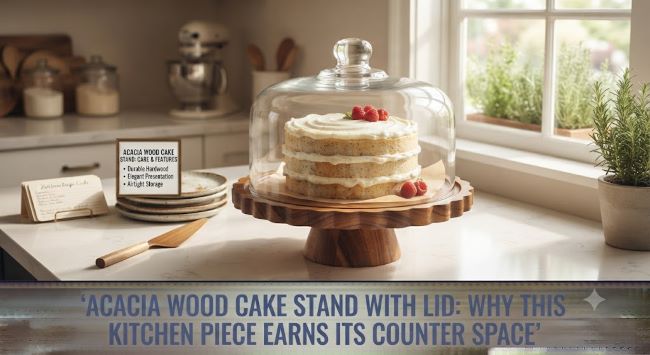
Glass dome. The classic acacia wood cake stand with lid configuration: acacia base, clear glass cloche on top. You see the cake, dust and flies do not touch it, and the bakery-display look is the whole aesthetic. Glass domes are heavy, which actually helps the seal, but they chip if knocked against the base carelessly.
Acrylic dome. Lighter, shatterproof, and safer around kids, with a less premium look and a tendency to scratch cloudy over years. Right for households where the lid gets handled constantly.
Wooden lid. Some designs pair the acacia base with a matching dome or flat top. Beautiful and opaque, protecting desserts from light but hiding the showpiece.
Convertible designs. A popular trick in this category: the lid inverts to become a serving bowl, turning the stand into a chip-and-dip or punch setup. If counter space is tight, a convertible acacia wood cake stand with lid earns its footprint twice.
A note on the seal: cake stand lids rest on the base or in a shallow groove; they are not airtight, and that is intentional. A breathable cover keeps frosted cakes at their best two to three days, while airtight containers trap moisture and soften crusts. Beyond day three, wrap and refrigerate.
What Fits Under the Dome
Buyers consistently underestimate the size an acacia wood cake stand with lid needs. Measure your typical bake against the dome, not the base:
| Measurement | What to Check |
|---|---|
| Interior dome diameter | Must exceed cake diameter by 1+ inch |
| Interior dome height | Must clear layer cakes (5-7 inches) plus decoration |
| Base platform diameter | 10-12 inches suits most; 12+ for three-layer builds |
A standard 9-inch layer cake with frosting needs roughly 10.5 inches of interior clearance and 6-plus inches of height. Tall showstoppers and decorated cakes need more. Beyond cake, these stands earn daily use holding banana bread, muffins, cookies, bagels, croissants, and fruit, which is the real reason the lid matters: it turns dessert storage into counter display for everything.
Quality Checks Before Buying
The category ranges from heirloom-grade to gift-shop flimsy, and photos hide the difference. Check for:
- Solid wood versus veneer. A quality acacia wood cake stand with lid is carved from solid wood or joined solid staves. Veneer over MDF looks identical online and delaminates at the first serious wash. Listings that say “acacia wood finish” instead of “solid acacia” are telling you.
- Food-safe finish. The wood should be sealed with food-safe oil or lacquer. Reputable sellers state it plainly.
- Weight and stability. A good base has heft. Lightweight stands tip under an off-center dome or a heavy cake sliced at the edge.
- The dome fit. The lid should seat into a groove or against a raised lip, not just balance on a flat surface where one bump slides it off.
- Pedestal joinery. On footed designs, the pedestal should be threaded or doweled into the plate, not just glued. Wiggle it in a store; read reviews for it online.
Expect to pay 30 to 60 dollars for solid entry-level pieces, 60 to 120 for the quality mid-range with glass domes and convertible features, and beyond that for artisan and large-format designs.
Caring for Acacia So It Lasts
An acacia wood cake stand with lid fails from neglect, not use. The care routine is short:
- Hand wash only, quickly. Warm water, mild soap, immediate towel dry. Never soak, never dishwasher.
- Oil it every month or two. Rub in food-grade mineral oil, let it absorb, buff off the excess. This is the secret to acacia that looks new at year ten. Skip olive or vegetable oils, which go rancid.
- Keep it off the radiator and out of direct sun. Heat sources and sunlight dry and fade wood over months.
- Sand out life’s accidents. A scratch or stain on solid acacia sands away with fine-grit paper, then re-oil. This repairability is the quiet superpower of solid wood over every other cake stand material.
Treated this way, an acacia wood cake stand with lid becomes one of those kitchen pieces that outlasts trends, moves houses with you, and eventually needs a story about where it came from. Not bad for something whose day job is guarding banana bread.
Key Takeaways
- Acacia’s density, natural oils, and water resistance make it one of the best functional woods for food serving pieces, with dramatic one-of-a-kind grain.
- Glass domes give the classic bakery display look; acrylic is lighter and shatterproof; convertible lids double as serving bowls.
- Cake stand lids are breathable by design, keeping frosted cakes fresh two to three days; refrigerate wrapped cakes beyond that.
- Measure the dome’s interior diameter and height against your actual bakes; a 9-inch layer cake needs about 10.5 inches of clearance.
- Insist on solid acacia with a stated food-safe finish; “acacia finish” wording signals veneer over MDF.
- Check for a lipped or grooved dome seat and a firmly joined pedestal before buying.
- Hand wash and towel dry immediately, and oil the wood with food-grade mineral oil every month or two.
- Scratches and stains on solid acacia sand out and re-oil, making it repairable in a way glass, marble, and ceramic never are.