Kitchen Faucet With Sprayer: How to Choose the Right One for Your Sink
Stand at your sink for one dishwashing session and count how many times you wish the water could move three inches to the left. That frustration is why the sprayer became the most requested faucet feature of the past two decades. But the kitchen faucet with sprayer category hides real differences behind similar photos, and picking wrong means a droopy spray head or leaky hose for years.
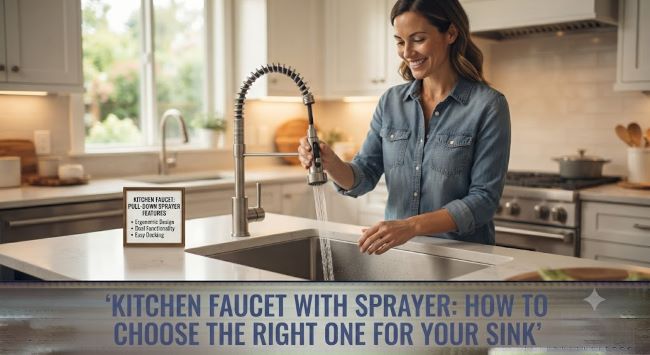
The Three Sprayer Types
Every kitchen faucet with sprayer falls into one of three designs, and the choice shapes daily use more than any other decision.
Pull-down faucets. The spray head tips a tall, arched spout and pulls straight down into the sink on a hose. This is the dominant modern design: the high arc clears stockpots, and the downward pull matches how you rinse dishes. The tradeoff is height, since pull-downs fight with low windowsills and shelving over the sink.
Pull-out faucets. The spray head pulls out toward you from a shorter, lower spout. Pull-outs shine in small kitchens and under low windows, and the longer hose reach fills pots on the counter. They give up the high arc, so washing tall items is more awkward.
Side sprayers. The classic separate sprayer in its own hole beside the faucet. They cost the least, but they occupy an extra sink hole, their diverter valves are a known failure point, and the hoses tangle below. They make sense mainly for matching an existing four-hole layout on a budget.
| Type | Best For | Watch Out For |
|---|---|---|
| Pull-down | Most kitchens, deep sinks, pot filling | Needs height clearance |
| Pull-out | Low windows, small sinks, counter reach | Lower arc for big items |
| Side sprayer | Budget, four-hole sinks | Diverter failures, extra hole |
The Specs That Separate Good From Frustrating
Listings bury the details that predict long-term satisfaction. Check these first:
Docking system. The single biggest quality difference in the pull-down world. Cheap faucets rely on gravity and a loose fit, and within a year the spray head hangs limp instead of snapping home. Magnetic docking, where a magnet pulls the head firmly into place, is the feature worth insisting on. Weighted-hose docking is the acceptable middle tier.
Spray modes and the pause button. Standard is a stream/spray toggle. Better models add a power-clean mode for stuck-on food and a pause button that stops flow at the head while you move a full pot. The pause button sounds trivial and becomes the feature you use daily on any kitchen faucet with sprayer.
Valve type. Ceramic disc valves are the modern standard and effectively drip-proof for decades. Any kitchen faucet with sprayer still using rubber washers or ball valves is signaling its overall quality tier.
Finish durability. Spot-resistant stainless and matte black hide water spots; chrome shows everything but wipes clean easiest. More important than color: physical vapor deposition (PVD) finishes bond to the metal and resist scratching far better than sprayed coatings.
Flow rate. US kitchen faucets typically flow 1.5 to 1.8 gallons per minute, with 1.8 as the federal maximum and some states capping lower. Within that band, spray pattern design matters more than raw numbers for cleaning power.
Hose length and weight. For pull-downs, 20-plus inches of hose travel covers a double sink. For pull-outs, look for 24 inches or more if counter-filling matters to you.
Mount Type and Hole Count: Measure Before You Buy
The most common return comes from ignoring the sink deck. Count your holes:
- One hole: single-handle pull-down or pull-out installs directly.
- Three holes: use a faucet with an included deck plate (escutcheon) to cover the extras, or a two-handle design.
- Four holes: room for faucet, side sprayer, and a soap dispenser, or cover options.
Also confirm mounting style. Deck-mounted (on the sink or counter) is standard; wall-mounted faucets are a different product entirely. And check under the sink: a kitchen faucet with sprayer needs room below for the hose to travel and, on pull-downs, for the weight that retracts it. Garbage disposals and water filters crowding that space cause the “hose won’t retract” complaint that fills review sections.
Smart and Touchless Options: Worth It?
Touchless models on a kitchen faucet with sprayer let you start water with a wrist wave, genuinely useful with raw-chicken hands. The honest tradeoffs: they need battery packs or AC power under the sink, the sensors add a failure point, and prices jump 100 to 250 dollars over the equivalent manual model. For households that cook heavily, the convenience earns its cost. For everyone else, a quality manual kitchen faucet with sprayer delivers 90 percent of the experience with none of the electronics.
Voice-controlled models exist at the top of the market; they are impressive demos and rarely missed.
What to Spend
Under 100 dollars buys builder-grade faucets with plastic internals and gravity docking, fine for rentals and rarely satisfying long-term. The 100-to-250 range is the value heart of the market: metal construction, ceramic valves, magnetic docking, and multi-mode sprays from established brands, usually with lifetime warranties on the finish and drips. From 250 to 500 you add premium finishes, touchless options, and design-forward looks. Above 500 is designer territory where the plumbing performance stops improving and the aesthetics carry the price.
Warranty is a real differentiator here. Major manufacturers back their faucets with limited lifetime warranties covering leaks, drips, and finish defects, and they honor them by shipping replacement cartridges and spray heads free. That coverage alone justifies staying with established brands over lookalike imports at the same price.
Installation and Care Notes
Most models install in 30 to 60 minutes with a basin wrench, and quick-connect hose fittings are now standard, so no soldering is involved. Two habits keep a kitchen faucet with sprayer working like new: unscrew and soak the spray face in vinegar every few months to clear mineral buildup from the nozzles, and if the spray pattern ever weakens suddenly, clean the inlet screen where the hose meets the head before assuming anything is broken. Nine times out of ten, that screen is the whole problem.
Key Takeaways
- Pull-down faucets suit most kitchens with their high arc; pull-outs fit low windows and small sinks; side sprayers are the budget option with diverter-failure risk.
- Magnetic docking is the most important quality feature on pull-downs, preventing the droopy spray head that plagues cheap models.
- Insist on ceramic disc valves, and prefer PVD finishes for scratch and spot resistance.
- Count your sink holes before buying and use a deck plate to cover extras; check under-sink clearance for hose travel.
- US flow rates run 1.5-1.8 GPM; spray pattern design matters more than the number.
- The $100-$250 range delivers metal construction, magnetic docking, and lifetime warranties, which is the best value tier.
- Touchless models add real convenience for heavy cooks at a $100-$250 premium plus batteries and an extra failure point.
- Soak the spray face in vinegar periodically and clean the inlet screen if pressure drops before assuming a defect.