Queen Bed Frame With Headboard: How to Choose the Right One
A bed without a headboard works fine until the first time you sit up to read and your pillow slides into the wall gap, leaving a scuff mark at head height. The headboard is one of those features you do not miss until you live without it, and it is also the single element that most defines how a bedroom looks. Buying a queen bed frame with headboard as one unit solves both problems at once, and the market offers everything from 150-dollar metal frames to four-figure statement pieces. Here is how to sort through it all.
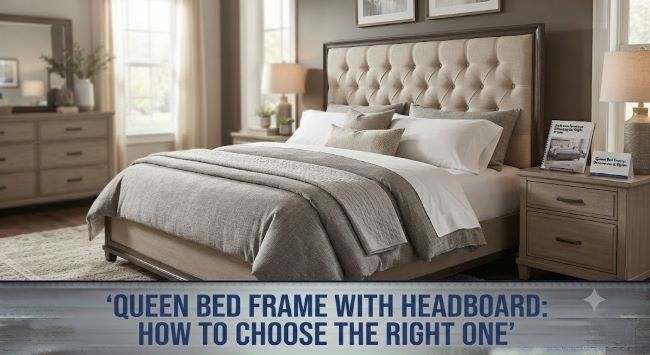
Why Buy the Frame and Headboard Together
You can buy a headboard separately and bolt it to a basic frame, so why choose an integrated queen bed frame with headboard instead? Three practical reasons:
- Stability. Integrated designs anchor the headboard to the full frame structure, not just two bolt points on a rail. That means no rattle against the wall and no gradual loosening.
- Proportions. The headboard height, leg style, and side rails are designed as one visual piece. Mix-and-match setups often end up with a headboard that looks too small or floats at an odd height.
- Cost. A combined unit almost always costs less than buying an equivalent-quality frame and headboard separately.
The exception: if you already own a frame you love, a bolt-on or wall-mounted headboard is the budget path. But starting from scratch, the integrated route wins.
Know Your Queen Dimensions First
A standard queen mattress measures 60 by 80 inches. The frame around it adds bulk, and this is where buyers get surprised. A typical queen bed frame with headboard runs 62 to 66 inches wide and 82 to 90 inches long, with upholstered and sleigh styles at the larger end. Headboard heights range from about 35 inches (low profile) to 60-plus inches (statement wingback styles).
Before buying anything, measure your room and apply the walking-space rule: leave at least 24 inches of clearance on each side of the bed and at the foot. In a 10-by-11-foot bedroom, a bulky oversized frame eats the room; a slim platform design keeps it livable. Also measure your stairwell and door turns if delivery involves tight corners, since headboards ship as large flat panels.
The Main Styles and Who They Suit
Upholstered. Fabric or faux leather over padding, in square, curved, or wingback silhouettes. The most popular category right now for good reason: soft against your back for reading, quiet, and available in every color. The tradeoffs are dust accumulation in tufting and fabric wear over years. Performance fabrics and velvet dominate the mid-range.
Wood. From mid-century slatted designs to farmhouse panels to traditional sleighs. Wood offers the longest lifespan and the easiest cleaning. Solid wood costs more and lasts decades; engineered wood with veneer hits lower prices with shorter lifespans.
Metal. Iron and steel frames with spindle or panel headboards. The budget-friendly and often the most durable option per dollar, though thin metal designs can creak if joints loosen. Look for thick-gauge posts and center support legs.
Platform with integrated headboard. These skip the box spring entirely, using wood slats to support the mattress directly. Most modern queen bed frame with headboard designs are platforms now, which saves the 100-to-300-dollar cost of a box spring and gives a lower, cleaner profile.
Storage hybrids. Some frames pair a headboard with drawers or lift-up storage underneath. If storage is your priority, that is a separate buying decision with its own tradeoffs around weight and mechanism quality.
Quality Markers That Matter More Than Style
Two frames can look identical online and behave completely differently after six months. When evaluating any queen bed frame with headboard, check these details:
| Feature | What Good Looks Like | What to Avoid |
|---|---|---|
| Center support | Center rail with legs to the floor | Slats spanning full width unsupported |
| Slats | 2.5-3 inch wide slats, gaps under 3 inches | Thin, widely spaced, or flimsy slats |
| Headboard attachment | Bolted into frame structure at 4+ points | Two thin brackets |
| Weight rating | 500+ lbs stated capacity | No stated capacity |
| Hardware | Metal-to-metal bolt connections | Screws directly into particleboard |
| Noise | Rubber or felt at contact points | Bare metal-on-metal joints |
The slat spacing detail matters doubly if you use a foam or hybrid mattress, since most mattress warranties require support gaps of 3 inches or less. A beautiful frame that voids your mattress warranty is not a bargain.
What to Spend
The queen bed frame with headboard market breaks into rough tiers. Under 200 dollars buys metal frames and basic upholstered designs that serve fine in guest rooms and first apartments, with lifespans of a few years. The 200-to-600 range is the sweet spot for most buyers: solid engineered wood or quality upholstered platforms with proper center support and hardware that survives a move or two. From 600 to 1,500 you get solid wood construction, premium fabrics, and designs that anchor a room for a decade. Above that, you are paying for craftsmanship and brand.
One consistent piece of advice: whatever the budget, put the extra 50 dollars toward the better support structure rather than the prettier fabric. The fabric is what you see; the slats and center rail are what you live with.
Assembly and Living With It
Nearly every queen bed frame with headboard ships flat and assembles at home in 30 to 90 minutes with two people. Read recent reviews specifically mentioning assembly, since predrilled holes that do not align is the most common quality complaint in the category. Keep the included hex wrench taped to the underside of the frame afterward, and retighten all bolts once at the three-month mark. That single habit prevents nearly all future squeaks.
For upholstered headboards, vacuum the fabric monthly with a brush attachment, and position the bed away from direct sunlight to prevent uneven fading. Wood headboards just need dusting and the occasional polish. Do these small things and a good queen bed frame with headboard outlasts two or three mattresses, which is exactly the ratio you want.
Key Takeaways
- An integrated queen bed frame with headboard beats separate purchases on stability, proportion, and total cost.
- A queen mattress is 60×80 inches, but frames run 62-66 inches wide and 82-90 long; leave 24 inches of walking space on each side.
- Upholstered frames win on comfort for reading, wood on lifespan, metal on durability per dollar, and platform designs eliminate the box spring.
- Check center support legs, slat spacing under 3 inches, four-plus headboard attachment points, and stated weight capacity before buying.
- Slat gaps over 3 inches can void foam and hybrid mattress warranties.
- The $200-$600 range delivers the best value for most buyers; spend extra on structure, not fabric.
- Expect 30-90 minutes of two-person assembly, and retighten all bolts at three months to prevent squeaks.
- A quality frame should outlast two to three mattresses, so buy for the decade, not the year.