
Queen Bed Frame With Storage: The Smart Buyer’s Guide to Under-Bed Space
The space under a queen bed covers about 33 square feet, which is more floor area than most closets. In a small bedroom, leaving that space to dust bunnies and lost socks is a genuine waste, and furniture makers know it. The queen bed frame with storage category has grown from clunky captain’s beds into a full range of drawer systems, lift-ups, and bookcase hybrids. Done right, one frame replaces a dresser. Done wrong, you get stuck drawers and a sagging mattress.
The Three Storage Systems and How They Compare
Every queen bed frame with storage uses one of three mechanisms, and choosing between them is the biggest decision in the purchase.
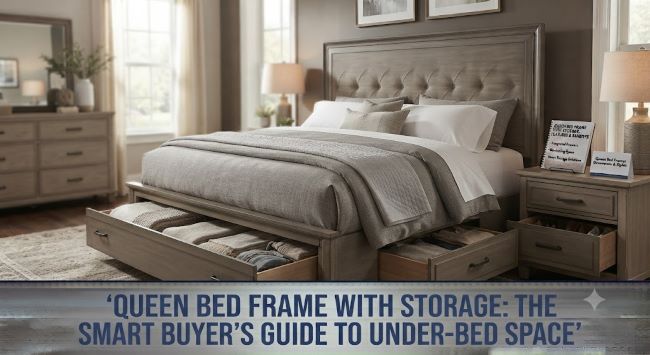
Drawer frames. Two to six drawers built into the sides and sometimes the footboard. Drawers give everyday access without touching the mattress, right for items you use weekly: clothes, bedding, kids’ toys. The limitation is clearance. Drawers need 18 to 24 inches of open floor to extend, so they fight nightstands and tight walls. Corners kill half the drawers.
Lift-up (ottoman) frames. The mattress platform rises on gas pistons, opening one huge compartment. Lift-ups store roughly twice the volume of drawers and work where the bed touches walls, since nothing extends outward. The tradeoff is access: getting anything out means lifting the bed, so this suits seasonal storage like comforters, luggage, and holiday boxes.
Bookcase and cubby designs. Open shelving built into the headboard or footboard, sometimes with drawers below. Best for books and baskets, and the only style adding storage above mattress level.
| Factor | Drawers | Lift-Up | Bookcase |
|---|---|---|---|
| Storage volume | Moderate | Largest | Smallest |
| Access frequency | Daily | Occasional | Daily |
| Side clearance needed | 18-24 in | None | None |
| Mechanical failure risk | Drawer glides | Gas pistons | None |
| Typical price premium | $$ | $$$ | $ |
Hybrid models combine systems, like drawers on one side and cubbies at the foot, which solves corner placements neatly.
Match the System to Your Actual Room
Before falling for a photo of a queen bed frame with storage, sketch your room and answer three questions:
- Which sides of the bed are open? Both sides open with 2 feet of clearance: drawers work fully. One side against a wall: buy a frame with drawers on one side only, or go lift-up. Bed in a corner: lift-up or bookcase only.
- What are you storing? Weekly-access items point to drawers. Seasonal bulk points to lift-up. If the honest answer is “I don’t know, just stuff,” drawers get used and lift-ups become time capsules.
- Who lifts the mattress? A queen mattress weighs 60 to 120 pounds. Quality pistons do most of the work, but budget pistons weaken over time, and heavy hybrid mattresses exceed some ratings. Check the stated mattress weight limit.
Quality Checks That Separate Good From Junk
The queen bed frame with storage category has a wider quality spread than almost any furniture type, because the storage mechanisms add failure points a plain frame does not have. Inspect these before buying:
- Drawer glides. Metal ball-bearing glides rated for full extension are the standard for a frame that lasts. Plastic runners or wood-on-wood drawers stick within a year, especially with clothes-level weight inside.
- Drawer bottoms. Look for bottoms of at least 1/4-inch material, properly captured in grooves. Stapled-on hardboard bottoms bow and pop under sweaters.
- Piston ratings on lift-ups. The listing should state the piston capacity and the maximum mattress weight. No stated numbers means budget pistons, and budget pistons mean a bed that gets harder to lift every year.
- Platform structure. Storage frames carry the mattress on a slatted or solid deck above the storage. Slats should be 2.5 inches or wider with gaps of 3 inches or less to protect foam mattress warranties, with a supported center rail.
- Weight capacity. A quality queen bed frame with storage states 500-plus pounds of total capacity. Storage weight adds to sleeper weight, so this number matters more here than on standard frames.
- Material honesty. Solid wood and metal-framed designs survive moves; particleboard boxes with veneer often do not survive one disassembly. If you move every couple of years, prioritize frames reviewers describe surviving a move.
What Storage Actually Fits
A four-drawer queen typically equals a standard three-drawer dresser: each drawer swallows a stack of jeans, 15 folded shirts, or two sets of queen bedding. A lift-up compartment holds far more: two large suitcases, four to six bins, or a full season’s wardrobe for two people.
That dresser-replacement math is the real financial argument for a queen bed frame with storage. A decent dresser costs 300 to 700 dollars and consumes 10 square feet. If the frame’s drawers eliminate that purchase, the premium pays for itself and the room gets bigger.
Pricing Tiers
Expect to pay a premium of 100 to 400 dollars over an equivalent frame without storage. Under 400 dollars total buys entry-level drawer frames, usually engineered wood with basic runners, fine for guest rooms and light loads. The 400-to-900 range is where the category gets good: metal ball-bearing glides, stated weight ratings, solid platform decks, and lift-up models with legitimate pistons. Above 900, you get solid wood construction, soft-close drawers, and upholstered lift-up designs that look nothing like storage furniture.
One warning that applies across every tier: read the assembly reviews. Storage frames arrive in two or three heavy boxes and assemble in 90 minutes to 3 hours. Frames with misaligned predrilled holes or confusing instructions get flagged loudly in reviews, and in this category those complaints predict long-term quality almost perfectly.
Living With It
Three habits keep a queen bed frame with storage working like new. Load drawers evenly, because uneven weight bends runners. Air out the lift-up compartment when swapping contents, since sealed spaces trap humidity, and moisture absorber packets cost almost nothing. And retighten every bolt at three months, doubly important when the structure carries fifty pounds of sweaters.
Do that, and the most underused 33 square feet in your home quietly becomes the hardest-working storage in it.
Key Takeaways
- The under-bed area of a queen covers about 33 square feet, and a queen bed frame with storage turns it into dresser-replacing capacity.
- Drawer frames suit daily-access items but need 18-24 inches of side clearance; lift-up frames hold twice the volume and work against walls but suit seasonal storage.
- Match the mechanism to your room layout and access habits before considering looks.
- Quality markers: metal ball-bearing drawer glides, captured drawer bottoms, stated piston and mattress weight ratings, slat gaps under 3 inches, and 500+ pound capacity.
- A four-drawer queen roughly replaces a three-drawer dresser; a lift-up holds two large suitcases or a two-person seasonal wardrobe.
- Expect a $100-$400 premium over storage-free frames; the $400-$900 range offers the best quality-to-price ratio.
- Assembly runs 90 minutes to 3 hours, and assembly-complaint reviews reliably predict overall quality in this category.
- Load drawers evenly, air out lift-up compartments, and retighten bolts at three months to keep everything working.