Appliance Repair Near Me: How to Find a Reliable Technician
A broken refrigerator, washing machine, or oven disrupts daily life in a way few other home issues do, which is exactly the kind of urgency that can lead to hasty decisions about who to call for repair. Finding a genuinely reliable appliance repair technician near you, understanding realistic cost expectations, and knowing when repair makes more financial sense than replacement all help you handle a broken appliance efficiently rather than panicking into an expensive mistake.
How to Find a Reliable Appliance Repair Technician
Manufacturer-authorized repair services. For appliances still under warranty, or for premium brands where you want technicians specifically trained on that brand’s systems, checking the manufacturer’s website for an authorized service locator ensures you’re getting someone with brand-specific training and access to genuine replacement parts, often a requirement for warranty coverage to remain valid.
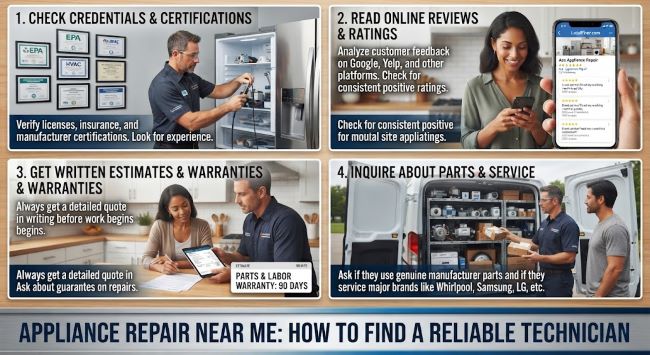
Google Maps and reviews. Search “appliance repair near me” and pay close attention to reviews that mention specific appliance types and specific outcomes (whether the actual problem was resolved, not just whether the technician was polite), since general star ratings alone don’t tell you whether repairs were genuinely effective and lasting.
Angi (formerly Angie’s List) and HomeAdvisor. These platforms aggregate reviews and allow filtering specifically for appliance repair, often including verified reviews tied to actual completed jobs rather than just general business ratings.
Better Business Bureau. Checking a company’s BBB rating and reading any filed complaints, along with how the business responded to those complaints, provides useful context beyond star ratings alone, particularly for identifying patterns of unresolved customer issues.
Ask for referrals from people you trust. A neighbor, friend, or family member who’s had a genuinely positive recent appliance repair experience can point you to someone reliable faster than starting from scratch with online research alone.
Local independent repair shops versus large chains. Both can be reliable, but independent local technicians sometimes offer more personalized service and potentially lower rates than larger franchise repair chains, while larger chains may offer more standardized scheduling and broader appliance brand coverage — there’s no universally correct choice here, and checking reviews for the specific business matters more than the general category it falls into.
What to Look For in a Quality Repair Technician
Proper licensing and certification. Many states require appliance repair technicians to hold specific licenses, particularly for any work involving gas appliances or refrigerant-containing systems (refrigerators, freezers, air conditioning). EPA Section 608 certification is required for anyone working with refrigerant specifically.
Transparent diagnostic fees. A reputable technician charges a clear, disclosed diagnostic fee (typically $50-$100) to assess the problem, which is often credited toward the repair cost if you proceed with the recommended work.
Written estimates before work begins. You should receive a clear written estimate detailing the diagnosed problem, the recommended repair, parts and labor costs separately, and the total before any repair work begins, not after.
Warranty on parts and labor. Reputable technicians stand behind their work with at least a 30-90 day warranty on both parts and labor, giving you recourse if the same problem recurs shortly after the repair.
Manufacturer-approved or OEM parts. Ask whether they use original equipment manufacturer parts or aftermarket alternatives, since this affects both repair quality and how the repair might interact with any remaining manufacturer warranty coverage.
What Common Appliance Repairs Typically Cost
Costs vary by region, appliance brand, and the specific issue, but general ranges provide a useful baseline:
Refrigerator repair: $200-$450 for common issues (compressor, thermostat, ice maker problems); can run higher for sealed system repairs involving refrigerant.
Washing machine repair: $150-$350 for typical issues (pump, belt, control board).
Dryer repair: $100-$300 for common problems (heating element, belt, thermostat).
Dishwasher repair: $150-$300 for typical issues (pump, control board, door seal).
Oven/range repair: $150-$400 depending on whether it’s a simple element replacement or a more complex control board or igniter issue.
Diagnostic fee alone (if you decide not to proceed with repair after assessment): typically $50-$100, sometimes waived if you do proceed with the recommended repair.
When Repair Makes More Sense Than Replacement
A commonly used guideline in the appliance industry is the “50% rule”: if the repair cost exceeds 50% of the cost of a new comparable appliance, replacement generally makes more financial sense than repair, particularly for appliances already several years into their expected lifespan.
Beyond just this cost comparison, consider the appliance’s age relative to its typical lifespan (refrigerators typically last 10-15 years, washing machines 10-13 years, dishwashers 9-12 years), whether this is a recurring problem with the same appliance (suggesting it may be heading toward broader failure even if this specific repair is reasonably priced), and energy efficiency considerations, since a much older appliance being repaired may still cost meaningfully more to operate monthly than a new energy-efficient replacement, a factor worth weighing alongside the upfront repair-versus-replacement cost comparison.
Red Flags to Avoid
Technicians who pressure you toward unnecessary additional repairs beyond what was needed to fix the original reported problem, particularly if they can’t clearly explain why the additional work is necessary.
No written estimate or unclear pricing before work begins, which leaves you vulnerable to unexpected charges once the work is already underway.
Refusal to provide licensing or insurance information when asked directly, particularly relevant for gas appliance work where proper licensing matters for both safety and liability reasons.
Extremely low quoted prices significantly below other quotes you’ve received, which can sometimes indicate a bait-and-switch approach where the final bill ends up substantially higher than the initial quote once the technician is already in your home.
No warranty offered on completed work, since a technician confident in the quality of their repair should be willing to stand behind it for a reasonable period.
For other home systems that share similar repair-versus-replace decision-making, particularly around heating and cooling appliances, furnace repair near me covers the parallel considerations specific to HVAC systems, which involve similar cost thresholds and technician vetting principles as the major household appliances covered here.
Key Takeaways
- Find appliance repair near me through manufacturer-authorized service locators (especially for warranty-covered appliances), Google Maps reviews with specific outcome details, Angi/HomeAdvisor, and trusted personal referrals
- Look for proper licensing (especially EPA Section 608 certification for refrigerant work), transparent diagnostic fees, written estimates before work begins, and a warranty on parts and labor
- Common repair costs range from $100-$450 depending on the appliance and specific issue, with diagnostic fees typically $50-$100 and often credited toward the repair if you proceed
- The “50% rule” is a useful guideline: if repair cost exceeds 50% of a comparable new appliance’s price, replacement generally makes more financial sense, especially for older appliances
- Consider the appliance’s age relative to typical lifespan and whether this is a recurring problem, not just the immediate repair cost, when deciding between repair and replacement
- Red flags include pressure toward unnecessary additional repairs, no written estimate, refusal to share licensing information, suspiciously low initial quotes, and no warranty offered on completed work
- Checking specific reviews mentioning whether the actual problem was resolved matters more than general star ratings alone when evaluating a potential technician