What Is Neural TTS? How Modern Text-to-Speech Technology Works
Text-to-speech technology has improved so dramatically over the past decade that the robotic, monotone voices many people still associate with the term have become largely a thing of the past for any modern application. Neural TTS (text-to-speech) is the technology behind this transformation, and understanding how it actually works helps explain why current synthetic voices sound so much more natural and why the technology has become viable for so many new applications that older speech synthesis methods simply couldn’t support convincingly.
What Neural TTS Actually Is
Neural TTS is a text-to-speech synthesis approach that uses deep neural networks — the same general category of machine learning technology behind many other recent AI advances — to generate speech audio from written text. Rather than relying on pre-recorded speech fragments stitched together (the older concatenative approach) or rule-based acoustic modeling (the older parametric approach), neural TTS systems learn to generate speech waveforms directly, producing audio with significantly more natural intonation, rhythm, and emotional expressiveness than previous generation systems could achieve.
The “neural” in neural TTS refers specifically to the use of deep neural network architectures trained on large datasets of recorded human speech paired with corresponding text, allowing the system to learn the complex relationships between written language and natural-sounding spoken delivery, including subtle elements like appropriate pausing, stress patterns, and intonation that earlier rule-based systems struggled to replicate convincingly.
How Neural TTS Differs from Older Speech Synthesis Methods
Concatenative synthesis (an older, once-dominant approach) worked by recording a voice actor speaking a huge number of phonetic fragments, then algorithmically stitching together the appropriate fragments to form new words and sentences based on the input text. While this could sound reasonably natural for common words and phrases well-represented in the original recordings, it often produced noticeably awkward or robotic results for less common words or unusual sentence constructions not well covered by the original recorded fragment library.
Parametric synthesis (another older approach) used statistical models to generate speech parameters (pitch, duration, spectral characteristics) algorithmically, producing more flexible and storage-efficient systems than concatenative approaches, but generally at the cost of sounding noticeably more synthetic and less naturally expressive, since the underlying acoustic modeling couldn’t capture the full complexity and naturalness of genuine human speech patterns.
Neural TTS improves substantially on both older approaches by using deep learning models trained directly on large volumes of natural speech data, learning to generate audio waveforms (or detailed acoustic representations that are then converted to waveforms) that capture far more of the natural variation, expressiveness, and contextual appropriateness found in genuine human speech, including appropriately varying emphasis based on sentence context and meaning rather than applying uniform, mechanical delivery patterns.
Key Components of Modern Neural TTS Systems
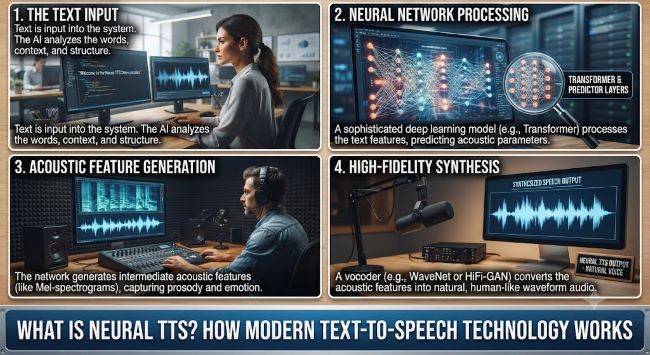
Text analysis and linguistic processing. Before audio generation, the system processes the input text to understand its linguistic structure, including how to handle abbreviations, numbers, and other elements that require specific pronunciation decisions beyond simply reading the literal text characters.
Acoustic modeling. A neural network component that converts the processed linguistic information into acoustic features representing how the speech should sound, including pitch, duration, and spectral characteristics for each unit of speech.
Vocoder. The final component that converts the acoustic feature representations into actual audio waveforms you hear, with modern neural vocoders (such as WaveNet and its various successors and alternatives developed since its introduction) producing significantly more natural-sounding audio than the simpler signal processing approaches used in earlier TTS generations.
Voice cloning and customization capabilities. Many modern neural TTS systems can be trained or fine-tuned on a relatively small amount of audio from a specific speaker, enabling the creation of custom synthetic voices that closely resemble a particular individual’s voice characteristics, a capability with both significant beneficial applications and meaningful ethical considerations depending on how it’s used and whether appropriate consent and disclosure practices are followed.
Where Neural TTS Is Used Today
Accessibility technology. Screen readers and other assistive technology for visually impaired users, along with text-to-speech tools supporting people with reading difficulties or learning differences, benefit enormously from the improved naturalness of neural TTS compared to older, more fatiguing-to-listen-to synthetic voices.
Virtual assistants. The voice technology behind major virtual assistant products has shifted substantially toward neural TTS approaches in recent years, contributing to the noticeably more natural-sounding responses compared to earlier generations of these products.
Audiobook and content narration. Neural TTS has made automated audiobook narration and content-to-audio conversion services genuinely viable for a much broader range of content, since the resulting audio quality has become listenable for extended periods in a way older synthetic speech generally wasn’t.
Customer service and IVR systems. Automated phone systems and customer service applications increasingly use neural TTS to provide more natural-sounding automated responses compared to the often jarring, clearly robotic systems common in previous decades.
Language learning and translation tools. Applications helping users learn pronunciation or providing spoken translation benefit from neural TTS’s improved naturalness, making the spoken output a more useful and pleasant learning aid.
Content creation tools. Video creators, podcasters, and other content producers increasingly use neural TTS for voiceover work, particularly for draft versions of content or in situations where hiring a human voice actor isn’t practical or cost-effective for the specific project.
Limitations and Ongoing Challenges
Despite significant improvements, neural TTS isn’t without remaining limitations. Highly emotional or dramatically expressive speech, the kind a skilled human voice actor brings to character work or emotionally complex narration, generally still falls short of genuine human performance in most current systems, though this gap continues to narrow with ongoing research and development. Pronunciation of unusual proper nouns, technical terminology, or words from languages other than the system’s primary training language can still occasionally produce noticeably incorrect results, requiring manual correction or pronunciation guidance in professional applications where accuracy matters significantly.
For applications specifically supporting students with reading differences, where natural-sounding, fatigue-reducing audio quality genuinely matters for sustained educational use, assisting dyslexic students with text-to-speech technology covers how this kind of technology, including the neural TTS advances described here, is being applied specifically in educational support contexts.
Key Takeaways
- Neural TTS uses deep neural networks trained on large volumes of recorded human speech to generate significantly more natural-sounding synthetic speech than older concatenative or parametric synthesis approaches
- Older concatenative synthesis stitched together pre-recorded speech fragments, while parametric synthesis used statistical acoustic modeling — both generally produced more robotic, less naturally expressive results than modern neural approaches
- Key components of a neural TTS system include text and linguistic analysis, acoustic modeling, and a vocoder that converts acoustic representations into actual audio waveforms
- Modern systems can support voice cloning capabilities, training custom synthetic voices from relatively small amounts of source audio, raising both beneficial applications and ethical considerations around consent and disclosure
- Neural TTS now powers accessibility technology, virtual assistants, audiobook narration, customer service systems, language learning tools, and content creation applications across many industries
- Remaining limitations include difficulty matching genuinely dramatic or emotionally complex human vocal performance, and occasional pronunciation errors with unusual proper nouns or technical terminology
- The technology’s improved naturalness has made it genuinely viable for extended listening applications, like audiobooks and accessibility tools, where older synthetic speech was often too fatiguing for sustained use