Understanding the Basics of Two-Way Radio Communication
“Can someone meet the delivery truck at the north entrance?”
Silence.
The supervisor reaches for a phone, starts scrolling through contacts, and waits for the call to connect. Meanwhile, the truck is still sitting outside, employees are wondering what to do next, and five perfectly productive minutes quietly disappear. It isn’t a major crisis, but enough small communication delays can turn an efficient day into a frustrating one.
That’s exactly why two-way radio communication continues to play such an important role. While smartphones have become our default communication tool, they aren’t always the fastest option when people need immediate answers. Sometimes pressing one button and speaking is still the smartest solution.
It All Starts With a Simple Conversation
At first glance, a two-way radio seems almost old-fashioned.
No endless menus. No contact list. No notifications demanding your attention every few seconds.
Just a push-to-talk button.
That simplicity is precisely what makes the technology so effective. Rather than placing individual phone calls, users communicate over a shared channel where everyone who needs the information hears it immediately. There’s no waiting for someone to answer, no voicemail, and no wondering whether a text message has been read.
One conversation can reach an entire team in seconds.
How Does It Actually Work?
Behind that simple button is surprisingly elegant technology.
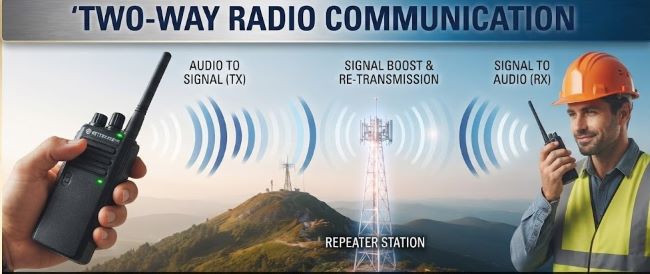
When someone presses the talk button, the radio converts their voice into radio signals and transmits them over a designated frequency. Other compatible radios tuned to the same channel receive those signals almost instantly before converting them back into sound.
The process is known as half-duplex communication, meaning one person speaks while everyone else listens, then another person responds when the channel is clear.
It sounds almost too straightforward.
That’s because it is.
According to the Federal Communications Commission, two-way radios operate on designated frequency bands, with licensing requirements varying depending on the radio service and intended use.
Not Every Two-Way Radio Works the Same Way
Here’s something many first-time buyers don’t realize.
The phrase two-way radio actually covers several different communication technologies.
Traditional radios communicate directly over radio frequencies between devices within range. They’re popular for construction sites, outdoor recreation, public events, and local business operations because they don’t depend on traditional phone calls.
Many modern push-to-talk devices take a different approach.
Instead of relying solely on radio frequencies, they use nationwide cellular data networks where coverage exists, allowing users to communicate across much larger distances while preserving the familiar push-to-talk experience.
Different technology.
Same objective.
Fast, reliable communication.
Why Businesses Keep Coming Back to It
Every workplace has one thing in common.
People need information quickly.
Construction supervisors coordinate crews across large job sites. Warehouse managers direct incoming shipments. Retail associates check inventory. Security personnel monitor multiple entrances. Hotel staff respond to guest requests.
Waiting for returned phone calls simply slows everything down.
With two-way radio communication, instructions reach the right people immediately. Employees spend less time searching for coworkers and more time solving problems. It’s not particularly glamorous, but efficiency rarely is.
The Outdoors Doesn’t Always Have Great Reception
The usefulness of two-way radios extends well beyond the workplace.
Think about hiking, camping, boating, hunting, skiing, or off-roading.
These adventures often take people into areas where cellular coverage becomes inconsistent or disappears altogether. That’s hardly surprising, mountains aren’t exactly famous for excellent mobile service.
Reliable communication allows groups to coordinate routes, share updates, and respond more quickly if plans change.
The National Park Service recommends planning communication methods before entering remote recreation areas, especially when traveling in groups.
Preparation tends to feel unnecessary…right until it suddenly becomes essential.
The Biggest Advantage Isn’t Technology, It’s Speed
People often assume newer technology automatically means better technology.
Not always.
A two-way radio excels because it removes unnecessary steps.
There’s no unlocking a screen.
No searching for contacts.
No waiting through multiple rings.
Users simply press the button, deliver the message, and continue working. That speed makes an enormous difference in busy workplaces, outdoor activities, and emergency situations where every second counts.
Sometimes less technology creates a better experience.
Choosing the Right Communication Tool
No single communication device is perfect for every situation.
Traditional radios work exceptionally well for nearby teams communicating over radio frequencies. Modern push-to-talk systems expand that capability by using nationwide cellular data networks where coverage is available.
Understanding the differences helps users choose equipment based on where they’ll actually use it instead of assuming every device functions the same way.
The best communication system isn’t necessarily the one with the longest feature list.
It’s the one people can rely on when they need an answer immediately.