Why Deepfakes and Face Swaps Are Not the Same Thing At All
You’ve probably seen both terms floating around online. “Deepfake.” “Face swap.” People use them like they mean the same thing. They don’t.
Mixing them up is like calling every flying object an airplane. Sure, they’re both in the air. But a helicopter and a jumbo jet are very different things. The same goes for deepfakes and face swaps.
Once you understand the difference, you’ll never mix them up again. And you’ll be much smarter about the AI content you see every day.
What Is a Face Swap?
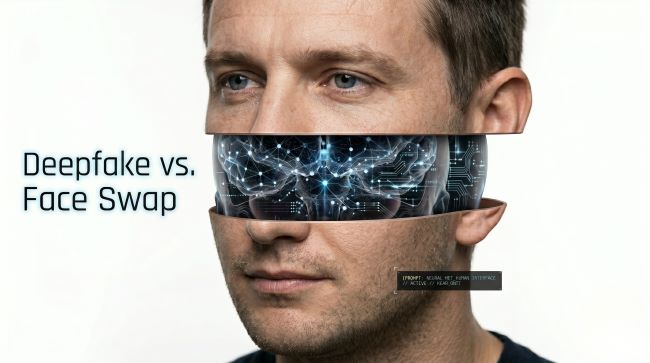
A face swap is simple. It takes one person’s face and puts it on another person’s body. That’s it.
You’ve probably done this already. Snapchat filters, Instagram effects, fun apps that put your face on a dancing cartoon. Those are all face swaps.
The technology behind it is pretty basic. The app looks at your face and finds the key points: your eyes, nose, mouth, and chin. Then it copies those features and pastes them onto a target image or video.
It’s a copy-paste job. A smart one, but still a copy-paste job.
Face swaps are usually made for fun. They’re fast to make. They don’t require a powerful computer. And most of the time, you can tell it’s a face swap if you look closely.
What Is a Deepfake?
A deepfake is something much more serious.
The word “deepfake” comes from two words: “deep learning” and “fake.” Deep learning is a type of AI that teaches itself by looking at thousands and thousands of examples. The more it sees, the smarter it gets.
To make a deepfake, the AI studies a real person. It looks at hundreds or even thousands of photos and videos of that person. It learns how they talk. How they move. How their face changes when they smile, blink, or turn their head.
Then it builds a fake version of that person from scratch. Not a copy-paste. A full AI-generated recreation.
The result is much harder to spot as fake. A good deepfake can show a real person saying something they never said. Doing something they never did. And it can look completely convincing.
The Big Difference in Simple Terms
Here’s the easiest way to remember it.
A face swap replaces a face. A deepfake recreates a person.
One is a substitution. The other is a simulation.
Think of it this way. A face swap is like putting a mask on someone. You can still see the edges of the mask if you look hard enough. A deepfake is more like hiring a very good actor to pretend to be someone else — and training them for months to get every tiny detail right.
How the Technology Is Different
Face swaps use simple machine learning. The AI detects facial landmarks and maps one face onto another. It works on a single image or short video clip. It needs very little training time. Most face swap apps can do this in seconds.
Deepfakes use something called a GAN. That stands for Generative Adversarial Network. It’s a system where two AIs work against each other. One AI tries to create a fake. The other AI tries to catch the fake. They keep pushing each other until the fake becomes nearly impossible to detect.
This process takes a lot more computing power. It takes a lot more time. And it needs a lot more data — meaning many photos or videos of the target person.
That’s why deepfakes are much harder to make. And much more convincing when done well.
What About AI Image Generators?
There is a third type of AI tool that often gets mixed into this conversation. AI image generators.
These are tools like DALL-E, Midjourney, and Stable Diffusion. They don’t swap faces or copy real people. They create brand new images from scratch using just a text description.
You type something like “a cat sitting on the moon wearing a space helmet” and the AI builds that image. No photo needed. No real face involved. It imagines and draws something that never existed.
This is very different from both face swaps and deepfakes. Here is how all three compare:
- Face swap takes a real face and puts it somewhere else
- Deepfake studies a real person and generates a fake version of them
- AI image generator creates something entirely new from a written prompt
Think of them as three different artists. A face swap is a cut-and-paste collage artist. A deepfake is a master impersonator. An AI image generator is a painter who works purely from imagination.
AI image generators are mostly used for creative work. Concept art, marketing visuals, social media graphics, and product mockups. They are fast, flexible, and require zero design experience.
The risk level is generally lower than deepfakes since they don’t recreate real people. But they can still be misused to generate misleading visuals or fake photographs of real events. Knowing which tool made an image helps you judge how much to trust it.
Who Uses Them and Why
Face swaps are mostly used for fun and creativity. Social media content. Memes. Entertainment. Some professional uses too, like swapping a model’s face in a product ad, or helping a content creator appear in multiple looks without reshooting.
Tools like Magic Hour AI face swap make this easy for everyday users. You upload a photo, pick a target, and the AI handles the alignment, lighting, and blending automatically. No technical skills needed. It works for photos, videos, and GIFs in seconds.
Deepfakes, on the other hand, have much more complex applications. Film studios use deepfake-like technology to de-age actors or recreate historical figures. But deepfakes are also misused to spread false information, create fake speeches from real politicians, or produce non-consensual content of private individuals.
The intent and the output are very different between the two.
Can Face Swaps Become Deepfakes?
This is where things get a little blurry.
As AI gets better, the line between face swaps and deepfakes is shrinking. Some modern face swap tools now produce results so realistic they look like deepfakes. The technology is getting better and faster every year.
But in terms of how they work at the core level, they are still different. A face swap maps one face onto another. A deepfake generates new content using a learned model of a person.
Think of it as the gap between a photocopy and a forged painting. A photocopy is a copy of something real. A forgery is a new creation made to look real. Both can fool you. But they’re made in completely different ways.
Why Does the Difference Matter?
This is the most important part.
Deepfakes carry much bigger risks than face swaps. Because deepfakes can show a real person doing or saying something entirely made up, they can be used to spread lies, damage reputations, or commit fraud.
In 2024, deepfake scams cost businesses and individuals billions of dollars worldwide. Fake videos of CEOs were used to trick employees into transferring money. Fake audio clips of politicians went viral during elections. These are not fun filters. These are tools of deception.
Face swaps can be misused too. Using someone’s face without their permission is never okay, even with simple technology. But the scale of harm is generally much smaller than what deepfakes can cause.
Understanding the difference helps you know what you’re looking at when you see something online. And it helps you make smarter choices about the tools you use.
How to Spot Each One
Spotting a face swap is usually easier. Look for unnatural edges around the face. Mismatched skin tones. Lighting that doesn’t quite match the rest of the image. The ears are a common giveaway — they often look blurry or misaligned.
Spotting a deepfake is harder. But there are still clues. Watch for unnatural blinking or no blinking at all. Strange lighting on the face that doesn’t match the background. Slight warping around the hairline or edges of the face. The mouth sometimes looks slightly off when speaking.
AI detection tools now exist specifically to catch deepfakes. Researchers at universities and tech companies are constantly building better detectors. It’s an ongoing race between the fakers and the detectors.
A Quick Side-by-Side
Here’s a simple comparison to lock in everything you just learned:
Face Swap
- Replaces a face with another face
- Uses simple face mapping technology
- Takes seconds to make
- Realism varies and is often detectable
- Mostly used for fun, entertainment, and marketing
- Lower risk level
Deepfake
- Recreates a person using AI from scratch
- Uses deep learning models like GANs
- Takes hours to days to make
- Very high realism, hard to detect
- Used in film but also misused for misinformation
- Much higher risk level
Frequently Asked Questions
Is every face swap a deepfake? No. A face swap is a simpler technology. A deepfake uses deep learning to recreate a person from scratch. All deepfakes may involve face elements, but not all face swaps are deepfakes.
Are face swaps legal? It depends on how you use them. Swapping faces for fun with your own photos is generally fine. Using someone else’s face without their consent, especially for deceptive or harmful purposes, can be illegal in many places. Always get permission before using another person’s likeness.
Can I make a deepfake on my phone? Making a real deepfake requires significant computing power and training data. Most phone apps that call themselves deepfake tools are actually face swaps. True deepfakes still require more resources than a typical smartphone can handle.
Why do deepfakes look so real? Because the AI has studied thousands of images of the real person. It learns every tiny detail — how their eyes move, how their face reacts to light, how their lips form words. That depth of learning is what makes the result so convincing.
How can I protect myself from deepfakes? Be skeptical of surprising video or audio content, especially if it involves public figures saying something shocking. Look for multiple credible news sources confirming the event. Use reverse image search tools and check for verification from trusted fact-checkers.
Are there good uses for deepfake technology? Yes. In film and entertainment, this technology helps studios recreate actors who have passed away or de-age performers for flashback scenes. In education, it can recreate historical figures for immersive learning. The technology itself is neutral. It’s how it gets used that matters.
The Bottom Line
Face swaps and deepfakes are both AI tools. Both deal with faces. But they are not the same thing.
Face swaps are fast, simple, and mostly harmless when used responsibly. Deepfakes are complex, powerful, and carry serious risks when misused. One replaces a face. The other invents a person.
Now you know the difference. And that knowledge matters more than ever. AI content is everywhere — in your feed, in the news, in marketing. The more you understand how it works, the better equipped you are to navigate it.
Stay curious. Stay critical. And always ask: is this real, or is this generated?