4 Ways AI Agents Are Reshaping Everyday Work
Most software promises to save time. Most of it doesn’t, honestly. People still copy data between tabs, still chase approvals, still write the same email for the hundredth time. That part hasn’t really gone away.
What seems different lately is the rise of AI agents, which don’t just respond to prompts but actually go off and do things. They click, they decide, they hand off tasks to other agents. There’s some hype around all this, sure. But the underlying shift looks real enough that even cautious researchers are paying attention. McKinsey recently argued that agents could move generative AI from a reactive sidekick to something more proactive, pulling companies out of the awkward stretch where they spent a lot on AI tools and got very little back. Whether that pans out is still a bit of an open question.
Here are four areas where the change is showing up.
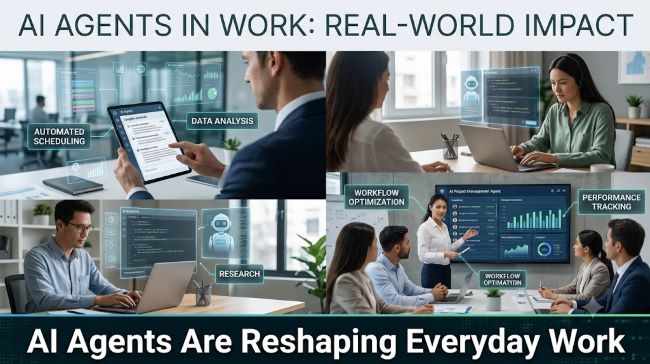
1. Ticket triage and customer support
This is the obvious one. Routine support tickets, password resets, refund requests, status checks. Agents handle them end-to-end now, not just by suggesting answers but by actually executing the workflow. The savings appear to be real in companies that have done the integration work.
Where it gets messy: edge cases. An agent that handles 80% of tickets brilliantly can still embarrass you on the other 20%.
2. Internal data work
This one’s less intuitive. A lot of office work is just moving information from one place to another. Pulling from a CRM, reformatting it, sending it on. Agents are quietly chipping away at this category, often by sitting on top of existing data pipeline workflows rather than replacing them. Not glamorous. But probably where the real productivity gains live.
3. HR busywork
Onboarding. Benefits questions. PTO approvals. The kind of stuff every HR team complains about. Agents can resolve a chunk of these without a human ever being pulled in. Some teams report ticket deflection in the 70 to 80 percent range, though those numbers should probably be taken with a grain of salt because vendor case studies tend to flatter the vendor.
4. Risk monitoring
Look, this one’s still early. Agents can watch systems, flag anomalies, and in some cases kick off remediation steps before a person even logs in. Government bodies have started to weigh in too. NIST has been building out frameworks for managing AI risk, which matters because nobody really wants an autonomous system making consequential calls without some kind of guardrail. The framework is voluntary, at least for now.
So that’s roughly the lay of the land. The honest answer to “is this going to change everything” is probably: in some places, yes. In others, not really. Real transformation tends to happen quieter than the press releases suggest.