Low Taper Fade: The Complete Guide to This Clean, Versatile Haircut
Walk into any barbershop today and one request comes up more than almost any other. The low taper fade has become the go-to cut for guys who want something sharp, professional, and easy to wear. It keeps the sides and back clean without going too dramatic, which is exactly why it works for the office, the gym, and a night out all at once. If you have been curious about this style, this guide covers everything you need to know.
We will break down what the cut actually is, how it stacks up against other fades, the best versions for different hair types, and how to ask for it and keep it looking fresh. By the end, you will know whether the low taper fade is the right pick for you and how to get the most out of it.
What Is a Low Taper Fade?
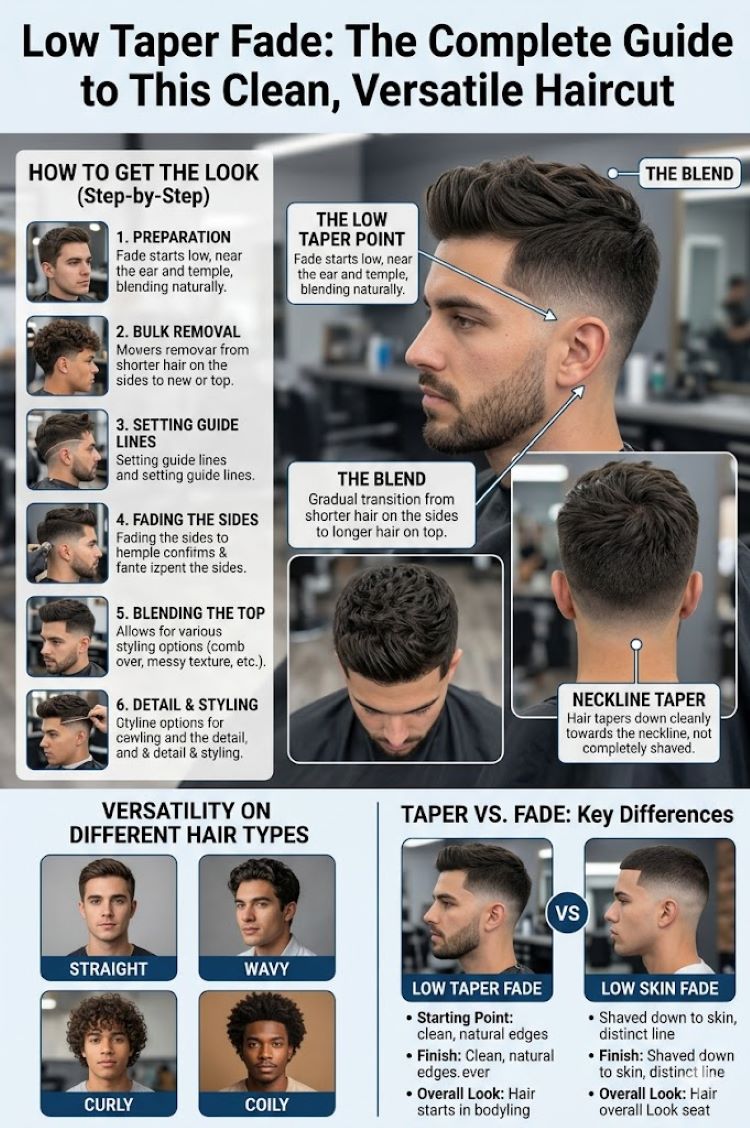
Let us start with the basics. So what is a low taper fade, exactly? It is a haircut where the hair gradually gets shorter as it moves down the sides and back, blending close to the skin near the bottom of the head, around the ears and the neckline.
To understand it, break the name into parts. A taper means the hair shortens gradually rather than all at once, giving a smooth, blended transition. The fade refers to that blend dropping all the way down to very short or bare skin. The word “low” tells you where the blend starts, sitting low on the head near the ears rather than higher up. Put together, the answer is a subtle, gradual blend that stays close to the natural hairline.
This is what makes the look so wearable. Because the blend sits low, it keeps more length up top and on the sides than a more aggressive cut, so it reads as polished rather than bold. When people ask why it is everywhere right now, the answer is that it offers a clean, barbershop-fresh finish that still looks natural and grown-up. It is the kind of cut that flatters almost everyone.
Breaking Down the Two Key Terms
Two words do the heavy lifting in this style, so they are worth understanding on their own. These two terms are related but not identical, and knowing the difference helps you talk to your barber.
A taper is the gradual shortening of hair, often the most subtle option, where the length steps down softly toward the edges. A classic taper haircut keeps the sides relatively conservative, simply tightening things up around the ears and neck without exposing skin. Many guys choose this look precisely because it looks neat without being flashy, making it a safe, professional choice.
A fade goes further. Where the first softens the length, the second blends it down to the skin, creating a sharper contrast between the longer hair on top and the bare sides. Combine the two and you get a taper fade, which marries that gradual softness with the skin-close finish of the blend. A taper fade is the foundation of the low version, since the “low” simply describes where it begins on the head. Understanding this base makes every variation easier to picture.
Low Fade vs Other Fades
One reason guys get confused is the sheer number of blending styles out there. The key difference between them is height, meaning where on the head the blend begins. Sorting that out makes choosing much simpler.
A low fade starts the blend low, near the ears and neckline, keeping the look subtle and conservative. A low fade haircut is the most understated of the bunch, which is why it pairs so naturally with the gradual blend to create the style this guide is about. By contrast, a high taper fade starts the blend much higher up the sides, creating a bolder, more dramatic contrast that stands out far more. A high taper fade suits guys who want a striking, modern statement rather than a quiet, professional finish.
There is also the matter of shape. A drop fade follows a curved line that dips down behind the ear, giving the blend a rounded shape that follows the head. A low drop fade combines that dropped, curved line with a low starting point, which flatters round and oval faces especially well. A low drop fade is a great pick if you want the subtlety of a low blend with a slightly more sculpted shape. Knowing these options, from the low blend to the drop fade, helps you describe exactly what you want.
It also helps to understand the broader category. Any fade haircut shares the same core idea of blending hair down toward the skin, and a fade haircut can be low, mid, or high depending on where it starts. Once you grasp that any blend is defined by its starting point, the names all click into place. The low version simply keeps that blend point near the bottom.
Why the Low Taper Fade Is So Popular
It is worth pausing on why this particular cut took over. The biggest reason is versatility, since it works with nearly every hair type, face shape, and setting. You can wear it to a job interview or a festival and look right at home in both.
It is also low-maintenance compared to bolder styles. Because the blend is subtle and sits low, it grows out gracefully rather than looking awkward after a couple of weeks, which means fewer barber visits. The cut keeps plenty of length and texture on top, giving you room to style it in many different ways depending on your mood.
Then there is the clean, modern aesthetic. The style looks intentional and well-groomed without screaming for attention, which is exactly the balance most guys want. It photographs well, suits professional environments, and still feels current and stylish. That combination of easy upkeep, broad flattery, and sharp looks explains why it has stayed at the top of barbershop request lists. In short, a low taper fade haircut delivers real polish with very little fuss.
The Low Taper Fade With Textured Fringe
One of the hottest versions right now pairs the cut with a textured top. The low taper fade with textured fringe brings forward-styled, piecey hair on top that falls toward the forehead, balancing the clean sides with movement and edge up top.
This combination is popular for good reason. The contrast between the tidy, faded sides and the tousled, textured fringe up front looks modern and fashion-forward. This combination works especially well for guys with thick or wavy hair, since the texture adds shape and the fringe frames the face. The style has exploded across social media, making it one of the most requested looks in barbershops today.
If a full fringe feels like too much, a subtler take still delivers. A simple low taper fringe keeps a bit of length falling forward without the heavily styled, piecey finish, offering a cleaner, more understated version of the same idea. A low taper fringe is a great middle ground for guys who want a touch of fringe without committing to a bold textured top. Either way, adding fringe is one of the easiest ways to personalize the cut.
Low Taper Fade for Curly Hair
Curly-haired guys are in luck, because this cut is fantastic with texture. A low taper fade curly hair combination lets the curls stay full and bouncy on top while the faded sides keep everything neat and controlled. The contrast between defined curls and clean edges is genuinely striking.
The reason it works so well is balance. Curls can look bulky or unkempt without structure, and a low taper fade curly hair pairing tames the sides so the curls become the intentional focal point rather than looking messy. Whether you have loose waves or tight coils, a low taper curly hair approach gives shape without sacrificing volume. Many barbers consider a low taper curly hair cut one of the best ways to manage and showcase natural texture at once. The low blend also grows out softly, which suits the way curls expand between cuts.
To keep it looking great, curly tops benefit from a good curl cream or light styling product and regular moisture. The faded sides need a touch-up every few weeks, but the curly top is forgiving and stylish even as it grows. For many guys, a low taper fade haircut is the easiest way to keep curls looking intentional.
Low Taper Fade for Straight Hair
Straight hair takes the cut in a sleeker direction. A low taper fade straight hair combination delivers crisp, clean lines and a polished, sharp finish that really shows off the precision of the blend. Straight hair makes the gradual transition look especially smooth and defined.
This version is endlessly adaptable. You can comb a low taper fade straight hair look to one side, push it back, or style a fringe forward, and the clean sides keep everything looking deliberate. A low taper straight hair approach is a favorite in professional settings because it reads as so neat and tidy. For guys who want maximum versatility, a low taper straight hair cut can be styled formal or casual in seconds with a little product. The straight texture also makes the faded blend look razor-sharp, which is part of the appeal.
Styling is straightforward. A light pomade or matte paste gives control and a clean finish, and because straight hair lies flat, the cut looks tidy with minimal effort, which is ideal for busy mornings.
Adding a Low Skin Fade
For guys who want a bit more edge, taking the blend all the way to bare skin is an option worth knowing. A low skin fade blends the hair down to completely smooth skin near the bottom, creating the sharpest possible contrast while keeping that low, subtle starting point.
The result is extra crisp. It reads as bold and ultra-clean right after the barber’s chair, though it does require more frequent touch-ups since bare skin shows regrowth quickly. It is a great choice if you love that freshly-cut, high-contrast look and do not mind visiting the barber a little more often. Paired with the low starting point, it stays refined rather than aggressive.
Sorting Out the Terminology
Because the terms get thrown around loosely, it helps to clarify a few closely related names. A plain trim and a full blend sit at opposite ends of a spectrum, with plenty of room in between.
A taper haircut, as covered earlier, keeps things subtle and rarely exposes skin, making it the most conservative option. Step it up and you reach a taper fade haircut, which blends shorter and closer to the skin for a sharper finish. This gives you more contrast than a simple version while still keeping that smooth, gradual transition. When a barber lists a taper fade haircut on the menu, they mean this blended, skin-close style.
Adding “low” to any of these just lowers the starting point. A low taper keeps the gradual blend conservative and near the ears, while a low taper haircut is simply that subtle, low-starting blend applied to a full cut. Add a skin-close blend to that and it becomes a full low taper fade haircut. Asking for a low taper or a low taper haircut signals that you want something neat and understated rather than bold. These small wording differences help you and your barber land on exactly the right cut.
How to Ask For and Maintain the Cut
Getting the result you want starts with clear communication. Bring a photo, since images beat words every time, and tell your barber you want a low blend that starts near the ears. Specify how short you want the sides to go and how much length to keep on top, and mention whether you want a fringe, a part, or a particular finish.
Use the right words too. Saying you want the blend to start low and stay subtle tells the barber to keep things conservative. If you want skin showing at the bottom, ask for it specifically. Clear language up front prevents surprises in the mirror.
Maintenance is manageable. Most guys need a touch-up every two to four weeks to keep the blend crisp, with skin versions needing more frequent visits. Between cuts, wash and condition regularly, use a styling product suited to your hair type, and consider a light trim of the neckline at home to stretch the time between appointments. Stocking up on the right products, from pomade to curl cream, is easy at a well-stocked Beauty Supply Near Me. With a little upkeep, the cut stays sharp and flattering for weeks.
Frequently Asked Questions
Is a low taper fade the same as a plain low blend? Not quite. The low blend point is only one piece, while the gradual softening on top completes the style, so the full look combines a low blend with a tapered transition.
Will it suit my face shape? Almost certainly. The subtle, low blend flatters nearly every face shape, and a dropped or curved variation can be added to complement rounder faces.
How often do I need a touch-up? Every two to four weeks keeps it sharp, though a skin version needs more frequent visits since bare skin shows regrowth faster.
Does it work with curly hair? Absolutely. Curls stay full on top while the faded sides keep everything neat, making it one of the best cuts for textured hair.
What is the difference between this and a high version? A high blend starts much higher on the head for a bolder contrast, while the low version stays subtle and professional near the ears.
Can I add a fringe? Yes. A textured fringe or a softer forward-falling fringe pairs beautifully with the clean sides and is one of the most popular variations.
Key Takeaways
- A low taper fade is a haircut where the hair blends gradually down to very short or bare skin low on the head, near the ears and neckline, for a clean, subtle finish.
- The answer to what is a low taper fade lies in its name: a taper is a gradual shortening, a fade blends to the skin, and “low” sets the blend point near the ears.
- A taper haircut is the most conservative option, while a taper fade and a taper fade haircut blend closer to the skin for sharper contrast.
- Compared to other styles, a low fade and low fade haircut stay subtle, a high taper fade is bolder, and a drop fade or low drop fade adds a curved, dropped shape.
- Any fade haircut shares the same blend-down idea, with the low version simply keeping that blend point near the bottom.
- The low taper fade with textured fringe is a top trend, while a simpler low taper fringe offers a more understated forward-falling look.
- For texture, a low taper fade curly hair or low taper curly hair cut keeps curls full on top with clean, controlled sides.
- For sleek precision, a low taper fade straight hair or low taper straight hair cut delivers crisp lines and easy styling.
- A low skin fade takes the blend to bare skin for maximum contrast, and a low taper or low taper haircut keeps the whole look neat and understated.
- Ask with a photo, specify the low blend point and your length, and plan a touch-up every two to four weeks to keep the cut sharp.