Best Educational YouTube Channels for Kids: 20 Picks by Age and Subject
YouTube holds an endless supply of videos for children. Some teach letters, numbers, and science with real care. Many others are loud, fast, and built only to keep small eyes on the screen. Parents need a short list they can trust. The best educational youtube channels for kids teach real skills, respect a child’s attention, and leave room for questions and play.
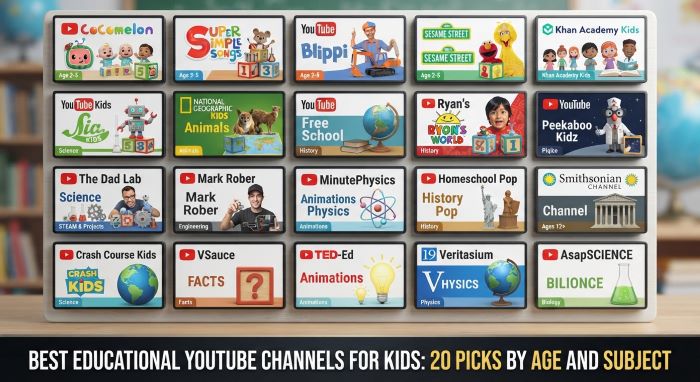
This guide lists 20 specific channels, sorted by age and subject. You will find a comparison table, notes on what each channel does well, and tips for setting up safe viewing at home.
What Makes a Channel Truly Educational
Not every channel with “learning” in its name earns the label. Look for these signs.
- Clear learning goals. Each video teaches a skill or idea you can name.
- A calm pace. Slower scenes give children time to think. Rapid cuts and constant noise do not.
- Accurate content. Good channels work with teachers, scientists, or child development experts.
- Invitations to join in. The host pauses, asks questions, and waits for an answer.
- Limited selling. The channel does not push toys or products in every video.
- Age fit. The language and ideas match the child’s stage.
We used these six signs to choose the best educational youtube channels for kids on this list.
Comparison Table: 20 Channels at a Glance
| Channel | Best Age | Main Subject | Style | Typical Video Length |
|---|---|---|---|---|
| Ms Rachel | 0 to 4 | Speech and first words | Live host, songs | 30 to 60 minutes |
| Sesame Street | 2 to 6 | Letters, numbers, feelings | Puppets, songs | 2 to 30 minutes |
| Super Simple Songs | 1 to 5 | Songs and routines | Animation | 2 to 60 minutes |
| Numberblocks | 3 to 7 | Math | Animation | 5 to 30 minutes |
| Alphablocks | 3 to 6 | Phonics and reading | Animation | 5 to 30 minutes |
| PBS Kids | 2 to 8 | Mixed subjects | Show clips and episodes | 2 to 25 minutes |
| Khan Academy Kids | 2 to 8 | Reading, math, stories | Animation, read-alouds | 3 to 15 minutes |
| Cosmic Kids Yoga | 3 to 9 | Movement and calm | Live host, stories | 10 to 30 minutes |
| Jack Hartmann Kids Music Channel | 3 to 8 | Counting, letters, movement | Songs | 2 to 10 minutes |
| Art for Kids Hub | 4 to 12 | Drawing | Live, step by step | 5 to 15 minutes |
| SciShow Kids | 5 to 10 | Science | Host and animation | 4 to 10 minutes |
| National Geographic Kids | 5 to 12 | Animals and nature | Video clips | 2 to 10 minutes |
| Homeschool Pop | 5 to 10 | History, science, geography | Animation, narration | 5 to 20 minutes |
| Free School | 6 to 12 | Arts, history, science | Narrated video | 5 to 15 minutes |
| Storyline Online | 4 to 10 | Reading and stories | Actors read picture books | 5 to 15 minutes |
| Crash Course Kids | 8 to 12 | Elementary science | Host and animation | 3 to 6 minutes |
| TED-Ed | 9 and up | All subjects | Animation | 4 to 6 minutes |
| Mark Rober | 9 and up | Engineering and science | Builds and experiments | 15 to 25 minutes |
| Kurzgesagt | 11 and up | Science and big ideas | Animation | 8 to 15 minutes |
| Khan Academy | 10 and up | Math, science, and more | Lessons on a digital board | 5 to 15 minutes |
Ages are general guides. You know your child best.
Channels for Babies and Toddlers
1. Ms Rachel
Rachel Accurso, a former music teacher with training in early childhood education, hosts “Songs for Littles.” She speaks slowly, looks at the camera, and leaves pauses for a child to respond. Her videos model first words, gestures, and simple signs. Many speech therapists point to her style as a good example of how adults can talk with toddlers.
2. Sesame Street
Sesame Street has taught young children since 1969, with research guiding its lessons from the start. The channel offers short clips with Elmo, Cookie Monster, and Abby, plus songs about letters, counting, and feelings. It also covers hard topics, such as a new sibling or a big worry, with great care.
3. Super Simple Songs
This channel grew out of a small English school in Tokyo, where teachers wrote slower, simpler songs for young learners. The animation is gentle and the music is calm. It works well for routines such as cleanup, bath time, and bedtime.
Channels for Preschool and Early Reading
4. Numberblocks
In this BBC series, each number is a character made of that many blocks. Children see that five is one more than four and that two threes make six. Math teachers helped shape the show, and it builds number sense in a clear order.
5. Alphablocks
Alphablocks is the reading partner of Numberblocks. Each letter is a character who makes its sound. When the letters hold hands, they form a word, and the word comes to life. It is a strong tool for teaching phonics and blending.
6. PBS Kids
The PBS Kids channel shares clips and full episodes from shows such as Daniel Tiger’s Neighborhood, Wild Kratts, and Work It Out Wombats. Each show has a set curriculum, from social skills to science. The content is free of ads aimed at children.
7. Khan Academy Kids
Khan Academy Kids is best known as a free app, but its channel offers read-alouds, songs, and short lessons with friendly animal characters. The content lines up with early learning standards for reading and math.
8. Jack Hartmann Kids Music Channel
Jack Hartmann writes songs that get children counting, spelling, and moving at once. Teachers use his videos for brain breaks in class. Try “Count to 100” on a rainy day when a child needs to burn off energy.
9. Storyline Online
The SAG-AFTRA Foundation runs this channel, where well-known actors read picture books aloud while the pages appear on screen. It builds listening skills and a love of stories. It is a calm choice before bed.
Channels for Movement, Art, and Creativity
10. Cosmic Kids Yoga
Host Jaime leads yoga sessions wrapped in stories, from undersea trips to popular film themes. Children stretch, balance, and breathe while they follow the tale. It gets kids off the couch, which sets it apart from most screen time.
11. Art for Kids Hub
Rob, a dad and artist, draws side by side with one of his children in each video. Viewers follow along step by step with a marker and paper. The message is that art takes practice and does not need to be perfect. A child ends each video with something they made.
Channels for Elementary Science and Nature
12. SciShow Kids
Host Jessi and her robot rat friend Squeaks answer the questions children ask. Why is the sky blue? How do bees make honey? Each video is short, accurate, and full of simple experiments to try at home.
13. National Geographic Kids
This channel brings animals, places, and science to young viewers with real footage. Series such as “Weird But True” make facts stick. It suits children who love animals and want to see the real thing.
14. Homeschool Pop
Homeschool Pop offers clear, friendly lessons on history, geography, science, and math for early grades. The narration is warm and the pace is steady. It works well as a starter for a school project.
15. Free School
Free School covers famous art, classical music, children’s books, and natural science. It is a good pick for families who want to bring culture into the mix. Lessons are calm and well sourced.
16. Crash Course Kids
This series teaches elementary science, including earth science, physics, life science, and engineering. Videos are brief and tied to school standards for fifth grade. The channel no longer posts new episodes, but the library remains useful.
Channels for Tweens and Older Kids
17. TED-Ed
TED-Ed pairs teachers with animators to make short lessons on almost any subject. Riddles and logic puzzles are a favorite. The videos spark questions that lead to deeper reading.
18. Mark Rober
Mark Rober, a former NASA engineer, builds wild projects such as squirrel obstacle courses and giant science demos. He explains the physics and the design steps behind each one. His videos show that engineering is creative and fun. Note that some videos feature sponsors and his own product line.
19. Kurzgesagt
Kurzgesagt, which means “in a nutshell” in German, makes bright animated videos on space, biology, and big questions. The team lists its sources for each video. Some topics, such as disease or the end of the universe, may worry younger children, so preview first.
20. Khan Academy
Khan Academy offers full lessons in math, science, history, and more. A student who is stuck on fractions or algebra can find a clear, step by step video. It is less about fun and more about real help with schoolwork.
Best Picks by Subject
| Subject | Top Channels |
|---|---|
| Speech and language | Ms Rachel, Super Simple Songs |
| Reading and phonics | Alphablocks, Storyline Online, Khan Academy Kids |
| Math | Numberblocks, Jack Hartmann, Khan Academy |
| Science | SciShow Kids, Crash Course Kids, Mark Rober |
| Animals and nature | National Geographic Kids, PBS Kids (Wild Kratts) |
| History and geography | Homeschool Pop, Free School, TED-Ed |
| Art | Art for Kids Hub |
| Movement and calm | Cosmic Kids Yoga, Jack Hartmann |
| Feelings and social skills | Sesame Street, PBS Kids (Daniel Tiger) |
How Much Screen Time Is Right?
The American Academy of Pediatrics advises against screen media for children under 18 months, other than video chat. For ages 18 to 24 months, it suggests high-quality content watched with a parent. For ages 2 to 5, it has long suggested about one hour a day of quality programs. For older children, it asks families to set steady limits that protect sleep, play, and schoolwork.
Even the best educational youtube channels for kids cannot replace play, books, and talk with a caring adult. Young children learn most from real people. Use videos as a tool, not as the main event.
How to Make YouTube Safer
- Use YouTube Kids for young children. The app filters content and gives you more control.
- Choose “Approved Content Only.” In YouTube Kids, this setting limits a child to channels and videos you pick by hand.
- Turn off autoplay. This stops the stream of suggested videos.
- Turn off search. Younger kids do not need it.
- Set a timer. YouTube Kids has one built in.
- Try a supervised account for tweens. It gives older children a wider but still filtered range.
- Build playlists. Save videos you have checked, and let your child choose from that list.
- Watch on a shared screen. A TV in the living room is easier to monitor than a tablet in a bedroom.
No filter is perfect. Check in often, and look at the watch history from time to time.
Why Watching Together Matters
Children learn more from video when an adult joins in. Sit down for a few minutes. Ask, “What do you think will happen next?” Name what you see. After the video, link it to real life. A Numberblocks episode can lead to counting stairs. An Art for Kids Hub lesson can lead to a drawing for Grandma. A SciShow Kids video on plants can lead to a bean in a paper cup.
Signs a Channel Is Not Worth the Time
- Bright, fast scenes with no clear lesson
- Toy unboxing or constant product placement
- Strange or upsetting versions of well-known characters
- Titles stuffed with keywords and no real content
- Videos that leave your child cranky or wired
- No information about who makes the channel
If a channel shows these signs, block it and move on.
Turning Videos Into Real Learning
- Pause and predict. Stop the video and ask what comes next.
- Do the activity. Draw the picture, try the experiment, sing the song.
- Retell it. Ask your child to explain the video to someone else.
- Find a book. Visit the library for a book on the same topic.
- Keep a wonder list. Write down questions your child asks, and look for videos that answer them.
For Homeschool Families and Teachers
Many of the best educational youtube channels for kids fit well into lessons. Use a five-minute SciShow Kids clip to open a science unit. Play Jack Hartmann for a movement break. Assign a TED-Ed video and its questions for older students. Khan Academy can fill gaps when a child needs a second explanation. Always preview a video in full before you show it to a group.
Free and Paid Options
Every channel on this list is free to watch. Free viewing on the main YouTube site includes ads, though videos marked as made for kids do not carry personalized ads. YouTube Premium removes ads and allows downloads for trips. PBS Kids, Khan Academy Kids, and Sesame Street also offer free apps with no ads at all, which can be an even safer choice for young viewers.
Frequently Asked Questions
What are the best educational youtube channels for kids under 3? Ms Rachel, Super Simple Songs, and Sesame Street suit this age, in short sessions with a parent nearby.
Which channels help most with reading? Alphablocks teaches phonics, and Storyline Online builds a love of stories.
Which channels help with math? Numberblocks for young children and Khan Academy for older students.
Is Blippi educational? Blippi visits places such as farms and fire stations and names what he sees. Many children love him. Some parents find the style too excitable. Preview and decide for your family.
Is Cocomelon educational? It teaches songs and routines, but its fast pace draws criticism from some parents and experts. Slower channels may suit young children better.
Are these channels safe? The channels listed here have strong records. The risk lies more in what autoplay serves next, so use the safety settings above.
Do kids learn from videos alone? They learn more when an adult talks with them about what they watch and links it to real life.
Final Thoughts
The best educational youtube channels for kids share a few traits. They teach clear skills, move at a pace a child can follow, and invite kids to think, sing, draw, or move. Start with two or three channels that fit your child’s age and interests. Build a playlist. Watch together when you can.
Screens work best in small, planned doses. Pair the best educational youtube channels for kids with books, outdoor play, and plenty of talk, and video time becomes one more way your child explores the world. As your child grows, revisit this list of the best educational youtube channels for kids and swap in picks for the next stage.
Key Takeaways
- The best educational youtube channels for kids have clear learning goals, a calm pace, and accurate content.
- For toddlers, choose Ms Rachel, Sesame Street, and Super Simple Songs.
- For preschool math and reading, Numberblocks and Alphablocks stand out.
- For elementary science, try SciShow Kids, National Geographic Kids, and Crash Course Kids.
- For tweens, TED-Ed, Mark Rober, Kurzgesagt, and Khan Academy offer deeper lessons.
- Use YouTube Kids, turn off autoplay, and pick approved content for younger children.
- Watch together and connect videos to real activities so the learning lasts.