Number of Books to Be Considered a Library
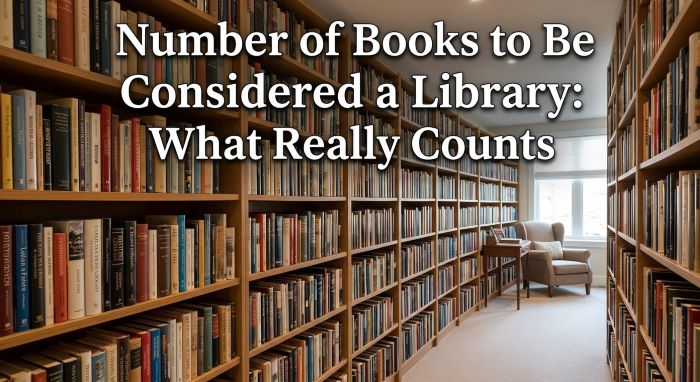
At some point, every book lover looks at their shelves and wonders: is this a library yet? Maybe you have a few dozen paperbacks, or maybe your books have spilled into every room. Either way, it’s natural to ask whether there’s an official number of books to be considered a library.
The short answer is no. There’s no legal or universal minimum. But definitions, research, and common practice offer helpful guidelines. This guide explains what counts, what the research says about home libraries, and how to build a collection you’re proud of.
Is There an Official Number of Books to Be Considered a Library?
No law or international standard sets a minimum number of books to be considered a library. Instead, most definitions focus on purpose and organization rather than size.
The word “library” comes from the Latin “liber,” meaning book. Over time, it came to mean any organized collection of books or other materials kept for reading, study, or reference. A shelf of 30 carefully chosen books can be a library, while a box of 500 random books in an attic might just be storage.
How Official Institutions Define a Library
Public Libraries in the United States
The Institute of Museum and Library Services (IMLS), the federal agency that tracks US public libraries, doesn’t use a book count either. According to a summary by the American Academy of Arts and Sciences, IMLS defines a public library as one set up under state law to serve a community, with:
- An organized collection of print or other materials, or both
- Paid staff
- A regular public schedule
- Facilities to support the collection, staff, and schedule
Notice what’s missing: a minimum number of books. What matters is organization, staffing, and access. Some states do set their own standards for public library collections, often based on how many people a library serves, but these are guidelines for funding and quality, not definitions.
What Counts as a Book?
If you’re counting, it helps to know what counts as a book. UNESCO, in a 1964 recommendation on book statistics, defined a book as a non periodical printed publication of at least 49 pages, not counting the covers. Shorter works were classed as pamphlets.
| Item | Counts as a book under UNESCO’s definition? |
|---|---|
| Novel of 300 pages | Yes |
| Children’s picture book of 32 pages | No, by this strict definition |
| Magazine | No, since it’s a periodical |
| Cookbook of 150 pages | Yes |
| Pamphlet of 20 pages | No |
In everyday life, nobody applies this rule strictly. Picture books, comics, and cookbooks all belong in a home library. But the definition shows that official bodies cared more about what a book is than how many make a library.
What Research Says About Home Libraries
While there’s no official number of books to be considered a library, research gives useful clues about how many books make a difference in people’s lives.
The 80 Book Threshold
A major study led by Dr. Joanna Sikora of the Australian National University, published in the journal Social Science Research, looked at data from more than 160,000 adults in 31 countries. Researchers asked how many books people had at home when they were 16 and compared that with their adult skills.
The findings were striking:
| Books at home at age 16 | Effect on adult literacy |
|---|---|
| Almost none | Below average literacy and numeracy |
| About 80 | Literacy around the average |
| About 350 | Benefits level off; few gains beyond this point |
According to the study, teens who grew up with many books but had only lower secondary education reached literacy levels similar to university graduates who grew up with few books.
Home Library Sizes Around the World
The study also found big differences between countries. Average home libraries at age 16 ranged from about 27 books in Turkey to 143 in the UK and 218 in Estonia.
These numbers suggest a practical guideline. If you’re asking about the number of books to be considered a library in a home, around 80 books is a meaningful starting point, and 300 or more is a substantial collection.
Common Rules of Thumb
Since there’s no official cutoff, people use their own guidelines. Here’s how many book lovers and collectors describe collection sizes:
| Number of books | Common description |
|---|---|
| 1 to 20 | A bookshelf or reading pile |
| 20 to 80 | A small personal collection |
| 80 to 300 | A home library in the making |
| 300 to 1,000 | A solid home library |
| 1,000 to 5,000 | A serious collector’s library |
| 5,000 or more | A private library on a grand scale |
These are informal labels, not rules. Your collection is a library when it feels like one to you.
What Really Makes a Collection a Library?
Beyond numbers, a few qualities turn a pile of books into a library:
- Organization: Books are grouped by subject, author, genre, or another system.
- Purpose: The collection supports reading, learning, or reference.
- Accessibility: You can find and use the books easily.
- Care: Books are stored properly and kept in good condition.
- Intention: You choose books on purpose, rather than keeping everything you get.
A small, well chosen collection often feels more like a library than a huge, messy one.
How to Organize a Home Library
If you want your collection to feel like a true library, organization is key. Popular methods include:
| Method | How it works | Best for |
|---|---|---|
| By genre | Fiction, history, science, and so on | Most home libraries |
| Alphabetical by author | A to Z by last name | Large fiction collections |
| Dewey Decimal System | Numbered subject categories used by many libraries | Big nonfiction collections |
| By color | Spines grouped by color | Decor focused shelves |
| By reading status | Read, to read, favorites | Active readers |
You can also use free apps to catalog your books by scanning barcodes. Cataloging helps you avoid buying duplicates and makes lending easier.
Building Your Home Library
You don’t need a huge budget to build a library. Here are simple ways to grow your collection:
- Shop used: Thrift stores, library sales, and used bookshops offer great prices.
- Swap books: Join book swaps or use Little Free Library boxes in your area.
- Ask for books as gifts: Birthdays and holidays are perfect chances.
- Follow your interests: Build around topics you love.
- Mix formats: Hardcovers, paperbacks, and reference books all count.
Books Worth Adding
A strong library includes books that help you think, plan, and grow. If you’re looking for ideas, start with these reading lists:
- Sharpen your reasoning with our list of the Best Books for Critical Thinking.
- Get more done with picks from the Best Books for Time Management.
- Build better habits and goals with the Best Books for Personal Growth.
These kinds of nonfiction titles pair well with novels, history, and reference works to create a balanced collection.
Do Ebooks and Audiobooks Count?
This is a common question. Digital books are still books, and many people now have large ebook libraries on their devices. Public libraries also lend ebooks and audiobooks through apps.
However, research like the Sikora study focused on physical books in the home. Seeing books on shelves may play a role in building reading habits, especially for children. Many families keep a mix of print and digital books for this reason.
Home Libraries and Children
The research on home libraries is especially important for parents. Growing up with books seems to build skills that last a lifetime. Simple ways to help kids benefit:
- Keep books in reach in children’s rooms and living areas.
- Read together every day.
- Let kids choose some of their own books.
- Visit the public library often to keep fresh books at home.
Even if you can’t own hundreds of books, regular library visits can bring a steady flow of books into your home.
Famous Private Libraries
Some people have built remarkable personal libraries:
- Thomas Jefferson sold about 6,500 books to the US government in 1815 to help rebuild the Library of Congress after it was burned in the War of 1812.
- Umberto Eco, the Italian author, was known for a personal library of tens of thousands of books.
- Karl Lagerfeld, the fashion designer, was reported to own hundreds of thousands of books.
These collections are extreme, but they show how a lifelong love of books can grow into something extraordinary.
How to Care for Your Books
Protecting your books keeps your library in good shape for years:
- Keep books out of direct sunlight to prevent fading.
- Avoid damp rooms, which can cause mold.
- Store books upright or flat, not leaning at an angle.
- Dust shelves regularly.
- Handle old or rare books with clean, dry hands.
Frequently Asked Questions
Is there a minimum number of books to be considered a library? No. There’s no official minimum. Most definitions focus on organization and purpose rather than size.
How many books does a typical home library have? It varies by country. Research found averages ranging from about 27 to over 200 books at age 16, depending on the country.
How many books help children the most? A large international study found that about 80 books at home raised adult literacy to average levels, with benefits leveling off around 350.
Do ebooks count toward a library? Yes, in everyday terms, though most research has focused on physical books.
What counts as a book? UNESCO defined a book as a printed, non periodical publication of at least 49 pages, though most people count any book they read.
Final Thoughts
There’s no magic number of books to be considered a library. A library is defined by care, organization, and purpose, not just size. Still, research suggests that around 80 books can make a real difference, and a few hundred well chosen titles create a rich home library. Whether you own 30 books or 3,000, if you’ve collected them with love and keep them ready to read, you have a library.
Key Takeaways
- There’s no official or legal number of books to be considered a library.
- The US government’s definition of a public library focuses on collection, staff, schedule, and facilities, not book counts.
- UNESCO defined a book as a non periodical printed publication of at least 49 pages.
- A study of 160,000 adults in 31 countries found about 80 books at home raised literacy to average levels.
- Benefits from home books leveled off at around 350 books.
- Organization, purpose, and care matter more than size when building a library.