
Doximity GPT
Artificial intelligence is moving fast in medicine, and few tools have spread as quickly among US clinicians as Doximity GPT. Launched in 2023 as a simple helper for writing insurance letters, it has grown into a full clinical AI assistant used by hundreds of thousands of clinicians. In 2026, Doximity renamed the tool “Ask” and added physician review, new medical content, and enterprise features.
This guide explains what the tool is, how it works, what it can and can’t do, how it compares with rivals, and what its rapid growth means for doctors and patients.
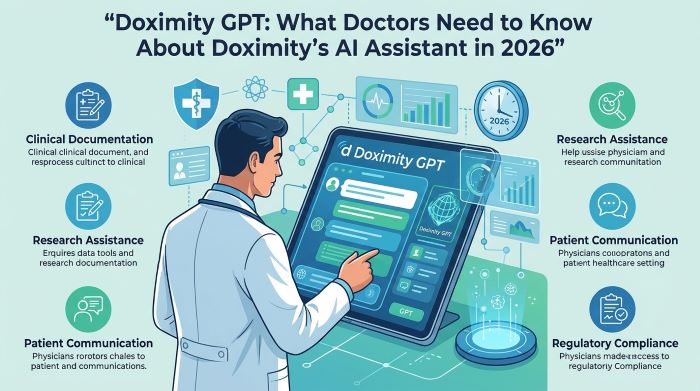
What Is Doximity GPT?
Doximity GPT is a free, AI powered assistant built by Doximity, the professional network used by most US physicians. It helps verified clinicians with two broad jobs:
- Administrative work: drafting prior authorization letters, insurance appeals, patient education handouts, and referral notes.
- Clinical questions: answering medical questions with referenced, evidence based responses drawn from journals, guidelines, and drug data.
Many clinicians call it DoxGPT for short. In May 2026, Doximity began calling the tool Ask, describing it as a “physician verified clinical AI assistant.” Ask is now part of the Doximity Clinical AI Suite, alongside an AI scribe and a calling tool.
A Quick Look at Doximity the Company
| Detail | Information |
|---|---|
| Founded | 2010 |
| Founders | Jeff Tangney, Nate Gross, and Shari Buck |
| Headquarters | San Francisco, California |
| Stock | NYSE: DOCS (public since 2021) |
| Members | More than 3 million registered members, including about 85% of US physicians, according to Fierce Healthcare |
| Fiscal 2026 revenue | About $644.9 million, according to Fierce Healthcare |
| CEO | Jeff Tangney |
Doximity is often called “LinkedIn for doctors.” Beyond networking, it offers secure messaging, digital faxing, telehealth calling, news, and now AI tools. Its huge physician network is the main reason its AI products spread so quickly.
The History of Doximity GPT
| Date | Milestone |
|---|---|
| February 2023 | Doximity launches a beta tool called DocsGPT, built on ChatGPT technology, to help doctors draft letters |
| 2023 | The tool becomes Doximity GPT, often called DoxGPT |
| July 2025 | Doximity buys Pathway Medical, a clinical AI reference startup |
| September 2025 | Pathway’s medical dataset is merged into the assistant, with faster, sourced answers |
| Early 2026 | PeerCheck physician review launches, with more than 10,000 physician experts |
| May 2026 | Doximity rebrands the tool as Ask and launches the Clinical AI Suite |
| May 2026 | Aledade partnership brings Ask and Scribe to independent primary care doctors |
| July 2026 | Doximity says Ask topped an independent clinical AI benchmark |
| October 2026 | Doximity and Wolters Kluwer announce a deal to bring UpToDate content into Ask |
When it first launched, the tool was mainly a letter writer. Doctors could type a request like “write a prior authorization letter for an MRI for chronic back pain,” and the tool would draft it, ready to edit and fax to an insurer. That saved time on one of medicine’s most hated tasks.
Key Features
1. Clinical Question Answering
Clinicians can ask medical questions and get summarized answers with references. According to a September 2025 Doximity blog post, answers put conclusions first, use tables for comparisons, and link to sources. The tool also offers “Instant Answers” for more than 3,200 drug monographs, covering dosing, interactions, and side effects, drawn from a structured, peer reviewed dataset rather than AI generated text.
2. Free Journal Access
Doximity says the assistant gives users free full PDF access to more than 2,000 medical journals, including JAMA, The Lancet, BMJ, and Nature Medicine. That’s a big perk for clinicians without institutional subscriptions.
3. Writing and Administrative Tools
| Task | How the tool helps |
|---|---|
| Prior authorization letters | Drafts letters explaining medical necessity |
| Insurance appeals | Writes appeal letters that can be faxed through Doximity |
| Patient education | Creates plain language handouts, which can be texted securely |
| Referral and consult letters | Summarizes cases for specialists |
| Research grants | Helps outline and draft grant language |
| Notes and templates | “Projects” save templates for progress notes and discharge summaries |
| File attachments | Extracts medications or treatments from uploaded files or labs |
| Dictation | Web based voice dictation for faster input |
4. PeerCheck Physician Review
One of the biggest differences between this tool and general chatbots is PeerCheck. According to Fierce Healthcare, physicians and other domain experts review AI generated clinical answers for accuracy, evidence strength, and potential bias. More than 10,000 physicians have taken part. Cardiologist and researcher Eric Topol and former US Surgeon General Regina Benjamin serve as co-editors in chief, and certified answers link to the reviewers’ profiles.
This “human in the loop” approach is meant to address the biggest worry doctors have about AI: whether its answers can be trusted.
5. Pathway Integration
In July 2025, Doximity closed its purchase of Pathway Medical, a small Montreal based startup, for $26 million in cash plus up to $37 million in equity grants, according to Fierce Healthcare. Pathway had built a clinical reference tool covering guidelines, drugs, interactions, and trials. Doximity says Pathway’s system is a knowledge graph grounded in peer reviewed evidence, and its data and AI were folded into the assistant to make answers faster and better sourced.
6. UpToDate Content
In October 2026, Doximity and Wolters Kluwer Health announced a partnership to bring UpToDate, one of medicine’s most widely used clinical references, into Ask. According to the announcement, clinicians at health systems using both products will see answers drawn from UpToDate’s roughly 13,000 topics.
The Doximity Clinical AI Suite
In May 2026, Doximity bundled its AI tools into one suite:
| Tool | What it does |
|---|---|
| Ask (the renamed assistant) | Clinical AI assistant with PeerCheck review |
| Scribe | Ambient AI note taking that drafts visit notes |
| Dialer | Calls, video visits, and texting with patients |
The idea is that a doctor can call a patient through Dialer, let Scribe write the note, and use Ask to answer a clinical question or draft a follow up, all in one place.
Doximity GPT Healthcare Use Cases
Here are common ways clinicians use Doximity GPT healthcare tools in daily practice:
- Fighting insurance denials: Drafting appeal letters that cite guidelines and studies.
- Preparing for rounds: Quickly reviewing current guidance on a condition.
- Checking drug interactions: Looking up dosing and interactions through drug monographs.
- Patient communication: Turning complex instructions into simple, readable handouts.
- Documentation: Using Scribe to cut charting time.
- Continuing education: Reading full journal articles for free.
These uses explain why Doximity GPT healthcare features have grown so popular. Most target the paperwork that eats into doctors’ time.
Is It an AI Doctor?
People sometimes describe tools like this as an “ai doctor,” but that’s misleading. The assistant is designed for licensed clinicians, not patients. It doesn’t diagnose or treat anyone on its own. Instead, it supports doctors, nurse practitioners, physician assistants, and medical students who still make every decision.
An ai doctor that replaces human judgment doesn’t exist in mainstream practice, and Doximity doesn’t market its tool that way. Its message is the opposite: physician involvement, through PeerCheck and clinical review, is the key to trust. As Doximity’s Amit Phull, MD, put it in the company’s 2026 AI report, “Real physician involvement in the development and deployment of AI will be key to unlocking its value in healthcare.”
Patients looking for an ai doctor app should know that this tool isn’t meant for them. Patients should always talk with a licensed clinician about symptoms and treatment.
Who Can Use It?
According to Doximity, the assistant is free for verified US physicians, nurse practitioners, physician assistants, and medical students. Users must verify their identity and credentials through Doximity. Health systems can also buy the enterprise Clinical AI Suite for their staff.
| User | Access |
|---|---|
| Verified US physicians | Free |
| Nurse practitioners and PAs | Free |
| Medical students | Free |
| Patients and the public | Not available |
| Health systems | Enterprise suite available for purchase |
Privacy and HIPAA
Privacy is a top concern with any medical AI. Doximity says Ask is HIPAA compliant, with data encrypted in transit and at rest, and that prompts and responses stay private to each clinician. Its May 2026 announcement with Aledade also described the Clinical AI Suite as HIPAA compliant.
Even so, clinicians should follow their employer’s AI policies. Doximity’s own 2026 survey found that 47% of physicians say their hospital’s AI policies are confusing or still evolving. Security matters at the hospital level too. For more on that topic, see How AI-Powered Healthcare Security Systems Are Transforming Smart Hospitals in 2026.
How Many Clinicians Use It?
Usage has grown fast. According to Fierce Healthcare’s coverage of Doximity’s earnings calls:
- More than 300,000 clinicians used Doximity’s AI tools in the October to December 2025 quarter.
- Active prescribers using the assistant asked about four questions per week on average in January 2026.
- Quarterly active prescribers on the platform passed 800,000 in the fiscal fourth quarter, with nearly half using clinical AI tools.
- 140 health systems have bought the Clinical AI Suite, including seven of the top 20 US hospitals.
Doximity GPT vs. OpenEvidence and Other Tools
The main rival is OpenEvidence, another AI clinical reference tool popular with US doctors. Here’s how they compare:
| Feature | Doximity Ask | OpenEvidence | General chatbots |
|---|---|---|---|
| Cost for clinicians | Free | Free for verified clinicians | Free and paid plans |
| Physician review | PeerCheck, 10,000+ experts | Not the same model | No |
| Administrative writing | Yes, plus faxing | Limited | Yes, but no fax or integration |
| Journal access | Free PDFs from 2,000+ journals | Partnerships with publishers | No |
| Built in network | Doximity’s physician network | Standalone | Standalone |
| HIPAA claims | Yes | Varies by product | Usually not for consumer versions |
Doximity has claimed strong results. On a February 2026 earnings call, it said physicians picked its answers as best 61% of the time versus 26% for OpenEvidence in a side by side evaluation, according to Fierce Healthcare. In July 2026, Doximity also said Ask outperformed rivals in an independent benchmark called NOHARM. These are company reported results, so independent studies will matter over time.
The OpenEvidence Lawsuit
The rivalry turned into a courtroom fight. In June 2025, OpenEvidence sued Doximity, alleging its staff used real doctor credentials to “prompt inject” OpenEvidence’s chatbot and try to extract its internal instructions. Doximity denied wrongdoing and countersued, accusing OpenEvidence of misleading attacks. According to AI Weekly, the two companies settled in October 2026, dismissing all claims and counterclaims, with each side paying its own legal costs. Other terms weren’t disclosed.
Benefits for Clinicians
- Saves time: Letters and notes that took 20 minutes can take two.
- Reduces burnout: Less after hours paperwork, often called “pajama time.”
- Free: No cost for individual clinicians.
- Evidence focused: Answers include sources, and PeerCheck adds human review.
- Integrated: Faxing, texting, and calling are all in one app.
Doximity’s 2026 State of AI in Medicine report, a survey of 3,151 physicians, found that 75% of physician AI users say AI has reduced their administrative burden, and 90% believe it can cut after hours work.
Limitations and Risks
No AI tool is perfect. Clinicians should keep these limits in mind:
- Accuracy: AI can still make mistakes or “hallucinate.” In Doximity’s own survey, 71% of physicians named accuracy and reliability as their top concern.
- Not a substitute for judgment: Clinicians must check facts, doses, and sources.
- Bias: Training data can reflect gaps in research.
- Privacy rules: Even with HIPAA protections, users should follow their organization’s policies.
- Company claims: Benchmark wins are reported by the company and its partners, so independent research is still important.
For a broader look at how AI and machine learning are reshaping medicine, read Impact of AI and ML on Healthcare Industry.
What Physicians Say About AI in 2026
Doximity’s 2026 report offers a snapshot of how doctors feel about AI:
| Finding | Share of physicians |
|---|---|
| Using AI or interested in it | 94% |
| Using AI daily (early 2026) | 63%, up from 47% in early 2025 |
| Say AI reduced their admin burden (among users) | 75% |
| Top concern: accuracy and reliability | 71% |
| Hospital AI policies confusing or evolving | 47% |
The top use cases were literature search (35%) and ambient scribes (29%). You can read the full findings in Doximity’s 2026 State of AI in Medicine Report.
How to Get Started
- Create or log in to a Doximity account on the website or mobile app.
- Verify your credentials as a US clinician or medical student.
- Open Ask from the menu.
- Type your question or request, such as “Draft a prior authorization letter for a GLP-1 medication for a patient with type 2 diabetes.”
- Review and edit the output carefully.
- Send or save using built in fax, text, or Projects.
Tips for Better Results
- Be specific about the patient’s condition, history, and the request.
- Ask for sources and check them.
- Use Projects to save templates you use often.
- Never rely on AI output without clinical review.
Business Impact for Doximity
Doximity calls 2026 an “AI investment year.” According to Fierce Healthcare, the company is spending more on research, computing, marketing, and peer review, and it expects little AI revenue in fiscal 2027. Investors reacted nervously to softer guidance, with shares falling after recent earnings calls. CEO Jeff Tangney has said, “We believe we’ll win the AI market here in 2026,” pointing to Doximity’s physician and hospital networks as its main advantage.
Partnerships with Aledade, Photon Health for e-prescribing, and Wolters Kluwer for UpToDate show how the company is trying to make its assistant the central AI tool in a doctor’s day.
The Future of Doximity GPT
Looking ahead, expect:
- Deeper EHR integration through partners like Aledade.
- More trusted content, such as UpToDate.
- Wider enterprise adoption by health systems.
- More physician review to build trust.
- New tools like e-prescribing inside Doximity.
The big question is whether physician reviewed AI can become the trusted standard. If it does, Doximity GPT could change how millions of patients are cared for, mostly by freeing doctors from paperwork.
Frequently Asked Questions
What is DoxGPT? It’s the nickname for Doximity’s AI assistant for clinicians, now called Ask.
Is it free? Yes, for verified US physicians, NPs, PAs, and medical students.
Is it HIPAA compliant? Doximity says yes, with data encrypted in transit and at rest.
Can patients use it? No. It’s built for verified clinicians.
How is it different from ChatGPT? It’s built for medicine, offers physician reviewed answers through PeerCheck, includes drug data and journal access, and connects to Doximity’s fax and messaging tools.
Who reviews the answers? More than 10,000 physicians and experts through PeerCheck, led by Eric Topol and Regina Benjamin.
Final Thoughts
From a simple letter writer to a physician reviewed clinical assistant, Doximity GPT has become one of the most widely used AI tools in American medicine. It saves doctors time, offers free access to medical evidence, and pairs AI with human review. Like any AI, it still needs careful checking, but for many clinicians, the tool has already changed the way they handle paperwork and find answers.
Key Takeaways
- Doximity GPT, often called DoxGPT, is Doximity’s free AI assistant for US clinicians, renamed Ask in 2026.
- It drafts letters and answers clinical questions with sources.
- PeerCheck lets more than 10,000 physicians review AI answers.
- Doximity bought Pathway Medical in 2025 and is adding UpToDate content through Wolters Kluwer.
- It’s free for verified physicians, NPs, PAs, and medical students, and Doximity says it’s HIPAA compliant.
- More than 300,000 clinicians used Doximity’s AI tools in late 2025.
- OpenEvidence is its main rival; the two settled their lawsuits in October 2026.
- It’s not built for patients; clinicians remain responsible for all decisions.