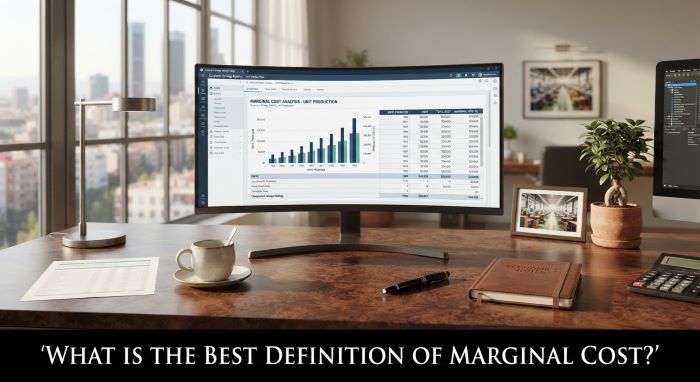
What Is the Best Definition of Marginal Cost?
If you are asking what is the best definition of marginal cost, you are likely working through an economics course, a business exam, or a homework set that wants a precise answer rather than a general idea. The best definition of marginal cost is the additional cost a business incurs to produce one more unit of a good or service. It sounds simple, but exam questions often include several answer choices that sound almost right, which makes understanding the precise definition worth spending real time on.
This article breaks down the correct definition, the formula behind it, how it differs from related cost concepts, and a worked example so the idea sticks.
The Best Definition of Marginal Cost, in Plain Language
The best definition of marginal cost is this: marginal cost is the change in total cost that results from producing one additional unit of output. It focuses specifically on the extra cost of that next unit, not the average cost per unit and not the total cost of everything produced so far. If a bakery’s total cost rises by three dollars when it bakes one more loaf of bread, then three dollars is the marginal cost of that loaf.
Every correct answer choice describing what is the best definition of marginal cost will include three components: it refers to a change in total cost, it is tied to one additional unit of production, and it is a forward looking, incremental measure rather than a cumulative one.
The Formula for Marginal Cost
Marginal cost is calculated as the change in total cost divided by the change in quantity produced. Written as a formula, it looks like this: Marginal Cost equals Change in Total Cost divided by Change in Quantity. If a factory’s total cost goes from 10,000 dollars to 10,150 dollars when output increases from 100 units to 101 units, the marginal cost of that 101st unit is 150 dollars, since the change in total cost is 150 dollars divided by a change in quantity of one unit.
Understanding this formula is often the fastest way to confirm what is the best definition of marginal cost on an exam, because the correct answer choice will always match this ratio conceptually, even if it is phrased in different words.
Common Wrong Answers and Why They Are Wrong
Exam questions asking what is the best definition of marginal cost typically include distractor answers that describe related but different concepts. Here is how to recognize and rule them out.
- Average cost distractors. These describe total cost divided by total units produced, which gives you the cost per unit across the entire production run, not the cost of the next unit specifically. Average cost and marginal cost are different numbers except in a special case where they happen to intersect.
- Total cost distractors. These describe the full cost of production at a given output level, without isolating the incremental change caused by one additional unit.
- Fixed cost distractors. These describe costs that do not change with production volume, such as rent or insurance, which is essentially the opposite of the incremental, output driven nature of marginal cost.
- Variable cost distractors. These describe costs that change with output overall, such as raw materials, but variable cost refers to the total variable expense at a given output level, not the specific additional cost of the next single unit.
- Marginal revenue distractors. These describe the additional revenue earned from selling one more unit rather than the additional cost of producing it. It is easy to confuse the two since both are incremental, but revenue and cost are opposite sides of the same production decision.
If you see an answer choice that mentions cost per unit averaged across production, or a cost that does not depend on the quantity produced, it is not describing what is the best definition of marginal cost.
Marginal Cost vs Marginal Revenue
Marginal cost and marginal revenue are frequently tested together because they determine a business’s most profitable output level. Marginal revenue is the additional revenue a company earns from selling one more unit. A business maximizes profit at the exact output level where marginal cost equals marginal revenue, since producing beyond that point costs more than it earns, and producing less than that point leaves potential profit on the table. If you want a deeper breakdown of how these two concepts interact, this explanation of the point of maximum profit being where marginal cost equals marginal revenue walks through the full logic with examples.
It is also worth understanding the difference between marginal cost and marginal revenue directly, since exam questions often test whether you can distinguish the two rather than define either one in isolation. Mixing them up is one of the most common mistakes students make when this topic first appears on a test.
A Worked Example
Imagine a small coffee roasting business. At 500 pounds of beans roasted per week, total cost is 4,000 dollars. When the business roasts 501 pounds, total cost rises to 4,012 dollars. Using the formula, the marginal cost of that 501st pound is the change in total cost, 12 dollars, divided by the change in quantity, one pound, which equals 12 dollars. If the business can sell that additional pound for more than 12 dollars, producing it increases profit. If it sells for less than 12 dollars, producing it actually reduces profit, even though the business is still generating revenue from the sale.
This example illustrates exactly what is the best definition of marginal cost in practice: it is not about whether a sale generates revenue, it is about whether that specific additional unit costs more or less to produce than it earns.
Why Marginal Cost Shapes Real Business Decisions
Businesses use marginal cost constantly, even if the term itself rarely comes up in daily conversation. A manufacturer deciding whether to run an extra production shift is really asking what is the best definition of marginal cost for that shift’s output, and comparing it against expected revenue. A software company deciding whether to onboard one more customer is weighing a marginal cost near zero against the revenue that customer generates. Airlines use marginal cost thinking when deciding whether to sell a last minute seat at a discount, since the marginal cost of flying one more passenger on a nearly full flight is often just the cost of a meal or fuel weight, far below the ticket price.
How Marginal Cost Changes at Different Production Levels
Marginal cost is rarely constant across all levels of output. In many industries, marginal cost initially falls as production increases, due to efficiencies of scale, before eventually rising again as a factory approaches its maximum capacity and needs overtime labor, rush shipping on materials, or additional equipment to keep up. This U shaped marginal cost curve is a foundational concept in microeconomics and explains why businesses have a specific, identifiable output level that maximizes their profit rather than profit simply increasing forever as production increases.
Marginal Cost and Economies of Scale
One reason marginal cost tends to fall before it rises is economies of scale, a concept closely tied to what is the best definition of marginal cost in a real production environment. As a factory increases output, it can often spread fixed costs, like the cost of machinery or a building lease, across more units, and it may also gain efficiencies from bulk purchasing of raw materials or more specialized labor. These efficiencies reduce the cost of producing each additional unit for a while. Eventually, though, a factory reaches its practical capacity. Beyond that point, producing more requires overtime pay, rushed shipping for materials, or additional equipment, all of which increase the cost of each additional unit and cause marginal cost to rise again. This is why the marginal cost curve is typically drawn as a U shape in introductory economics textbooks, falling initially and then climbing as a business approaches its maximum output.
Marginal Cost in Everyday Business Examples
Seeing marginal cost applied across different industries helps solidify the definition. A restaurant deciding whether to stay open for one additional hour on a slow night is essentially calculating the marginal cost of that hour, mostly additional labor and utilities, against the marginal revenue from any extra customers who might walk in. A publisher deciding whether to print one thousand additional copies of a book is weighing the marginal cost of paper, ink, and binding for those extra copies against the expected revenue from selling them, since the cost of writing and editing the book, a fixed cost, has already been spent regardless of how many additional copies get printed. A ride sharing company deciding whether to offer a lower fare during a slow period is essentially estimating that the marginal cost of driving one more passenger, mostly fuel and vehicle wear, is low enough that even a discounted fare still generates a profit on that specific ride.
Why Textbooks Emphasize This Definition So Heavily
Economics courses spend significant time on what is the best definition of marginal cost because it underlies so many other concepts taught later in the course, including profit maximization, market supply curves, and how firms respond to changes in input prices. A firm’s short run supply curve, for instance, is directly derived from its marginal cost curve. Understanding marginal cost correctly early in a course makes every subsequent unit, from perfect competition to monopoly pricing, considerably easier to follow, which is exactly why exam questions on this specific definition appear so consistently across introductory and intermediate economics courses.
A Second Worked Example With Diminishing Returns
Consider a small landscaping company that owns two mowers and employs two workers. Mowing the first five lawns of the day costs the company 200 dollars total, covering fuel, wages, and equipment wear. Taking on a sixth lawn requires paying a worker overtime wages, since regular hours are already used up, pushing total cost to 235 dollars. The marginal cost of that sixth lawn is 35 dollars, notably higher than the roughly 40 dollar average cost of the first five lawns might suggest at first glance, illustrating how overtime and capacity constraints can cause marginal cost to spike even when average cost still looks reasonable. If the company only charges 30 dollars per lawn, taking on that sixth lawn actually reduces total profit for the day, even though it generates additional revenue, which is precisely the kind of decision marginal cost analysis is designed to catch.
Marginal Cost in Short Run vs Long Run Analysis
Economists distinguish between short run and long run marginal cost, and the distinction matters for a complete answer to what is the best definition of marginal cost in more advanced coursework. In the short run, at least one input, usually factory space or major equipment, is fixed, which means marginal cost eventually rises sharply as a business tries to squeeze more output from a fixed set of resources. In the long run, every input can be adjusted, including building a new factory or purchasing additional equipment, which allows a business to avoid the sharp increases in marginal cost that come from short run capacity constraints. This is why a company facing consistently high marginal costs might choose to expand its physical capacity rather than continuing to pay overtime wages and rush shipping fees indefinitely, since the long run marginal cost of adding capacity can be lower than the short run marginal cost of overworking existing resources.
How Marginal Cost Appears on Standardized Tests
Marginal cost questions show up constantly on Advanced Placement Microeconomics exams, introductory college economics finals, and business school entrance exams, often paired with a small data table showing total cost at several output levels. The typical format asks you to calculate marginal cost between two rows of a table, then use that figure to answer a follow up question about optimal production level or pricing strategy. A common trap is forgetting that marginal cost specifically measures the change between two adjacent output levels, not the total cost at either level individually. Students who mix up marginal cost with average cost on this style of question, a frequent error, often get the calculation started correctly but then divide by the wrong denominator, using total units produced instead of the change in units between the two rows being compared.
Marginal Cost Pricing as a Business Strategy
Some businesses, particularly in industries with very low marginal cost per additional unit, deliberately price close to marginal cost as a competitive strategy. Streaming services and software companies are classic examples, since the marginal cost of serving one additional subscriber is often just a few cents in server costs, far below the price customers actually pay. This gap between price and marginal cost is what allows these businesses to fund their high fixed costs, like content licensing or software development, through the difference. Airlines use a related strategy with last minute discounted fares, since the marginal cost of an empty seat flying anyway is close to zero, making even a steeply discounted fare more profitable than an empty seat generating no revenue at all.
A Quick Self Test
Before moving on, try applying the definition to a new scenario without looking back at the formula. A bakery’s total cost is 500 dollars when it bakes 200 loaves in a day. Baking a 201st loaf raises total cost to 504 dollars. Pause and calculate the additional cost of that one loaf before reading further. The answer is 4 dollars, found by taking the 4 dollar change in total cost and dividing it by the 1 unit change in quantity. If you landed on 4 dollars without hesitation, the core concept has clicked, and applying it to more complex exam questions involving larger data tables or graphs should feel far more manageable going forward. If the calculation felt shaky, revisit the formula section above and try one more example on your own before moving to practice problems, since this specific skill, isolating the cost of a single additional unit, is the foundation that nearly every later question in the unit builds on.
Key Takeaways
- The best definition of marginal cost is the additional cost incurred from producing one more unit of output.
- The formula is the change in total cost divided by the change in quantity produced.
- Average cost, total cost, fixed cost, and variable cost are common distractor concepts that describe something different from marginal cost.
- Marginal revenue is the mirror concept on the revenue side, and profit is maximized where marginal cost equals marginal revenue.
- A worked example shows that marginal cost isolates the cost of the next unit specifically, not the average or total cost of production.
- Businesses use marginal cost thinking for decisions like adding shifts, onboarding new customers, or selling discounted last minute inventory.
- Marginal cost typically follows a U shaped curve, falling with efficiencies of scale before rising again near maximum capacity.