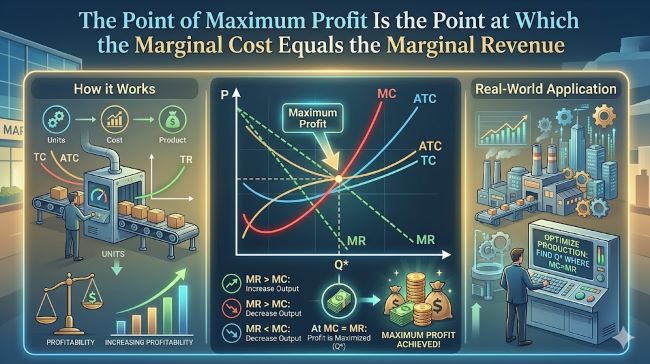
The Point of Maximum Profit Is the Point at Which the Marginal Cost Equals the Marginal Revenue
You’re making a business decision. You could produce more units. Should you? The answer depends on one fundamental principle that guides all profit-maximizing decisions.
The point of maximum profit is the point at which the marginal cost equals the marginal revenue. This simple statement holds enormous power for understanding business strategy, pricing decisions, and production levels.
Understanding this principle helps you see why some businesses expand while others contract, why some products get discounted while others maintain prices, and how successful companies make production decisions.
Let’s explore why this principle is true and what it means for real-world business.
The Foundation: What Are Marginal Cost and Marginal Revenue
Before understanding why they’re equal at maximum profit, understanding what each means matters.
Marginal cost is the cost of producing one additional unit. Not the total cost. Not the average cost. The cost of that specific next unit.
If you make 100 widgets for $1,000, your average cost is $10. But making the 101st widget might cost only $8. That $8 is marginal cost.
Marginal revenue is the money you make from selling one additional unit. Not the total revenue. The revenue from that specific next unit.
If you sell 100 widgets for $1,000, your average revenue is $10. But selling the 101st widget might bring in only $9. That $9 is marginal revenue.
Both concepts focus on that next unit. What does one more unit cost? What does one more unit earn?
The Logic of the Principle
The logic behind maximum profit at MC = MR is straightforward once you think about it.
When marginal revenue exceeds marginal cost, producing one more unit makes you money. If MR = $10 and MC = $8, you gain $2 per unit. You should produce more.
Keep producing as long as MR > MC. Each unit adds to profit.
When marginal cost exceeds marginal revenue, producing one more unit costs you money. If MC = $10 and MR = $8, you lose $2 per unit. You should produce less.
Stop producing when MC > MR. Each additional unit reduces profit.
The only point where you’re not leaving money on the table is where they’re equal. MC = MR. At this point, producing one more unit breaks even. Producing less means leaving profit on the table. Producing more means incurring losses.
This is where maximum profit sits. Not at maximum revenue. Not at maximum output. At the point where they’re equal.
Why This Isn’t Maximum Revenue or Maximum Output
A common misconception is that maximum profit occurs at maximum revenue or maximum output. It doesn’t.
Maximum revenue might occur when you’ve sold everything possible. You’ve pushed price down so low that selling more doesn’t increase total revenue. But you’re not maximizing profit. You’re barely making money because you’ve discounted so heavily.
Maximum output occurs when you’re producing as much as physically possible. You’ve pushed every constraint to its limit. But you’re probably losing money on the last units because marginal cost has risen and marginal revenue has fallen.
Maximum profit sits between these extremes. It’s the sweet spot where the cost of one more unit exactly matches the revenue from one more unit.
Real-World Examples
Examples show why this principle works.
Coffee shop scenario. A shop sells coffee for $5 per cup. The cost to make each cup is $2. Marginal revenue is $5. Marginal cost is $2. The shop should keep making coffee because MR > MC.
But at some production level, capacity constraints kick in. The tiny shop gets crowded. Customer service suffers. Maybe marginal cost rises to $3 due to slower service. Still MR > MC. Keep producing.
Eventually, during the worst rush, MC reaches $5. The shop can’t maintain quality while making that many cups. Each additional cup costs $5 to make and sells for $5. No profit. This is where maximum profit is. Where MC = MR.
If the shop somehow pushed to make more, MC might rise to $6. Now each additional cup loses $1. They’ve passed the profit-maximizing point.
Manufacturing scenario. A factory makes widgets for $8 cost per unit and sells them for $15. Marginal cost is $8, marginal revenue is $15. The difference of $7 per unit is profit. They should keep making widgets.
As production increases, efficiency suffers. MC rises to $10. Still less than MR of $15. Keep producing.
MC rises to $12, then $13, then $14. Each unit still generates profit. The factory adds another shift. MC stays at $14.
MC rises to $15. Now each additional unit breaks even. This is maximum profit. One more unit of production generates zero additional profit.
If they somehow pushed to make even more, MC might hit $16. Now each additional unit loses money. They’ve passed the optimal point.
Airline pricing scenario. An airline sells seats for $300. The marginal cost of one more seat is just food, fuel burn, and processing. Maybe $50. MR > MC massively. Sell as many seats as possible.
As the flight gets fuller, it gets harder to sell more seats. You have to lower price. At $250, you still sell seats. MR is $250, MC is still $50. Keep selling.
Price drops to $100. You’re filling remaining seats. MR is $100, MC is $50. Still profitable.
Price drops to $55. You’re selling last few seats for almost nothing. MR is $55, MC is $50. Still barely profitable.
When price drops to $50, MR = MC. You’ve found maximum profit. Lowering price below this point loses money on each seat. You’ve passed the profit-maximizing point.
Understanding Different Cost Structures
Different business types have different cost structures that affect where MC = MR occurs.
High fixed cost, low variable cost businesses. Software companies are examples. They invest heavily upfront but then have nearly zero cost per additional customer. MC is nearly zero. They should produce and sell as much as possible until marginal cost rises.
MR usually decreases as they sell more (price must drop to sell more). MR eventually equals MC at some production level, but that level is very high. They sell massive quantities.
Low fixed cost, high variable cost businesses. Service businesses are examples. They have lower upfront costs but high per-unit cost. A plumber has low overhead but high cost per job. MC is relatively high from the start.
MR might be moderate. They quickly reach the point where MC = MR. The profit-maximizing quantity is lower because the per-unit cost is higher.
Capacity-constrained businesses. Restaurants and retail shops have limited space. MC initially decreases as they use capacity better. Then MC increases as they hit capacity limits.
MR typically decreases as they try to attract more customers (lower prices). They meet at some point that represents the optimal production level within their constraints.
Mathematical Expression
The principle can be expressed mathematically.
Profit = Total Revenue minus Total Cost Profit = TR – TC
To find maximum profit, take the derivative of profit with respect to quantity.
dProfit/dQ = dTR/dQ – dTC/dQ
The derivative of TR with respect to Q is marginal revenue (MR). The derivative of TC with respect to Q is marginal cost (MC).
So: dProfit/dQ = MR – MC
Profit is maximized when this derivative equals zero. When dProfit/dQ = 0, then MR = MC.
This mathematical approach confirms the principle. Maximum profit occurs where MR = MC.
Why Businesses Sometimes Don’t Operate Here
If maximum profit occurs where MC = MR, why don’t all businesses operate there?
Some businesses don’t have the information to know where MC = MC. They lack good cost accounting or revenue data.
Some businesses can’t produce at the optimal level due to constraints. A restaurant might want to serve more customers but doesn’t have space. A manufacturer might want to produce more but can’t get materials.
Some businesses prioritize growth or market share over immediate profit. They produce above the MC = MR point to capture market share. They accept lower profit margins.
Some businesses make poor decisions. They don’t understand the principle and produce too much or too little.
But in theory, all profit-maximizing businesses should operate where MC = MR.
The Second-Order Condition
There’s actually a technical consideration: the second-order condition.
When MC = MR, you’ve found a point where profit stops changing. But it could be a maximum or a minimum.
The second-order condition requires that MC is increasing faster than MR at the intersection point. This ensures it’s a maximum, not a minimum.
In real business, MC usually increases at the point where MC = MR, while MR decreases. So it’s typically a maximum.
But theoretically, if MR were increasing faster than MC, you’d have a minimum at their intersection. You’d want to produce either much more or much less.
In practical business, this rarely happens. The standard case is maximum profit at MC = MR.
Application to Pricing Decisions
Understanding this principle guides pricing strategy.
If you’re currently selling at a price where MR exceeds MC significantly, you can increase profit by raising prices (which decreases quantity sold but increases MR per unit) until MR = MC.
If you’re currently selling at a price where MC exceeds MR, you’re losing money on each unit. Lower price to increase quantity until MR rises to meet MC. Or raise price to increase MR until it meets MC.
This principle explains why companies sometimes have sales. They believe they’re on the portion of their demand curve where MC > MR. A sale lowers price, increases quantity, and moves them toward MC = MR.
Application to Production Decisions
Understanding this principle guides how much to produce.
If you have the ability to produce more at the same cost per unit, do so up until MC = MR.
If production costs are rising as you make more, watch marginal cost. When it starts approaching marginal revenue, you’re getting close to the optimal point.
If demand for your product is strong and marginal revenue is high, you can produce more before hitting the maximum profit point.
If demand is weak and marginal revenue is low, the maximum profit point comes at lower production levels.
Long-Term vs Short-Term
The MC = MR principle applies to both short-term and long-term decisions.
In the short term, some costs are fixed. You decide production quantity for the next month.
In the long term, all costs are variable. You decide capacity, location, and long-term production levels.
The principle applies in both cases, though the specific MC and MR values differ.
In the short term, fixed costs don’t affect marginal cost. You ignore them for MC calculation.
In the long term, all costs affect marginal cost. A new factory increases marginal cost in the long run because you have to build and maintain it.
Key Takeaways
- The point of maximum profit is the point at which the marginal cost equals the marginal revenue.
- Marginal cost is the cost of producing one additional unit.
- Marginal revenue is the revenue from selling one additional unit.
- When MR > MC, produce more. Each additional unit increases profit.
- When MC > MR, produce less. Each additional unit decreases profit.
- When MC = MR, you’ve found maximum profit. You’re not leaving money on the table.
- Maximum profit does not occur at maximum revenue or maximum output.
- Maximum profit is the optimal balance between revenue and cost at the margin.
- Different business types have different cost and revenue structures that affect where MC = MR occurs.
- High fixed cost, low variable cost businesses typically have high profit-maximizing output.
- Low fixed cost, high variable cost businesses typically have lower profit-maximizing output.
- The principle applies to pricing decisions. Find the price where MR = MC.
- The principle applies to production decisions. Find the quantity where MR = MC.
- Mathematical analysis confirms this principle through calculus.
- Some businesses don’t operate at MC = MR due to constraints or priorities.
- Understanding this principle helps explain why some companies have sales or discounts.
- The principle applies in both short-term and long-term decision-making.
- If you’re making business decisions about pricing or production, finding the point where marginal cost equals marginal revenue maximizes your profit.