
Best At Home Laser Hair Removal: 8 Devices That Deliver Real Results
Shaving every other day, waxing every few weeks, and dealing with ingrown hairs in between gets old fast. Professional laser treatments can fix the problem, but a full course at a clinic can cost well over a thousand dollars. That is why at-home devices have become so popular. They let you reduce hair growth on your own schedule, in your own bathroom, for a fraction of the price. The catch is that not every device works for every skin tone and hair color, and the marketing can be confusing. This guide covers the best at home laser hair removal devices, how they work, who they suit, and how to use them safely.
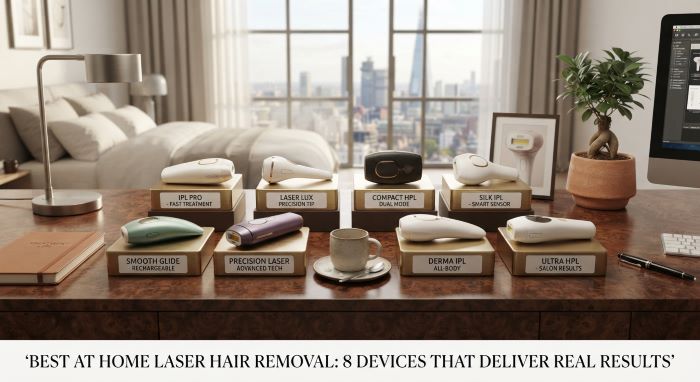
Laser versus IPL: what you are really buying
Most devices sold as “laser” hair removal are actually IPL, or intense pulsed light. The difference matters.
- Diode laser: Uses a single, focused wavelength of light that targets the pigment in the hair follicle precisely. It is closer to what clinics use, but it treats a small area per pulse, so sessions take longer.
- IPL: Uses a broad spectrum of light spread over a larger window. It is less concentrated than a laser, but it covers more skin per flash, making sessions much faster.
Both work on the same principle. The light is absorbed by the melanin in dark hair, turns to heat, and damages the follicle so it grows back finer and slower over time. For most people shopping for the best at home laser hair removal, IPL offers the best balance of speed and results, while a true diode laser offers more precision for smaller areas.
Who these devices work for
This is the most important section of the guide. At-home light-based hair removal works best when there is strong contrast between hair color and skin tone.
- Best results: Light to medium skin with dark brown or black hair.
- Limited results: Blonde, red, gray, or white hair, since there is little pigment for the light to target.
- Use caution or avoid: Darker skin tones, since the skin’s own melanin can absorb the light and cause burns or pigment changes.
Most devices are rated for Fitzpatrick skin types I through IV or V, and many include a skin tone sensor that blocks flashes on skin that is too dark. Always check the manufacturer’s skin tone chart before you buy. If your skin or hair falls outside the recommended range, a professional clinic with lasers designed for darker skin is the safer choice.
The 8 best at home laser hair removal devices
Prices are approximate and change often with sales.
1. Tria Hair Removal Laser 4X (about 450 to 600 dollars)
The Tria 4X is the standout for anyone who wants a true laser rather than IPL. It uses an 810nm diode laser, the same type of wavelength used in many professional clinics, and it is FDA-cleared for permanent hair reduction. Five intensity levels let you adjust to your comfort, and a built-in sensor checks your skin tone before firing.
Because it uses a focused laser, the treatment window is small, so full legs take much longer than with IPL. Many users find it works best for smaller areas like the underarms, bikini line, and upper lip.
Pros: True diode laser, clinic-like precision, FDA-cleared, strong long-term results.
Cons: Slow for large areas, can feel more intense, suitable for light to medium skin only.
Best for: Precision treatment of smaller areas by people with light to medium skin and dark hair.
2. Braun Silk-expert Pro 5 (about 400 to 500 dollars)
The Braun Silk-expert Pro 5 is one of the most trusted IPL devices on the market. Its SensoAdapt skin sensor reads your skin tone continuously and adjusts the light intensity automatically, which adds a layer of safety and makes it easy to use. It offers 400,000 flashes, ten intensity levels, and a gentle mode for sensitive areas.
It is known for fast, visible results, often within a few weeks of consistent use, and it comes with accessories like a precision head and a razor for prep.
Pros: Automatic skin tone sensor, fast results, trusted brand, long flash life.
Cons: Not effective on light hair, higher price, suitable for light to medium skin.
Best for: Anyone who wants a reliable, easy IPL device with built-in safety features.
3. Ulike Air 10 (about 300 to 450 dollars)
The Ulike Air 10 has become a favorite thanks to its Sapphire Ice Cooling technology, which chills the skin as you flash and makes treatments far more comfortable. That matters, since IPL can sting on sensitive areas. It also offers an auto-glide mode for quick coverage, a SmartSkin sensor that adjusts intensity, and unlimited flashes.
It is FDA-cleared and one of the fastest devices for full-body sessions, which makes it popular for legs and arms.
Pros: Cooling makes treatment nearly painless, fast full-body sessions, unlimited flashes.
Cons: Works best on light to medium skin and dark hair, like most IPL devices.
Best for: People who are sensitive to discomfort or want quick full-body treatments.
4. Philips Lumea 9000 Series (about 400 to 550 dollars)
Philips was one of the first major brands in home IPL, and the Lumea line remains a strong performer. The 9000 series includes curved attachments designed for different body areas, such as the face, underarms, bikini, and legs, so the light fits each contour better. A SmartSkin sensor recommends the right intensity, and a companion app guides you through a treatment schedule.
The app coaching helps with consistency, which is often the biggest factor in success.
Pros: Body-specific attachments, app guidance, skin sensor, established brand.
Cons: Higher price, attachments add bulk, not for light hair or dark skin.
Best for: Users who want tailored attachments for different body areas and app reminders.
5. SmoothSkin Pure Adapt (about 300 to 400 dollars)
The SmoothSkin Pure Adapt uses a smart sensor that analyzes your skin and hair and automatically adjusts the energy level with every flash. It offers unlimited flashes, ten customizable settings, and an adaptive head that follows the contours of your body. Comfort modes let you choose a gentler experience.
It is FDA-cleared and a good middle ground between price and features.
Pros: Adaptive sensor, unlimited flashes, comfort settings, contour-friendly head.
Cons: Still limited to light to medium skin and darker hair.
Best for: Buyers who want automatic adjustment and solid performance at a moderate price.
6. Nood The Flasher 2.0 (about 200 to 300 dollars)
Nood’s Flasher 2.0 is built for speed and value. It has a large treatment window and a high-intensity lamp that is especially effective on coarse, dark hair. Sessions can be as quick as ten minutes, and the device offers 600,000 flashes, which lasts for years.
It lacks some of the sensor sophistication of pricier devices, so it pays to read the skin tone guidance carefully.
Pros: Affordable, large window for fast sessions, strong on coarse hair.
Cons: Fewer smart features, best for fair to light brown skin.
Best for: Budget-conscious buyers with coarse, dark hair.
7. Silk’n Infinity Fast (about 300 to 400 dollars)
The Silk’n Infinity Fast uses eHPL, a form of pulsed light combined with galvanic energy that the brand says helps the light penetrate more effectively. It offers five intensity settings and 600,000 pulses in a compact, easy-to-hold design, and it claims faster treatments than earlier models.
Silk’n has a long track record in home hair removal, and this model is a solid all-rounder.
Pros: Established brand, long pulse life, compact design.
Cons: Not effective on light hair, best on light to light brown skin.
Best for: Users who want a proven brand in a compact, fast device.
8. Iluminage Touch (about 300 to 450 dollars)
Most IPL devices struggle with lighter hair, but the Iluminage Touch combines IPL with radio frequency energy, which helps it work on a broader range of hair colors, including some dark blonde and red hair. The brand also rates it for a wider range of skin tones than many competitors.
It offers unlimited pulses and three energy levels. Results can be slower on light hair, but it gives more people an at-home option.
Pros: Works on more hair colors, broader skin tone range, unlimited pulses.
Cons: Slower results, fewer intensity levels, still not effective on white or gray hair.
Best for: People with lighter hair who get little from standard IPL devices.
Quick comparison table
| Device | Type | Approx. price | Standout feature | Best for |
|---|---|---|---|---|
| Tria 4X | Diode laser | 450 to 600 dollars | Clinic-style laser | Small areas, precision |
| Braun Silk-expert Pro 5 | IPL | 400 to 500 dollars | Auto skin sensor | Reliable all-rounder |
| Ulike Air 10 | IPL | 300 to 450 dollars | Ice cooling | Comfort, full body |
| Philips Lumea 9000 | IPL | 400 to 550 dollars | Body attachments, app | Tailored treatment |
| SmoothSkin Pure Adapt | IPL | 300 to 400 dollars | Adaptive energy | Mid-price value |
| Nood Flasher 2.0 | IPL | 200 to 300 dollars | Large window | Budget, coarse hair |
| Silk’n Infinity Fast | eHPL | 300 to 400 dollars | Galvanic boost | Compact, proven brand |
| Iluminage Touch | IPL + RF | 300 to 450 dollars | Works on lighter hair | Blonde and red hair |
How to use a home device safely
Even the best at home laser hair removal device needs careful use. Follow these steps for safer, better results:
- Patch test first. Try a small area and wait 24 to 48 hours to check for a reaction.
- Shave before each session. Hair above the skin absorbs light and can burn the surface. Never wax or pluck, since the root must stay in place.
- Start on a low setting. Increase intensity gradually as your skin tolerates it.
- Avoid sun exposure. Do not treat tanned or sunburned skin, and use sunscreen on treated areas.
- Protect your eyes. Never flash near the eyes, and follow the device’s eye safety guidance.
- Skip certain areas. Avoid tattoos, dark moles, and broken skin.
- Follow the schedule. Most devices call for weekly sessions for the first two to three months, then touch-ups.
Consistency matters more than intensity. Skipping sessions resets progress, since hair grows in cycles and the light only affects follicles in the active growth phase.
Which body areas work best
Not every area responds the same way. Legs, underarms, and the bikini line usually respond well because the hair there tends to be dark and coarse. Arms and chest also work for many users. The face is trickier. Many devices are cleared for use below the cheekbones, such as the upper lip and chin, but never near the eyes. Hormonal facial hair can also be stubborn and may need longer treatment.
When comparing the best at home laser hair removal devices, check which areas each one is approved for. Models with a precision attachment, like the Braun and Philips options, make the face and bikini line easier to treat safely. Larger treatment windows speed up legs and back, but they are harder to control on small, curved areas.
Cost compared with clinic treatments
A full course of professional laser for one area, such as the legs, often runs from several hundred to well over a thousand dollars, and treating multiple areas multiplies that cost. The best at home laser hair removal devices cost a few hundred dollars once and can treat your whole body, often for years. For many people, that price gap is the biggest reason to go the at-home route, as long as their skin tone and hair color fit the device.
What results to expect
At-home devices reduce hair rather than remove it all forever. Most people notice finer, sparser regrowth after four to six sessions, with the best results after about twelve weeks of consistent use. Hair that grows back tends to be lighter and thinner. You will usually need occasional touch-up sessions to maintain results, since hormones and new follicles can bring some regrowth over time.
If you want faster, more complete results, or your skin or hair type falls outside what home devices handle, professional treatment is worth considering. This guide to finding Laser Hair Removal Near Me explains how to choose a reputable provider and what a clinic session involves.
Caring for the hair you keep
Removing body hair is one part of a grooming routine, and the hair on your head deserves attention too. Heat styling, humidity, and harsh products can leave it dry and hard to manage. If you have curls, the right products make a real difference, and this guide to the Best Shampoo and Conditioner for Curly Hair covers formulas that hydrate without weighing curls down. For anyone fighting flyaways, these tips on How to Fix Frizzy Hair help you keep hair smooth and healthy while you work on the rest of your routine.
Common mistakes to avoid
People often get poor results from the best at home laser hair removal devices because of simple errors. Watch out for these:
- Buying a device that does not match your skin and hair. Check the chart first.
- Waxing or plucking between sessions. This removes the root the light needs to target.
- Treating tanned skin. It raises the risk of burns and pigment changes.
- Giving up too early. Results take weeks, not days.
- Cranking intensity too fast. Higher settings are not always better and can irritate skin.
The bottom line
At-home hair removal has come a long way, and the right device can save you hours of shaving and hundreds of dollars in clinic fees. The best at home laser hair removal pick for precision is the Tria 4X, a true diode laser. For most people, IPL devices like the Braun Silk-expert Pro 5, Ulike Air 10, and Philips Lumea offer faster sessions and excellent results. Budget buyers can look at the Nood Flasher 2.0, and those with lighter hair should consider the Iluminage Touch. Match the device to your skin tone and hair color, use it consistently, and follow safety steps closely. Do that, and smoother skin with far less effort is well within reach.
Key Takeaways
- Most at-home “laser” devices are actually IPL; the Tria 4X is a true diode laser that offers more precision but slower sessions.
- These devices work best on light to medium skin with dark hair, and they are less effective on blonde, red, gray, or white hair.
- People with darker skin tones should check device ratings carefully or choose a professional clinic to avoid burns and pigment changes.
- Top IPL picks include the Braun Silk-expert Pro 5, Ulike Air 10, Philips Lumea 9000, and SmoothSkin Pure Adapt.
- The Nood Flasher 2.0 suits budget buyers with coarse hair, while the Iluminage Touch works on a wider range of hair colors.
- Patch test, shave before sessions, start on low settings, avoid tanned skin, and never wax or pluck between treatments.
- Expect gradual hair reduction over about twelve weeks with occasional touch-ups, not instant or total permanent removal.