Top-Rated CRM Platforms for Small Business: The 2026 Buyer’s Guide
Running a small business means wearing every hat at once, and customer relationships are easy to let slip through the cracks. A good customer relationship management tool fixes that by keeping every contact, deal, and follow-up in one place. But the market is crowded and the pricing pages are confusing. This guide cuts through the noise and walks through the top-rated CRM platforms for small business, what each does best, and how to pick the right one without overpaying.
What to look for first
Before comparing names, get clear on your own needs. The top-rated CRM platforms for small business all cover the basics, so the real question is which extras you actually need. Ask yourself a few things:
- How many people will use it, and what is your monthly budget per user?
- Do you mainly need sales pipeline tracking, or marketing and support tools too?
- How comfortable is your team with software, and how much setup are you willing to do?
- Which tools do you already use, like email, invoicing, or calendars, that it must connect to?
Answer those and the field narrows fast.
HubSpot: best free tier and all-rounder
HubSpot is one of the most popular of the top-rated CRM platforms for small business, and its free plan is the main reason. You get unlimited contacts, deal tracking, and email integration at no cost, which is generous compared with rivals. Paid plans start around fifteen to twenty dollars per user per month.
One thing to understand is HubSpot’s structure. It splits features into separate “Hubs” for marketing, sales, and service, so combining several can push your bill higher than the headline price. Still, it is often cheaper than buying separate tools, and the interface is clean and beginner-friendly.
Zoho CRM: best for customization on a budget
Zoho gives small teams a level of customization usually reserved for enterprise software. It is free for up to three users, with paid plans starting around fourteen dollars per user per month. You get custom workflows, custom fields, multi-channel communication, and an AI assistant called Zia for lead predictions.
Among the top-rated CRM platforms for small business, Zoho stands out when your sales process does not fit standard templates. The trade-off is a steeper learning curve. The interface can feel busy at first, but for teams with specific needs, it bends where others will not.
Pipedrive: best for pure sales pipelines
If your focus is closing deals rather than marketing, Pipedrive is built for you. It is affordable, with entry plans in the low teens per user per month, and its visual pipeline makes it obvious what stage every deal is in. It is one of the most sales-focused of the top-rated CRM platforms for small business.
Pipedrive keeps things simple and easy to learn, which suits small sales teams that want to get moving quickly. It is less suited to businesses that need heavy marketing automation or complex reporting, so match it to a sales-first workflow.
Salesforce: best for growth and complexity
Salesforce is the dominant name in the industry, holding the largest share of the global CRM market. Its Starter Suite begins around twenty-five dollars per user per month, with the Pro Suite around one hundred dollars per user per month for automation tools like Flow Builder.
It earns a place among the top-rated CRM platforms for small business because of its depth and its huge library of add-ons. The catch is complexity. Salesforce offers more power than most small teams need at first, and the learning curve is steep. It makes the most sense if you expect to scale quickly and want a platform that will grow with you for years.
Other strong options
A few more names are worth a look depending on your niche:
- monday CRM starts around twelve dollars per user per month (with a three-seat minimum) and offers a colorful, visual work platform that goes beyond CRM.
- HoneyBook prices per account rather than per user, around twenty-nine dollars per month, and bundles client management, contracts, scheduling, and payments. It is a favorite among freelancers and service businesses.
- Insightly combines CRM with project management, which helps teams that manage both the sale and the delivery of the work.
Quick comparison
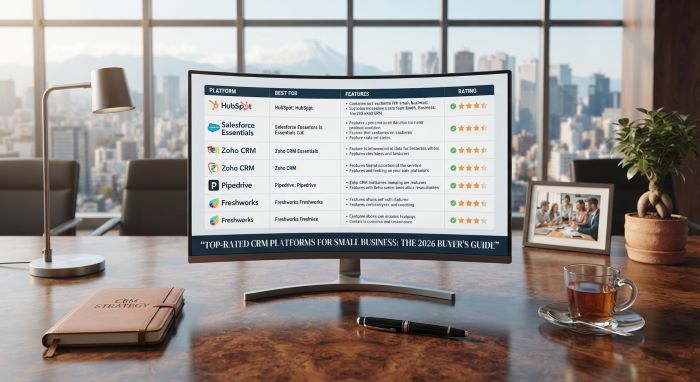
Here is a snapshot of the top-rated CRM platforms for small business to help you compare at a glance. Prices are approximate starting points and change over time.
| Platform | Starting price | Best for |
|---|---|---|
| HubSpot | Free, paid from about $15/user/mo | All-around use and a strong free tier |
| Zoho CRM | Free up to 3 users, from about $14/user/mo | Customization on a budget |
| Pipedrive | From about $12 to $15/user/mo | Simple sales pipelines |
| Salesforce | From about $25/user/mo | Scaling and complex needs |
| monday CRM | From about $12/user/mo | Visual work management |
| HoneyBook | About $29/mo flat | Freelancers and service businesses |
How to choose the right one
With the field narrowed, let the free trials do the work. Nearly all of the top-rated CRM platforms for small business offer a free plan or trial, so shortlist two or three and actually load in your real contacts and deals.
Pay attention to hidden costs. Many platforms lock the feature you truly need behind a higher tier, so read the pricing pages carefully and budget for the plan that includes what you require, not just the cheapest one. Also confirm it connects to the tools you already rely on.
The bottom line
There is no single winner, only the best fit for your situation. HubSpot suits most small teams thanks to its free tier, Zoho rewards those who want customization, Pipedrive keeps sales simple, and Salesforce scales for the long haul. The top-rated CRM platforms for small business all share solid core features, so pick based on your budget, your process, and the tools you already use. Try a couple, trust your daily experience, and commit to the one that makes your team’s work easier.
Key Takeaways
- The top-rated CRM platforms for small business all cover core features, so choose based on your budget, team size, and whether you need sales, marketing, or support tools.
- HubSpot is the strongest all-rounder, with a generous free tier (unlimited contacts, deal tracking, email) and paid plans from around $15 per user per month.
- Zoho CRM offers deep customization at a low price, free for up to three users, making it ideal for non-standard sales processes.
- Pipedrive is the pick for simple, visual sales pipelines and small sales-first teams, though it is light on marketing automation.
- Salesforce leads the market in power and add-ons and scales well, but it is complex and better suited to businesses expecting fast growth.
- Other strong options include monday CRM for visual work management and HoneyBook, a flat-rate favorite among freelancers and service businesses.
- Use free trials with your real data, watch for features locked behind higher tiers, and confirm the tool connects to software you already use.