
Difference Between Subsidized and Unsubsidized Loans
If you’re filling out the FAFSA or reading a college aid offer, you’ve probably seen two loan types listed side by side: Direct Subsidized and Direct Unsubsidized. They sound alike, and they come from the same federal program, but the way they handle interest can change how much you owe by thousands of dollars.
This guide breaks down the difference between subsidized and unsubsidized loans, how each one works, the latest interest rates and limits, and how new rules that started in July 2026 affect borrowers.
The Short Answer
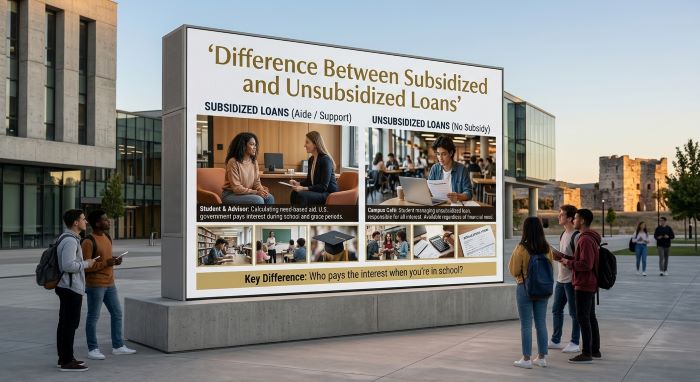
The main difference between subsidized and unsubsidized loans is who pays the interest while you’re in school.
- Subsidized loans: The US Department of Education pays the interest while you’re enrolled at least half time, during your six month grace period, and during approved deferment.
- Unsubsidized loans: Interest starts adding up as soon as the money is paid out, and you’re responsible for all of it.
Subsidized loans are also need based and available only to undergraduates. Unsubsidized loans are available to undergraduates and graduate students, whether or not they show financial need.
Federal Student Loans Basics
Both loan types are part of the William D. Ford Federal Direct Loan Program, the largest source of federal student loans in the United States. You apply for them by filing the Free Application for Federal Student Aid (FAFSA). Your school then decides how much you can borrow and which type you qualify for.
Compared with most private loans, federal student loans offer:
- Fixed interest rates set by law
- No credit check for Direct Subsidized and Unsubsidized Loans
- Flexible repayment options, including income driven plans
- Deferment and forbearance options
- Access to forgiveness programs, such as Public Service Loan Forgiveness
Unlike a car loan or mortgage, these loans have no collateral. If you want to understand how that compares with other borrowing, see Which Best Describes the Difference Between Secured and Unsecured Loan?
Subsidized vs Unsubsidized Loans at a Glance
Here’s a side by side look at both loan types for the 2026 to 2027 school year:
| Feature | Direct Subsidized Loan | Direct Unsubsidized Loan |
|---|---|---|
| Who can get it | Undergraduates only | Undergraduates, graduate, and professional students |
| Based on financial need? | Yes | No |
| Interest while in school | Paid by the government | You owe it |
| Interest during grace period | Paid by the government | You owe it |
| Interest during deferment | Paid by the government | You owe it |
| 2026 to 2027 interest rate | 6.52% fixed (undergraduates) | 6.52% undergraduates, 8.07% graduate students |
| Credit check | No | No |
| Origination fee | About 1.057% | About 1.057% |
How Interest Works on Each Loan
Interest is where the real difference between subsidized and unsubsidized loans shows up, and it’s the main reason people compare subsidized vs unsubsidized loans so closely.
Subsidized Loans
With a subsidized loan, the government covers interest during certain periods. If you borrow $3,500 as a freshman and stay in school for four years, you’ll still owe about $3,500 when repayment begins. Interest only starts to grow after your grace period ends.
Unsubsidized Loans
With an unsubsidized loan, interest begins accruing the day the money is paid out. If you don’t pay it while you’re in school, the unpaid interest may be added to your balance, a process called capitalization, when repayment begins. After that, you pay interest on a larger balance.
Example: Same Amount, Different Cost
To see the difference between subsidized and unsubsidized loans clearly, imagine a first year undergraduate who borrows $3,500 at 6.52% and doesn’t make payments during four years of school plus a six month grace period.
| Loan type | Amount borrowed | Interest built up before repayment | Balance when repayment starts |
|---|---|---|---|
| Subsidized | $3,500 | $0 | About $3,500 |
| Unsubsidized | $3,500 | About $1,030 | About $4,530 |
These numbers are rough estimates using simple interest, but they show the difference between subsidized and unsubsidized loans in real dollars. Over a 10 year repayment period, that extra $1,000 also builds its own interest.
2026 to 2027 Interest Rates
Federal loan rates are set each year based on the 10 year Treasury note auction held in May. For loans first paid out between July 1, 2026, and June 30, 2027, the Department of Education announced these fixed rates:
| Loan type | Borrower | Fixed rate |
|---|---|---|
| Direct Subsidized | Undergraduates | 6.52% |
| Direct Unsubsidized | Undergraduates | 6.52% |
| Direct Unsubsidized | Graduate and professional students | 8.07% |
| Direct PLUS | Parents and graduate students | 9.07% |
Each loan keeps the same rate for its whole life, even if rates change in later years.
How Much Can You Borrow?
Your school sets your exact amount, but federal law caps how much you can take. For undergraduates, the limits combine both loan types.
Dependent Undergraduates
| Year | Total annual limit | Maximum subsidized portion |
|---|---|---|
| First year | $5,500 | $3,500 |
| Second year | $6,500 | $4,500 |
| Third year and beyond | $7,500 | $5,500 |
| Total over all years | $31,000 | $23,000 |
Independent Undergraduates
Independent students, and dependent students whose parents can’t get a PLUS loan, can borrow more in unsubsidized loans:
| Year | Total annual limit | Maximum subsidized portion |
|---|---|---|
| First year | $9,500 | $3,500 |
| Second year | $10,500 | $4,500 |
| Third year and beyond | $12,500 | $5,500 |
| Total over all years | $57,500 | $23,000 |
Graduate Students
Graduate students can’t receive subsidized loans. Under new rules that began July 1, 2026, graduate students in most programs can borrow up to $20,500 a year in unsubsidized loans, with a $100,000 total limit. Students in professional programs, such as medicine or law, can borrow up to $50,000 a year, with a $200,000 total limit, according to Harvard’s student financial services office. Some current students may keep older limits for a limited time.
What Changed in July 2026
The One Big Beautiful Bill Act, signed in 2025, made major changes to federal loans starting July 1, 2026:
- Grad PLUS loans are being phased out for new borrowers.
- New graduate limits apply to unsubsidized loans, as shown above.
- Parent PLUS loans are capped at $20,000 per student per year and $65,000 total per student.
- A lifetime limit of $257,500 applies to most federal loans combined, not counting Parent PLUS.
- New repayment plans: New loans made after July 1, 2026, use the Repayment Assistance Plan (RAP), an income driven option, or a new tiered standard plan.
According to Harvard’s summary, undergraduate subsidized and unsubsidized loan limits did not change. Rules are still being put in place, so check studentaid.gov or your school’s aid office for the latest details.
Who Qualifies for Each Loan?
To get either loan, you generally need to:
- File the FAFSA
- Be enrolled at least half time in an eligible program
- Be a US citizen or eligible noncitizen
- Make satisfactory academic progress
- Not be in default on another federal loan
For a subsidized loan, you must also be an undergraduate with financial need. Your school figures out need by comparing the cost of attendance with your Student Aid Index (SAI) and other aid.
Federal student loans have their own eligibility rules, separate from business programs. If you’re curious how other government loan programs set limits, see Who Is Not Eligible for a PPP Loan.
Which Loan Should You Take First?
Knowing the difference between subsidized and unsubsidized loans helps you choose the right order.
When weighing subsidized vs unsubsidized loans in your aid offer, accept the subsidized loan first. It costs less because the government covers interest during school. Then accept only as much unsubsidized money as you truly need.
A simple order to follow:
- Grants and scholarships (free money)
- Work study
- Direct Subsidized Loans
- Direct Unsubsidized Loans
- Parent PLUS Loans or private loans, only if needed
Tips for Managing Unsubsidized Interest
If you have unsubsidized loans, you can reduce what you owe:
- Pay interest while in school. Even small monthly payments can stop interest from capitalizing.
- Borrow only what you need. You can decline or reduce loan amounts in your aid offer.
- Make payments during the grace period. This keeps your balance from growing.
- Sign up for autopay. Federal loan servicers often offer a small rate discount for automatic payments.
The Risks of Borrowing Too Much
Student loans can help you earn a degree, but too much debt can strain your budget for years. High monthly payments can make it harder to save, buy a home, or handle emergencies. To learn more about the downsides of debt, read 5 Ways a Loan Can Hurt Your Personal Finances.
Before you accept any loan, estimate your future monthly payment and compare it with the salary you expect in your field. A common rule is to keep total student debt below your expected first year salary.
Repayment Basics
Both loan types have a six month grace period after you graduate, leave school, or drop below half time enrollment. After that, repayment begins.
| Repayment stage | Subsidized loan | Unsubsidized loan |
|---|---|---|
| While in school | No payments; no interest added | No payments required; interest builds |
| Grace period | No interest added | Interest builds |
| Repayment | Interest begins | Interest continues |
| Deferment | Interest usually paid by the government | Interest builds |
If you struggle with payments, contact your loan servicer right away to ask about income driven plans, deferment, or forbearance.
Common Myths
- “Unsubsidized loans are bad.” Not true. They still have fixed rates, no credit check, and strong protections. They just cost more over time.
- “Graduate students can get subsidized loans.” Not anymore. Graduate students lost access to subsidized loans in 2012.
- “You don’t have to pay back subsidized loans.” You do. The government only covers interest during certain periods.
Frequently Asked Questions
What is the main difference between subsidized and unsubsidized loans? Subsidized loans don’t build interest while you’re in school or during your grace period, because the government pays it. Unsubsidized loans build interest from day one.
Can I have both loan types at once? Yes. Many undergraduates receive a mix of both in their aid offer.
Are interest rates the same? For undergraduates in 2026 to 2027, both loans carry a 6.52% fixed rate. Graduate unsubsidized loans carry 8.07%.
Do I need good credit? No. Neither loan requires a credit check.
Is this financial advice? This guide is general information, not financial advice. Talk to your school’s financial aid office about your situation.
Final Thoughts
Understanding the difference between subsidized and unsubsidized loans can save you real money. Subsidized loans are the better deal because the government covers interest while you study. Unsubsidized loans fill the gap but cost more over time. Borrow wisely, accept subsidized money first, and keep an eye on the new rules that took effect in July 2026.
Key Takeaways
- The key difference between subsidized and unsubsidized loans is who pays the interest during school.
- Subsidized loans are need based and only for undergraduates; the government pays interest while you study.
- Unsubsidized loans are open to all students and build interest from the day they’re paid out.
- For 2026 to 2027, undergraduate rates are 6.52% and graduate unsubsidized rates are 8.07%.
- Dependent undergraduates can borrow up to $31,000 total, with no more than $23,000 subsidized.
- New July 2026 rules phase out Grad PLUS for new borrowers and set new graduate limits.
- Accept subsidized loans first, then borrow only what you need in unsubsidized loans.