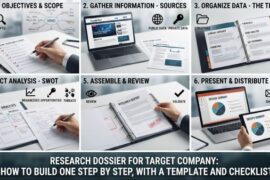
Dossier Target Company: How to Build a Complete Company Profile
Whether you are pursuing an acquisition, preparing for a major sales pitch, evaluating an investment, or sizing up a competitor, knowledge is leverage, and a well-built company dossier is how you capture that knowledge. A dossier on a target company is a comprehensive, organized profile that pulls together everything you need to know about an organization: its business, finances, people, market position, and more. Done well, it turns scattered information into a clear picture that informs smart decisions. Done poorly, or not at all, it leaves you negotiating and deciding in the dark. This guide explains how to build a thorough dossier target company profile, what to include, where to find the information, and how to use it effectively.
What Is a Company Dossier?
A dossier target company profile is a structured collection of information and analysis about a specific organization, compiled for a strategic purpose. The word “dossier” simply means a detailed file on a particular subject, and in a business context, a dossier on a target company gathers the key facts and insights about that company into one organized document.
The term “target company” comes largely from the world of mergers and acquisitions, where the target is the company being considered for purchase. But the concept applies far more broadly. This kind of profile is equally valuable for:
- Mergers and acquisitions, evaluating a company you might buy.
- Sales and business development, researching a prospect before a pitch or negotiation.
- Investment analysis, assessing a company you might invest in.
- Competitive intelligence, understanding a rival’s strengths, weaknesses, and strategy.
- Partnerships, vetting a potential business partner.
In each case, the goal is the same: to compile a clear, comprehensive understanding of the target so you can make informed decisions and act from a position of knowledge rather than guesswork.
Why a Company Dossier Matters
Before diving into how to build one, it is worth understanding why a dossier target company profile is so valuable. Information asymmetry, one side knowing more than the other, is a decisive advantage in any deal or negotiation. A thorough dossier tilts that asymmetry in your favor.
A good one helps you identify risks and red flags before you commit, understand the target’s true value and position rather than its marketing spin, tailor your approach to the target’s specific situation and needs, anticipate objections and negotiate more effectively, and make confident, evidence-based decisions. Whether you are buying a company, selling to it, investing in it, or competing with it, entering the situation with a deep, organized understanding of the target is a genuine competitive edge. That is why building a proper dossier target company profile is time well spent.
What to Include in the Dossier
A comprehensive profile covers several key areas. Here is what to include:
Company Overview and Basics
Start with the fundamentals: the company’s legal name, headquarters, locations, founding date, ownership structure (public, private, subsidiary), size (employees, revenue if known), and a clear description of what the company actually does. This foundational section frames everything else.
Business Model and Operations
Detail how the company makes money: its products and services, its revenue streams, its business model, its key customers and markets, and its operational footprint. Understanding how the target actually generates value is central to any dossier target company analysis.
Financial Information
For any serious dossier, financial data is critical. Include revenue, profitability, growth trends, funding history, and financial health where available. For public companies, this information is abundant through filings; for private companies, it is harder to find but partial information can often be pieced together. Financial understanding underpins nearly every use of a dossier target company profile.
Leadership and Key People
Profile the leadership team and key decision-makers: executives, board members, founders, and other influential figures. Understanding who runs the company, their backgrounds, and their priorities is invaluable, especially for sales and negotiation, where knowing the decision-makers shapes your approach.
Market Position and Competition
Analyze where the target sits in its market: its market share, its main competitors, its competitive advantages and weaknesses, and industry trends affecting it. A dossier target company profile should place the company in its competitive context, not treat it in isolation.
Recent News and Developments
Include recent news, announcements, product launches, leadership changes, funding rounds, acquisitions, and other developments. Current events reveal the company’s trajectory, priorities, and any pressures it is facing, which is essential context.
Strengths, Weaknesses, and Risks
Synthesize your research into an assessment of the target’s strengths, weaknesses, opportunities, and risks. This analytical layer transforms raw information into actionable insight, which is the whole point of a dossier target company exercise.
Purpose-Specific Information
Finally, include information specific to your goal. For an acquisition, that means valuation and integration considerations. For sales, it means pain points and buying signals. For competitive intelligence, it means strategic vulnerabilities. Tailor the dossier to what you actually need it to do.
Where to Find the Information
Building the profile requires gathering information from many sources. Here is where to look:
The company’s own website, for its self-description, products, leadership, news, and messaging. Always a starting point, though remember it reflects the company’s own framing.
Public filings and regulatory sources, for public companies especially, which must disclose extensive financial and operational information. These are gold-standard sources for accurate data.
Business information databases, which compile company profiles, financials, and details, some free and some subscription-based.
News and media coverage, for recent developments, context, and outside perspectives on the company.
Professional networking platforms, for information on leadership, employees, and organizational structure.
Industry reports and analysis, for market context, competitive positioning, and trends.
Customer and employee reviews, which can reveal insights about the company’s products, culture, and reputation.
Social media and company communications, for current messaging, priorities, and public posture.
The key is triangulating across multiple sources rather than relying on any single one, since each has its own biases and gaps. A strong dossier target company profile synthesizes many sources into a coherent, verified picture.
How to Structure Your Dossier
Organization matters, since a dossier is only useful if you can find and use its information quickly. A well-structured dossier target company profile typically follows a logical flow:
- Executive summary, a concise overview of the key findings and takeaways, so a busy reader gets the essentials immediately.
- Company overview, the foundational facts.
- Business and operations, how the company works.
- Financials, the numbers.
- Leadership and people, who runs it.
- Market and competition, where it stands.
- Recent developments, what is happening now.
- Analysis and assessment, your synthesized insights, risks, and recommendations.
- Sources and appendix, supporting documentation and references.
Leading with an executive summary is especially valuable, since decision-makers often need the key points fast. The detailed sections then support and expand on that summary for those who need to dig deeper.
Best Practices for a Strong Dossier
To make your dossier target company profile genuinely useful, follow these best practices:
Verify your information. Cross-check facts across multiple sources, since inaccurate information leads to bad decisions. Reliability is paramount.
Cite your sources. Note where information comes from, both for credibility and so you can reassess if a source proves unreliable.
Distinguish fact from analysis. Clearly separate verified facts from your own interpretations and assessments, so readers know what is established versus inferred.
Keep it current. Company information changes constantly, so a dossier target company profile has a shelf life. Update it before important decisions and note when the information was gathered.
Focus on relevance. Include what serves your purpose rather than every fact you can find. A focused, relevant dossier is more useful than an exhaustive but unwieldy one.
Stay objective. Resist the temptation to see what you want to see. An honest assessment, including inconvenient findings, is far more valuable than a rosy one.
Respect legal and ethical boundaries. Gather information through legitimate, ethical means and respect privacy and legal limits. A dossier built on proper research is both more defensible and more reliable.
Using the Dossier Effectively
A dossier target company profile is only valuable if you actually use it. Reference it throughout your engagement with the target, whether that is a negotiation, a sales process, due diligence, or competitive strategy. Use it to prepare for meetings, anticipate the other side’s position, identify the right approach, and make evidence-based decisions. Share relevant portions with your team so everyone operates from the same understanding. And update it as new information emerges, keeping it a living document rather than a one-time report.
The most effective users treat the dossier as an ongoing intelligence asset, not a box-ticking exercise, continually refining their understanding of the target as the relationship or deal develops.
The bottom line on building a dossier target company profile is that it transforms scattered information into organized, actionable intelligence that gives you a genuine edge in acquisitions, sales, investments, and competitive strategy. Cover the key areas, from company basics and financials to leadership, market position, and risk assessment; gather information from many sources and verify it; structure it clearly with an executive summary up front; and keep it current, objective, and relevant. Do that, and your dossier becomes a powerful tool for making confident, informed decisions about any target company.
Common Mistakes to Avoid
Even experienced professionals make errors when compiling one of these profiles, and knowing the common pitfalls helps you avoid them.
Relying on a single source. Drawing your whole picture from one source, especially the company’s own website or marketing, gives you a distorted, self-serving view. Always triangulate across multiple independent sources.
Confusing volume with value. A dossier stuffed with every available fact is not better than a focused one. Padding the profile with irrelevant detail buries the insights that actually matter and wastes the reader’s time.
Mistaking marketing for reality. Companies present themselves in the best possible light. Treat their self-descriptions as claims to verify, not facts to accept, and look for independent evidence of what they actually do and how they actually perform.
Letting it go stale. Company information changes constantly through leadership shifts, new products, funding, and market moves. A profile compiled months ago and never updated can lead you badly astray.
Confirmation bias. If you approach the research hoping to justify a decision you have already made, you will find what you want and miss what you need. Stay genuinely open to what the evidence shows, including inconvenient findings.
Tailoring the Dossier to Your Goal
The most effective profile is shaped by its purpose, since different goals demand different emphases. For an acquisition, the focus falls on valuation, financial health, liabilities, cultural fit, and integration challenges, since you are evaluating whether and how to absorb the company. For a sales pursuit, the emphasis shifts to the target’s pain points, priorities, decision-makers, budget cycles, and buying signals, since you are trying to win their business. For competitive intelligence, you concentrate on the rival’s strategy, strengths, weaknesses, and vulnerabilities, since you are looking to outmaneuver them. And for an investment, you weigh growth potential, financial trajectory, market position, and risk.
Recognizing which of these purposes drives your research keeps the profile focused and genuinely useful. A generic, one-size-fits-all file rarely serves any specific goal well, while a purpose-built one becomes a sharp, decision-ready tool. Before you begin gathering information, define clearly what decision the dossier needs to support, and let that decision guide what you prioritize, what you dig into deeply, and what you can safely leave out.
Keeping the Dossier Secure and Ethical
A final consideration that is easy to overlook is how you handle the dossier itself once it exists. A well-built profile on a target company often contains sensitive competitive information, so treat it with appropriate care. Store it securely, share it only with those who genuinely need it, and be mindful of confidentiality obligations, especially in acquisition or partnership contexts where non-disclosure agreements may govern what you can gather and how you can use it.
Equally important is how you gather the information in the first place. Rely on legitimate, publicly available sources and ethical research methods rather than deception, misrepresentation, or anything that crosses legal lines. Beyond being the right thing to do, information gathered ethically is more reliable and more defensible if your dossier’s findings are ever scrutinized. A profile built on sound, ethical research is one you can act on with confidence, while one built on questionable methods introduces both legal risk and doubt about the accuracy of what you have compiled.
Key Takeaways
- A dossier target company profile is a structured, comprehensive file compiling key information and analysis about a specific organization.
- Though rooted in M&A, it is equally valuable for sales, investment analysis, competitive intelligence, and partnerships.
- A good dossier reduces information asymmetry, helping you spot risks, understand true value, and negotiate from strength.
- Include company basics, business model, financials, leadership, market position, recent developments, and a strengths-and-risks assessment.
- Gather information from the company’s site, public filings, databases, news, networking platforms, and industry reports, triangulating across sources.
- Structure it logically with an executive summary first, followed by detailed sections and a sources appendix.
- Verify information, cite sources, separate fact from analysis, stay objective, keep it current, and respect legal and ethical limits.
- Use the dossier as a living intelligence asset throughout your engagement, updating it as new information emerges.