Research Dossier for Target Company
Before you buy a business, pitch a major account, invest in a stock, or walk into a final job interview, you need to know the company on the other side of the table. A research dossier for target company analysis puts that knowledge in one place. It is a structured file that covers what the company does, how it makes money, who runs it, where it stands in its market, and what could go wrong.
Good dossiers save time and prevent costly mistakes. Bad ones are data dumps that nobody reads. This guide shows you how to build one that people will use. It covers the sections to include, the best sources, a step-by-step process, a template, and a checklist.
What Is a Company Research Dossier?
A dossier is an organized collection of facts and analysis about one subject. In business, the subject is a company you plan to deal with, often called the target. The file can run from two pages to more than fifty, based on the stakes.
A strong dossier does three things.
- It gathers facts. Ownership, finances, products, customers, and people.
- It checks them. Each claim links to a source and a date.
- It interprets them. It ends with a clear view of what the facts mean for your decision.
That last point matters most. A list of facts is a profile. A dossier adds judgment.
Who Uses One and Why
| Use Case | Main Goal | Depth | Sections That Matter Most |
|---|---|---|---|
| Mergers and acquisitions | Decide whether to pursue a deal and at what price | Very deep | Financials, ownership, legal risks, strategic fit |
| B2B sales and account planning | Win or grow a key account | Medium | Business priorities, decision makers, buying triggers |
| Investing | Decide whether to buy, hold, or sell | Deep | Financials, valuation, competitive position, risks |
| Competitive intelligence | Understand a rival | Medium to deep | Products, pricing, strategy, hiring signals |
| Partnerships and vendor review | Judge reliability and fit | Medium | Financial health, reputation, compliance |
| Job search and interviews | Stand out as a candidate and judge the employer | Light | Business model, news, culture, leadership |
| Journalism and academic work | Report or study accurately | Varies | History, ownership, controversies |
The same skeleton works for all of them. What changes is the depth and the emphasis.
Core Sections of a Strong Dossier
Each Dossier Target Company file should cover the ten areas below. Scale each one to your purpose.
1. Executive Summary
Write this last, and put it first. In one page or less, state who the company is, the three to five facts that matter most, the main risks, and your recommendation or next step. Many readers will stop here, so make it count.
2. Company Snapshot
Give the basics in a short table: legal name, trade names, year founded, headquarters, other locations, number of employees, legal structure, public or private status, ticker symbol if any, website, and industry codes.
3. Business Model, Products, and Customers
Explain how the company makes money. List its main products or services and the share of revenue each brings, if known. Describe its customers, sales channels, pricing approach, and key suppliers. Note any heavy reliance on a single customer or supplier.
4. Market and Industry
Describe the market the company serves. Cover market size, growth rate, main trends, rules and regulations, and where the industry sits in its cycle. Use more than one source for market size, since estimates vary widely.
5. Competitive Position
Name the main rivals and compare them on size, price, product, and reach. State what sets the company apart. Tools such as a SWOT grid or Porter’s Five Forces can help you organize this section, as long as you fill them with specifics.
6. Financial Profile
Show three to five years of revenue, profit, margins, cash flow, and debt. Add growth rates and a few key ratios. For private firms, give estimates, label them clearly, and explain how you reached them.
7. Leadership and Ownership
List the key executives and board members with short professional backgrounds. Describe who owns the company: founders, family, private equity, venture investors, or public shareholders. Include an organization chart if you can build one.
8. Strategy and Recent Developments
Summarize the stated strategy and the events of the past 12 to 24 months. Include acquisitions, funding rounds, product launches, leadership changes, layoffs, new markets, and major contracts. A timeline works well here.
9. Risks and Red Flags
List what could go wrong. Cover lawsuits, regulatory problems, debt pressure, customer concentration, executive turnover, bad press, security breaches, and supply issues. Rate each one by likelihood and impact.
10. Sources and Open Questions
End with a full source list and a list of what you could not confirm. Open questions tell the reader where to dig next and show honesty about the limits of the file.
Where to Find Reliable Information
| Information Needed | Good Sources | Notes |
|---|---|---|
| Public company financials | SEC EDGAR filings such as the 10-K, 10-Q, 8-K, and proxy statement | Free and audited |
| Strategy and outlook | Annual reports, investor presentations, earnings call transcripts | Company’s own view, so read with care |
| UK and European companies | Companies House and national business registers | Many private firms must file accounts |
| Private company basics | State business registries, company website, press releases | Confirms legal name and status |
| Funding and investors | Crunchbase, PitchBook, press coverage | Paid tools have more depth |
| Leadership backgrounds | LinkedIn, company bios, conference talks | Professional history only |
| News and events | Major business press, trade journals, local news | Check dates and original sources |
| Customer opinion | G2, Capterra, Trustpilot, app store reviews | Look for patterns, not single reviews |
| Employee views | Glassdoor, Indeed | Useful for culture signals, with bias in both directions |
| Hiring direction | The company’s job postings | Reveals priorities and new projects |
| Intellectual property | USPTO and Google Patents | Shows research focus |
| Litigation | Court records such as PACER, news reports | Fees may apply |
| Government contracts | USASpending.gov | For firms that sell to public agencies |
| Web and technology signals | Similarweb, BuiltWith | Estimates, not exact figures |
| Industry context | Trade associations, government statistics, analyst reports | Compare several |
For any research dossier for target company work, start with primary sources. A company’s own filings and registry records beat a secondhand summary.
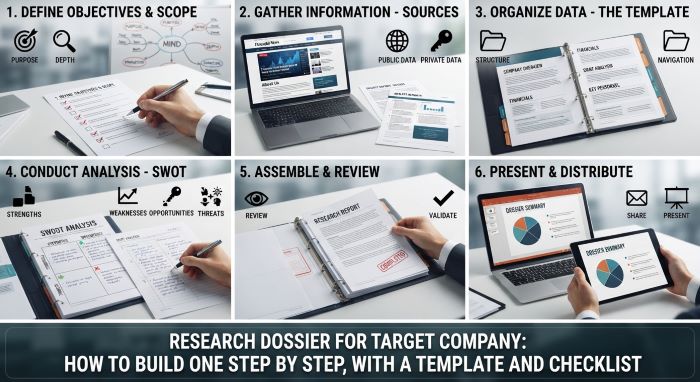
How to Build It: A Step-by-Step Process
- Define the purpose. Write one sentence that states the decision this file will support.
- List your key questions. Five to ten questions keep you focused.
- Set the scope and a deadline. Decide the depth before you start.
- Create the template. Set up the ten sections with empty tables.
- Collect primary sources first. Filings, registry records, and the company’s own materials.
- Add secondary sources. News, databases, reviews, and analyst views.
- Log each source as you go. Record the link and the date you opened it.
- Cross-check key facts. Confirm important numbers with at least two sources.
- Analyze. Turn facts into findings. Ask “so what?” after each one.
- Flag gaps and risks. Say what you do not know.
- Write the executive summary. Lead with the answer.
- Review and update. Have a colleague read it, and set a date to refresh it.
Research Dossier Template
Copy this outline as a starting point.
- Title page: Company name, your name, date, version, and purpose.
- Executive summary: Key facts, main risks, and recommendation.
- Company snapshot: Basic data table.
- History and milestones: Short timeline.
- Business model: Products, customers, channels, and pricing.
- Market overview: Size, growth, trends, and rules.
- Competitors: Comparison table and positioning.
- Financials: Multi-year table, ratios, and notes.
- Leadership and ownership: Bios, board, and cap table summary.
- Strategy and recent news: Timeline of the past two years.
- Risks and red flags: Rated list.
- Opportunities or fit: What this means for your goal.
- Open questions: What still needs an answer.
- Sources: Full list with dates.
A one-page Dossier Target Company summary at the front of this outline helps busy readers who will not open the full file.
Public vs. Private Companies
Public companies must disclose a great deal. You can read audited financials, risk factors, executive pay, and major contracts in their filings. The challenge is volume. Focus on the annual report, the latest quarterly report, the proxy statement, and the most recent earnings call.
Private companies disclose far less. You will need to piece together a picture from indirect signals.
- Funding announcements and investor names
- Headcount trends on professional networks
- Job postings and office openings
- Web traffic and app download estimates
- Customer logos, case studies, and reviews
- Interviews, podcasts, and conference talks by executives
- Registry filings in places that require them
- Import and export records for firms that ship goods
Label every estimate as an estimate, and give a range where you can.
How to Check Your Sources
Not all information deserves equal trust. Rate each source.
| Rating | Meaning | Examples |
|---|---|---|
| High | Primary, official, or audited | Regulatory filings, court records, registry data |
| Medium | Reputable secondary source | Major business press, established databases |
| Low | Unverified or biased | Anonymous posts, single reviews, marketing claims |
Practical habits help.
- Confirm key facts with two independent sources.
- Trace news stories back to the original document.
- Check the date. Old numbers mislead.
- Watch for one press release repeated across many sites. That is one source, not ten.
- Separate facts from opinions and from your own inferences.
- Treat text from AI tools as a lead to verify, never as a source.
Turning Data Into Insight
Collection is the easy part. Analysis is what makes a research dossier for target company decisions worth reading.
- Ask “so what?” Revenue grew 30 percent. What does that mean for your decision?
- Look for change. Trends over three years tell more than a single year.
- Compare. Set the company against two or three peers.
- Find triggers. New funding, a new executive, a merger, or a new rule often creates a need you can meet.
- Spot contradictions. If the company claims fast growth while cutting staff, dig further.
- Link back to your goal. Each finding should help answer one of your key questions.
A simple structure for each insight is fact, implication, and action.
Tailoring the Dossier
For Mergers and Acquisitions
Focus on strategic fit, quality of earnings, customer concentration, contracts, liabilities, and culture. The dossier is the first screen. It does not replace formal due diligence, which gives you access to private records under a confidentiality agreement.
For Sales Teams
Focus on the account’s goals, challenges, buying process, and the people involved. Tie your product to a stated priority from the annual report or an executive interview. Keep it to two or three pages and refresh it each quarter.
For Investors
Focus on the business model, competitive edge, financial trends, valuation, management record, and risks. Read the footnotes. This article is general education, not investment advice.
For Job Seekers
A light research dossier for target company interviews can fit on a single page. Cover what the company sells, how it earns money, recent news, its main rivals, its stated values, and the backgrounds of your interviewers. Add three thoughtful questions to ask.
Legal and Ethical Rules
Good research stays within clear limits.
- Use public and lawfully obtained information only.
- Never misrepresent who you are to get information.
- Do not seek trade secrets or confidential documents.
- Respect website terms and copyright.
- Follow privacy laws such as GDPR and CCPA when handling personal data.
- Keep research on people limited to their professional roles. Leave out home addresses, family details, and other private matters.
- If you hold material nonpublic information about a public company, do not trade on it.
- Honor any confidentiality agreements you have signed.
- Ask a lawyer when you are unsure.
Tools That Help
- Filing databases: SEC EDGAR, Companies House.
- Company databases: Crunchbase, PitchBook, Dun & Bradstreet, ZoomInfo.
- News monitoring: Google Alerts and news search tools.
- Financial data: Yahoo Finance, company investor pages, and paid terminals.
- Note taking: A shared document or a database tool with a source log.
- Spreadsheets: For financial tables and peer comparisons.
- AI assistants: Useful for summarizing long filings and drafting. Always check their output against the source.
How to Present It
- Lead with the answer.
- Use short paragraphs, tables, and charts.
- Keep one idea per section.
- Mark confidence levels: confirmed, likely, or unverified.
- Put detail in appendices.
- Add the date and a version number.
- Match the length to the reader. An executive wants one page. An analyst wants the full file.
Keeping It Current
A dossier starts to age the day you finish it. Set a review cycle.
- Active deals or sales pursuits: Update weekly or after each major event.
- Key accounts and competitors: Update quarterly, after earnings reports.
- Watch list companies: Update twice a year.
Set news alerts for the company name and its executives. Keep a change log at the front so readers can see what is new.
Common Mistakes to Avoid
- Starting research with no clear question.
- Collecting everything and analyzing nothing.
- Relying on a single source.
- Using outdated figures.
- Presenting estimates as facts.
- Skipping the risks section.
- Ignoring ownership and who really controls the company.
- Burying the conclusion on the last page.
- Leaving out sources and dates.
- Letting your own hopes shape the findings.
- Never updating the file.
Final Checklist
Use this Dossier Target Company checklist before you share your work.
- The purpose and key questions appear at the top.
- The executive summary fits on one page.
- Basic company data is complete and current.
- The business model is explained in plain words.
- Market size and growth come from named sources.
- At least three competitors are compared.
- Financials cover at least three years, or estimates are labeled.
- Key leaders and owners are identified.
- Events from the past 12 to 24 months are listed.
- Risks are listed and rated.
- Key facts are confirmed by two sources.
- Every claim has a source and a date.
- Open questions are listed.
- The file has a date, a version, and a review date.
Frequently Asked Questions
How long should a dossier be? One to two pages for an interview, three to five for a sales account, and twenty or more for an acquisition screen.
How long does it take to build? A light version takes one to two hours. A deep research dossier for target company acquisition work can take days or weeks.
What is the difference between a company profile and a dossier? A profile lists facts. A dossier adds verification, analysis, and a point of view.
Is a dossier the same as due diligence? No. A dossier relies mostly on public information. Due diligence involves private records shared under agreement.
Can I use AI to build one? Yes, as a helper for summarizing and drafting. Verify every fact against the original source.
How do I research a private company? Combine registry records, funding news, hiring data, customer reviews, and executive interviews, and label your estimates.
How often should I update it? Quarterly for most uses, and more often during an active deal.
Final Thoughts
A research dossier for target company analysis is a decision tool. It starts with a clear question, draws on reliable sources, checks its facts, and ends with a point of view. The ten sections in this guide give you a structure that works for deals, sales, investing, and job interviews alike.
Start small. Pick one company, set a two-hour limit, and fill in the template. Note what you could not find, then improve the file over time. With practice, each research dossier for target company work will come together faster, and the decisions built on it will be sounder.
Key Takeaways
- A research dossier for target company analysis gathers, verifies, and interprets information to support a specific decision.
- Core sections include a summary, snapshot, business model, market, competitors, financials, leadership, recent events, risks, and sources.
- Start with primary sources such as regulatory filings and registry records, then add news and databases.
- Confirm key facts with two sources, and log the link and date for each one.
- Analysis matters more than volume. Ask “so what?” after each fact.
- Tailor depth and focus to the use case, from a one-page interview brief to a full acquisition screen.
- Use only lawful, public information, and update the file on a set schedule.