How Is an Excise Tax Different From a Sales Tax? A Clear, Simple Explanation
If you are taking an economics, civics, or personal finance class, you have probably run into this question: how is an excise tax different from a sales tax? Both are taxes on things people buy, and both raise money for governments. Yet they work in very different ways, and the difference shows up every time you fill your gas tank or look at a store receipt.
This guide gives you the short answer first, then explains each tax in plain language. You will find a side-by-side comparison table, real examples, common test traps, and a quick quiz to check your understanding. The information here is educational and is not tax advice.
The Short Answer
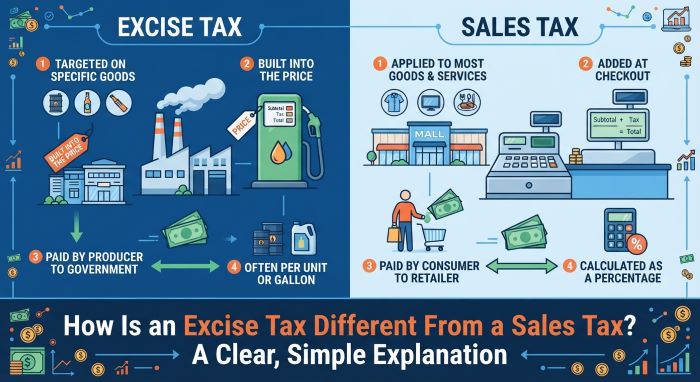
An excise tax is a tax on specific goods or services, such as gasoline, tobacco, alcohol, and airline tickets. It is often charged as a fixed amount per unit and is usually built into the price. A sales tax is a broad tax on most retail purchases. It is charged as a percentage of the price and is added at the register.
So how is an excise tax different from a sales tax in one sentence? An excise tax is narrow and targets particular products, while a sales tax is broad and applies to a wide range of goods.
What Is a Sales Tax?
A sales tax is a consumption tax that state and local governments charge on the retail sale of goods and some services. The seller collects it from the buyer at checkout and sends it to the government.
Key features of a sales tax:
- Broad base: It applies to most goods, such as clothing, electronics, furniture, and restaurant meals, with some exemptions.
- Percentage rate: It is calculated as a percentage of the purchase price, such as 6 percent or 8.25 percent.
- Visible: It appears as a separate line on your receipt.
- Collected at the point of sale: The retailer collects it from the customer.
- State and local: There is no national sales tax in the United States. States, counties, and cities set their own rates.
Five states have no statewide sales tax: Alaska, Delaware, Montana, New Hampshire, and Oregon. Some local governments in Alaska do charge their own sales taxes. Many states exempt groceries, prescription drugs, or clothing, or tax them at a lower rate.
What Is an Excise Tax?
An excise tax is a tax on a specific good, service, or activity. Federal, state, and local governments all use excise taxes.
Key features of an excise tax:
- Narrow base: It applies only to selected items, like fuel, cigarettes, alcohol, firearms, tires for heavy trucks, indoor tanning, and air travel.
- Often a fixed amount per unit: For example, a set number of cents per gallon of gasoline or dollars per pack of cigarettes. Some excise taxes are a percentage of the price.
- Usually hidden: It is often included in the posted price, so buyers may not see it on the receipt.
- Often collected from producers or wholesalers: Manufacturers, importers, or distributors usually pay the tax and pass the cost along to consumers through higher prices.
- Used by all levels of government: The federal government and the states both charge excise taxes on many of the same products.
Excise taxes on products considered harmful, like tobacco and alcohol, are sometimes called “sin taxes.”
Comparison Table: Excise Tax vs. Sales Tax
| Feature | Excise Tax | Sales Tax |
|---|---|---|
| What is taxed | Specific goods, services, or activities | Most retail goods and some services |
| Tax base | Narrow | Broad |
| How it is calculated | Often a fixed amount per unit; sometimes a percentage | A percentage of the sale price |
| Visibility | Usually included in the price | Listed separately on the receipt |
| Who collects it | Often the producer, importer, or wholesaler | The retailer at the point of sale |
| Who levies it | Federal, state, and local governments | State and local governments |
| Main purposes | Raise revenue, discourage certain behavior, fund related programs | Raise general revenue |
| Common examples | Gasoline, tobacco, alcohol, airline tickets, firearms | Clothing, electronics, furniture, restaurant meals |
| Changes with price | Per-unit excise does not change when prices change | Rises and falls with the price |
Per-Unit vs. Percentage: Specific and Ad Valorem Taxes
Economists use two terms that help explain the difference.
A specific tax is a fixed amount per unit. The federal gasoline excise tax is 18.4 cents per gallon. It stays the same whether gas costs $3 or $5 per gallon.
An ad valorem tax is based on value. It is a percentage of the price. Sales taxes are ad valorem taxes. If the price of an item goes up, the sales tax on it goes up too.
Most excise taxes are specific taxes, but not all. Some excise taxes are ad valorem, such as the federal tax on indoor tanning services, which is a percentage of the price. That is why the best answer to how is an excise tax different from a sales tax focuses on what is taxed, narrow versus broad, rather than only on how the tax is calculated.
Examples of Excise Taxes
Gasoline and diesel: The federal government charges 18.4 cents per gallon on gasoline and 24.4 cents per gallon on diesel. States add their own fuel taxes. The money mainly funds highways and transit.
Tobacco: The federal excise tax on cigarettes is about $1.01 per pack. State cigarette taxes vary widely.
Alcohol: Beer, wine, and spirits are taxed by volume or alcohol content at both the federal and state levels.
Air travel: Airline tickets include federal excise taxes and fees that help fund airports and air traffic control.
Firearms and ammunition: A federal excise tax on these products funds wildlife conservation programs.
Heavy trucks and tires: Excise taxes on large trucks and certain tires support highway funding.
Sports betting and gambling: Wagers are subject to federal and state excise taxes.
Indoor tanning: A federal excise tax applies to indoor tanning services.
Examples of Sales Taxes
- You buy a $50 jacket in a state with a 6 percent sales tax. You pay $3 in sales tax, for a total of $53.
- You buy a $1,000 laptop in a city with a combined 8.5 percent rate. You pay $85 in sales tax.
- You eat at a restaurant, and the bill shows a line for sales tax based on the cost of your meal.
In each case, the tax is a percentage of the price, and you see it on the receipt.
When Both Taxes Apply
Some purchases are hit by both taxes. Gasoline is the classic example. The price at the pump already includes federal and state excise taxes. In some states, a sales tax is also applied to fuel. Cigarettes and alcohol often carry excise taxes plus a sales tax at the register.
This is called tax stacking. In some places, the sales tax is calculated on a price that already includes the excise tax, so you pay a tax on a tax.
Why Governments Use Excise Taxes
Excise taxes serve several purposes beyond raising revenue.
Discouraging harmful behavior: Higher taxes on tobacco and alcohol raise prices and reduce consumption. Economists call a tax designed to correct a harmful side effect a Pigouvian tax.
Paying for related services: Fuel taxes work like a user fee. Drivers who use roads more buy more fuel and pay more toward road upkeep. Airline ticket taxes support the aviation system.
Covering social costs: Smoking and heavy drinking create health care and public safety costs. Excise taxes help offset them.
Raising revenue from stable demand: Demand for products like fuel and tobacco does not drop much when prices rise, so these taxes produce steady revenue.
Why Governments Use Sales Taxes
Sales taxes are a major source of general revenue for states and cities. The money pays for schools, police, fire departments, roads, parks, and other public services. Because the tax applies to a wide range of purchases, a fairly low rate can raise a large amount of money.
Sales taxes are also simple for shoppers to understand. You see the rate, and you see the amount on your receipt.
Who Really Pays? Tax Incidence
The person who sends the tax to the government is not always the person who bears the cost. Economists call this tax incidence.
With a sales tax, the buyer clearly pays at the register. With an excise tax, the producer or wholesaler usually pays the government, then raises prices to pass some or all of the cost to buyers.
How much gets passed along depends on elasticity. If buyers keep purchasing a product even when the price rises, as with gasoline or cigarettes, sellers can pass most of the tax on to them. If buyers are quick to switch to alternatives, sellers absorb more of the tax.
Are These Taxes Fair? Regressive Taxes Explained
Both excise taxes and sales taxes are generally regressive. A regressive tax takes a larger share of income from lower-income people than from higher-income people.
Here is why. A family earning $30,000 and a family earning $300,000 pay the same tax on a gallon of gas or a pack of cigarettes. That tax is a much bigger share of the first family’s income. Lower-income households also spend more of their income on taxable goods, while higher-income households save more.
Many states reduce this effect by exempting groceries, medicine, and other necessities from sales tax.
How These Taxes Affect Prices and Behavior
A sales tax raises the final cost of most goods by the same percentage, so it does not change which products people choose very much.
An excise tax raises the price of one product compared to others. That can change behavior. Higher cigarette taxes lead some people to smoke less or quit. Higher fuel taxes may push people toward more efficient cars. This is one more way to answer how is an excise tax different from a sales tax: excise taxes are often designed to influence choices, while sales taxes are mainly designed to raise money.
Excise Tax vs. Other Taxes
Value-added tax (VAT): Common in other countries, a VAT is collected at each stage of production. It is broad like a sales tax. The United States does not have a national VAT.
Use tax: A use tax applies when you buy something without paying sales tax, such as from an out-of-state seller, and then use it in your home state.
Tariff: A tariff is a tax on imported goods. It is similar to an excise tax because it targets specific products, but it applies only to imports.
Property tax: A tax on the value of real estate or, in some states, vehicles. Some states call an annual vehicle tax an “excise tax,” which can cause confusion.
Income tax: A tax on what you earn rather than what you buy.
Common Test Traps
Exam questions on this topic often include tempting wrong answers.
“Excise taxes are only federal, and sales taxes are only state.” Wrong. States also charge excise taxes. Sales taxes are state and local.
“Excise taxes are always paid directly by consumers at the register.” Wrong. They are usually paid by producers or sellers and built into the price.
“A sales tax applies only to luxury goods.” Wrong. A sales tax applies broadly to most goods.
“Excise taxes and sales taxes are the same thing.” Wrong. They differ in what they tax, how they are calculated, and how they are collected.
“Excise taxes are based on income.” Wrong. They are based on the purchase or production of specific goods.
When a test asks how is an excise tax different from a sales tax, look for the answer that says an excise tax applies to specific goods while a sales tax applies to a broad range of goods.
Real-World Scenario
Imagine you stop at a gas station and convenience store.
You buy 10 gallons of gas. The posted price already includes federal and state excise taxes. You do not see them listed, but they are part of every gallon.
Inside, you buy a phone charger for $20. In a state with a 7 percent sales tax, the register adds $1.40, and the receipt shows it clearly.
In one stop, you paid both kinds of taxes. One was hidden in the price of a specific product. The other was a visible percentage added to a general purchase. That simple trip shows how is an excise tax different from a sales tax in everyday life.
Key Terms to Know
- Excise tax: A tax on specific goods, services, or activities.
- Sales tax: A broad percentage tax on retail purchases.
- Specific tax: A fixed tax per unit.
- Ad valorem tax: A tax based on value, charged as a percentage.
- Sin tax: An excise tax on products seen as harmful, such as tobacco and alcohol.
- Tax incidence: Who actually bears the cost of a tax.
- Regressive tax: A tax that takes a larger share of income from lower earners.
- Pigouvian tax: A tax meant to reduce harmful side effects of an activity.
- Tax base: The range of things a tax applies to.
- Use tax: A tax on goods bought without sales tax and used in your state.
Quick Practice Quiz
1. Which tax is charged per gallon of gasoline? An excise tax.
2. Which tax appears as a separate line on a store receipt? A sales tax.
3. True or false: The federal government charges a national sales tax. False. There is no national sales tax in the United States.
4. Which tax is more likely to be used to discourage a behavior? An excise tax.
5. Who usually sends excise tax payments to the government? Producers, importers, or wholesalers.
6. Are sales and excise taxes generally progressive or regressive? Regressive.
Study Tips
Use a memory aid. Think “excise equals exact items.” An excise tax targets exact, specific products.
Connect to daily life. Gas, cigarettes, and alcohol carry excise taxes. Most other store purchases carry a sales tax.
Remember the calculation. Excise is often per unit. Sales is always a percentage.
Know who collects. Excise is collected upstream from producers. Sales tax is collected at the register.
Practice explaining it aloud. If you can explain how is an excise tax different from a sales tax to a friend in two sentences, you understand it.
Why the Difference Matters
Understanding these taxes helps you make sense of prices, budgets, and public policy. It explains why gas prices differ from state to state, why a pack of cigarettes costs far more in some cities, and why your receipt total is higher than the shelf price.
It also helps you take part in public debates. Proposals to raise fuel taxes, tax sugary drinks, or exempt groceries from sales tax all involve trade-offs between revenue, fairness, and behavior. Knowing the basics lets you weigh those choices as an informed citizen.
Final Answer Recap
How is an excise tax different from a sales tax? An excise tax is a narrow tax on specific goods or services, often charged as a fixed amount per unit, usually built into the price, and commonly collected from producers. A sales tax is a broad tax on most retail purchases, charged as a percentage of the price and added at checkout.
Keep that distinction in mind, and you will be ready the next time a teacher, exam, or news story raises the question of how is an excise tax different from a sales tax.
Key Takeaways
- An excise tax targets specific goods and services, while a sales tax applies broadly to most retail purchases.
- Excise taxes are often a fixed amount per unit, and sales taxes are a percentage of the price.
- Excise taxes are usually hidden in the price, while sales taxes appear on the receipt.
- Producers or wholesalers typically pay excise taxes and pass the cost to consumers.
- The federal government and states charge excise taxes, but only state and local governments charge sales taxes in the United States.
- Excise taxes are often used to discourage behavior or fund related programs, such as roads.
- Both taxes are generally regressive, taking a larger share of income from lower earners.