How to Make Your Hair Not Look Greasy in 5 Minutes: Quick Fixes That Work
Your hair looked fine this morning. Now it’s midday and your hair looks like you dunked it in oil. You have a meeting in an hour. You don’t have time for a full wash and dry. You need a solution that works fast.
How to make your hair not look greasy in 5 minutes is the question you’re asking. The good news is that several quick fixes exist that genuinely work. You don’t need to overhaul your whole routine. You just need the right approach for the next hour.
Let’s talk about fast, practical solutions for dealing with greasy hair when you don’t have much time.
Understanding Why Hair Gets Greasy
Before jumping to solutions, understanding why your hair gets greasy helps you address the root cause.
Your scalp produces sebum, an oil that protects your hair and skin. Your scalp produces the right amount when everything is balanced. Too much sebum and your hair looks greasy. Too little and your hair looks dry.
Why does my hair get greasy so fast is a common question. Several factors cause rapid greasiness.
Overwashing strips natural oils from your scalp. Your scalp responds by producing extra sebum to compensate. You wash more to remove it. Your scalp produces more. A cycle begins.
Hot water opens your hair cuticles and strips oils. Warm or cool water preserves oils better.
Not rinsing thoroughly leaves shampoo residue that makes hair look greasy.
Touching your hair frequently transfers oils from your hands to your hair.
Hormonal fluctuations affect sebum production. Stress and certain times of the menstrual cycle increase sebum.
Diet high in certain fats affects scalp oil production.
Why does my hair get oily so fast might be your genetics. Some people’s scalps naturally produce more sebum. This isn’t a flaw. It’s just how your body works.
Understanding these factors helps you address the underlying issue long-term. For now, though, you need the 5-minute fix.
The 5-Minute Quick Fix Arsenal
Several products and techniques work fast for greasy hair. You don’t need all of them. Pick what you have available.
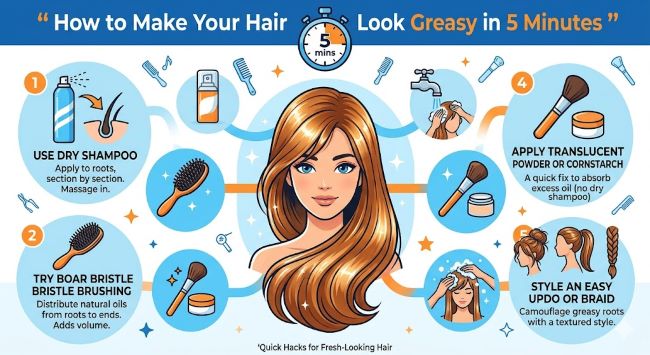
Dry shampoo is the fastest solution. Spray it on your roots, wait 30 seconds, and rub it in with your fingers. The powder absorbs oils immediately. Your hair looks fresh without water or styling tools.
Dry shampoo works because the powder absorbs sebum. The powder particles cling to oil and make hair look cleaner. It’s not a permanent fix, but it works for hours.
Blotting with paper towels or tissue removes surface oil without getting hair wet. Press the tissue against greasy areas. The oil transfers to the tissue. Your hair looks less greasy immediately.
Texturizing spray adds grip to oily hair and makes it look less slick. It’s similar to dry shampoo but with different texture. Some people prefer it.
Dry powder like translucent powder or baby powder works if you don’t have dry shampoo. Use sparingly. Too much looks chalky.
Styling with volume at the roots helps greasy hair look intentional rather than oily. Tousle your hair or flip it upside down. Volume disguises greasiness.
The Dry Shampoo Method
Dry shampoo for greasy hair is the fastest, most effective solution.
Step 1: Apply to roots. Spray dry shampoo where your hair looks greasiest. Usually this is at the roots and around your face.
Step 2: Wait. Let it sit for 30 to 60 seconds. This gives the powder time to absorb oil.
Step 3: Rub it in. Use your fingers to massage the dry shampoo into your roots. Work it through completely.
Step 4: Brush or tousle. Run a brush through your hair or tousle it with your fingers. This distributes the product and removes excess powder.
Your hair looks fresher immediately. The effect lasts 4 to 8 hours depending on how greasy your hair gets.
Dry shampoo works on all hair types. It works especially well on darker hair where powder shows less. On very light hair, choose a color-matched dry shampoo to avoid looking chalky.
The Blotting Technique
If you don’t have dry shampoo, blotting works.
Get a tissue, paper towel, or blotting sheet. Press it firmly against the greasy areas of your hair. Hold for a few seconds. The paper absorbs oil from the surface.
Blotting doesn’t get your hair wet. It removes surface oil without needing water or styling tools.
The downside is blotting only removes surface oil. Deep greasiness can’t be fully blotted. But it helps enough for a few hours.
Blotting sheets designed for makeup work on hair too. They absorb oil effectively and cost little.
Styling Tricks for Greasy Hair
Sometimes the issue isn’t the greasiness itself. It’s how the greasiness looks.
Changing your part makes a difference. Greasy areas show more in some parts than others. Moving your part changes where greasiness shows.
Adding volume at the roots disguises greasiness. Greasy hair looks slick and flat. Volume makes it look intentional.
Using a texture spray before styling adds grip. Greasy hair is slippery. Texture spray makes it easier to work with. Your style holds better.
Flipping your hair upside down temporarily works. Gravity pulls oils away from roots. Flip upside down and your roots look less greasy. The effect lasts until you flip back.
Braiding or twisting can work. Some styles look better with greasy hair. French braids, buns, and twists embrace the texture rather than fighting it.
Straightening can make greasy hair look worse by showing shine. Curling or texturizing disguises the greasiness.
Understanding Your Hair Type
Different hair types handle greasiness differently.
Fine hair gets greasy easily. Fine strands can’t support much oil. Oil weighs it down and shows quickly.
Thick hair can hide greasiness better. The thickness disguises oil shine. But it also produces more sebum, so it gets greasy too.
Curly hair often appears less greasy even with the same oil levels. Curls break up shine. Straight hair shows shine obviously.
Textured hair sometimes benefits from some oil. A little greasiness can add definition. Too much though still looks bad.
Understanding your hair type helps you find the best quick fix. Fine hair might benefit from dry shampoo more than blotting. Curly hair might benefit from styling tricks.
Products That Help
Beyond dry shampoo, several products help with greasy hair.
Best shampoo for greasy hair uses clarifying formulas. These remove buildup and excess oil. Sulfate-based shampoos are harsh but effective for greasy hair. Sulfate-free options exist for sensitive scalps.
What shampoo is good for oily hair includes volumizing formulas. These add lift without adding weight.
Best leave in conditioner for oily hair is lightweight. Heavy conditioners weigh down greasy hair. Lightweight options add shine without greasiness.
Some leave-in conditioners work better for oil-prone hair than others. Look for products described as lightweight or designed for oily hair.
Shampoo for oily hair shouldn’t be the moisturizing type. Moisturizing formulas add weight. Clarifying or balancing shampoos work better.
Using the right products long-term helps. But for the 5-minute fix, dry shampoo is faster than switching products.
Getting Rid of Greasy Hair Long-Term
How to get rid of greasy hair long-term requires addressing root causes.
Wash less frequently if you wash daily. Daily washing strips oils, causing your scalp to overproduce. Try every other day or every third day.
Use cooler water. Hot water opens cuticles and strips oils. Lukewarm or cool water preserves natural oils.
Don’t touch your hair constantly. Each touch transfers oil from your hands. Keeping hands off your hair reduces greasiness.
How to make hair less oily involves using the right products. Clarifying shampoos remove buildup. Volumizing products add texture. Lightweight conditioners won’t weigh hair down.
Scalp health matters. If you have an oily scalp, addressing scalp health helps. Scalp exfoliation removes dead skin cells. Salicylic acid clarifying shampoos help regulate sebum.
How to get rid of oily hair isn’t just about products. It’s about habits and routine. Once you find a routine that works, stick with it. It takes time to regulate sebum production. Don’t keep switching products.
Understanding Oily Scalp vs Dry Ends
Sometimes the issue is oily scalp with dry ends.
Oily scalp is common even when ends are dry. Your scalp produces sebum. The oil travels down the hair shaft, making roots greasy while ends stay relatively dry.
Don’t condition your scalp if you have this issue. Condition only the ends. This prevents adding oil to already-oily scalp.
Dry ends need moisture. But adding conditioner to your scalp makes it greasier. Balance is key.
Why does my hair get greasy after one day might be this situation. Your scalp gets oily fast. The oil pools at the roots and makes your whole hair look greasy even if ends are dry.
For this situation, dry shampoo at roots combined with conditioner on ends works well.
When You Actually Need to Wash
Sometimes the 5-minute fix isn’t enough. You actually need to wash.
If you have an hour, you can wash and dry your hair in time.
Wash with lukewarm water. Use a clarifying shampoo if you have very greasy hair. Condition only the ends.
Rinse thoroughly. Shampoo residue makes hair look greasy.
Dry your hair. Wet hair always looks worse than dry. Blow drying removes any excess moisture and adds volume.
If the greasiness comes back within an hour, the issue isn’t just oil. It might be product buildup or shampoo residue. Consider a clarifying treatment.
Special Situations: Dry Skin on Face
Dry skin on face sometimes coexists with greasy hair. This is frustrating. You can’t just add moisture because it makes your hair greasier.
The solution is targeted treatment. Use dry shampoo specifically on your scalp and hair roots. Use facial moisturizer on your face. They don’t interfere with each other.
Avoid products that are meant for both skin and hair. They usually balance the problem by being mediocre for both.
Quick Reference: 5-Minute Solutions
If you have exactly 5 minutes:
1 minute: Apply dry shampoo to greasy areas. Work it in with your fingers.
2-3 minutes: Brush or tousle your hair to distribute product and remove excess powder.
4 minutes: Style for volume at roots or change your part.
5 minutes: Check in mirror and make final adjustments.
If you don’t have dry shampoo, blotting with tissue takes the same time. The effect lasts a few hours.
Key Takeaways
- How to make your hair not look greasy in 5 minutes uses dry shampoo, blotting, or styling tricks.
- Greasy hair results from excess sebum production, overwashing, or product buildup.
- Oily hair and greasy hair are the same thing. Both mean excess oil on your scalp and hair.
- Why does my hair get greasy so fast has multiple causes including genetics, washing frequency, and water temperature.
- Oily scalp is different from dry ends. Address each separately with appropriate products.
- Shampoo for greasy hair should clarify rather than moisturize.
- Why is my hair so oily might be genetics. Some people naturally produce more sebum.
- Best shampoo for greasy hair uses clarifying formulas that remove excess oil and buildup.
- How to get rid of greasy hair involves changing washing frequency, water temperature, and touching habits.
- Why does my hair get oily so fast could be overwashing causing your scalp to overproduce oil.
- Greasy hair shampoo isn’t just shampoo. It’s about the whole routine including frequency and water temperature.
- How to fix oily hair short-term uses dry shampoo or blotting. Long-term uses routine changes.
- Why does my hair get greasy after one day is often due to overwashing training your scalp to overproduce oil.
- Best leave in conditioner for oily hair is lightweight and used only on ends.
- How to make hair less oily takes time. Give your scalp several weeks to regulate sebum production.
- Shampoo for oily hair should be volumizing or clarifying, not moisturizing.
- How to get rid of oily hair involves product changes, habit changes, and patience as your scalp adjusts.
- Dry skin on face and greasy hair need separate treatment. Don’t compromise both by using one product.
- For the immediate 5-minute fix, dry shampoo is your fastest solution. For long-term solutions, change your washing routine and product choices.
- If you’re dealing with greasy hair today, use dry shampoo. If you’re tired of managing it constantly, change your routine.