2-Watt Laser Satellite Communication: The Future of Space Technology Explained
Space communication is changing. Traditional radio frequency methods, used for decades, face new competition from laser-based systems. 2-watt laser satellite communication represents the cutting edge of this technological shift. Understanding this technology and why it matters helps you grasp ongoing developments in space innovation.
The emergence of laser communication systems, particularly China’s developments in this area, reflects serious investment in next-generation satellite technology. These systems promise faster data transmission, higher security, and revolutionary capabilities for global connectivity. The development also raises questions about competition between space programs and the future of satellite internet.
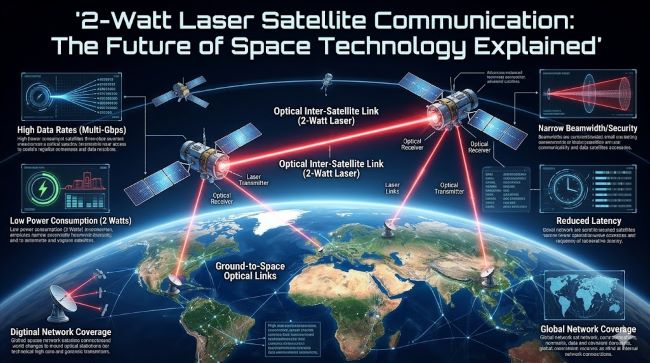
Understanding Laser Satellite Communication
Laser satellite communication uses focused light beams to transmit data between satellites or between satellites and ground stations. Instead of radio waves, this technology employs visible or infrared laser light.
2-watt laser satellite communication uses a 2-watt laser to send data. This power level might sound modest compared to some applications, but in space communication, precision matters far more than raw power. A 2-watt laser, properly focused through a telescope, can transmit data across vast distances.
The advantages over traditional radio communication are significant. Laser beams are narrow and focused, making them difficult to intercept. Radio signals broadcast in all directions, making them easier to jam or intercept. Laser communication provides inherent security through its directional nature.
Laser systems also achieve much higher data transmission rates. Radio frequency systems send data at certain speeds limited by physics. Laser systems transmit at much higher rates due to the shorter wavelength of light compared to radio waves.
How the Technology Works
Laser satellite communication involves several components working together.
At the source, a laser generates a beam of coherent light. The beam is directed through a telescope that focuses and aims it precisely. This telescope might be only inches in diameter but focuses the beam onto a receiver potentially thousands of kilometers away.
The receiving satellite has sensors that detect the incoming laser light. These sensors convert the light signal back into electrical signals that computers interpret as data. Sophisticated tracking systems keep the laser aimed precisely at the receiving satellite even as both move through space.
The entire system operates in fractions of a second. Satellites in orbit move at thousands of miles per hour, but ground stations track them and adjust laser aim accordingly. The precision required is extraordinary, but modern technology handles it effectively.
Chinese Satellite Developments
Recent news about Chinese satellite starlink competition has highlighted advances in laser communication. China has invested heavily in satellite communication capabilities.
Chinese satellite pulverizes starlink claims have emerged in headlines, though these claims often reflect competitive rhetoric rather than technical superiority. The actual situation is more nuanced. China is developing advanced satellite systems that pose genuine competition to Western systems like Starlink.
China’s satellites incorporate 2-watt laser satellite communication systems according to various reports. These systems represent significant technological achievement. Whether these systems “pulverize” competing systems depends on which metrics you measure. Laser communication systems offer advantages in certain contexts but don’t universally outperform all radio-based systems.
China starlink competition reflects broader space competition between nations. Multiple countries and private companies now develop satellite internet systems. This competition drives innovation and accelerates technological advancement.
Advantages of Laser Communication
Chinese satellite starlink laser technology highlights specific advantages that laser systems offer.
Higher Data Rates: Laser systems transmit data much faster than radio frequency systems. Where radio systems might transmit at gigabits per second, laser systems push toward terabits per second.
Lower Power Consumption: Laser systems use less power to transmit the same amount of data. The 2-watt laser system is energy-efficient despite its power output. This matters for satellites with limited power from solar panels.
Improved Security: The narrow, focused beam is harder to intercept than broadcast radio signals. This inherent directional advantage appeals to military and government applications.
Reduced Interference: Laser signals don’t interfere with radio frequencies. Satellites can operate laser and radio systems simultaneously without conflict.
Lighter Equipment: Laser communication equipment weighs less than bulky radio frequency transmitters. In space, where launch weight costs money, lighter equipment is valuable.
Longer Range: Laser systems can transmit data across greater distances with less signal degradation than radio systems of comparable power.
These advantages explain why multiple space programs invest in laser communication technology.
Challenges and Limitations
Despite advantages, 2-watt laser satellite communication faces real challenges that limit deployment.
Atmospheric Interference: Earth’s atmosphere scatters and absorbs laser light. Ground-to-space laser communication faces interference from clouds, dust, and air turbulence. Space-to-space communication avoids this problem, making inter-satellite laser links more practical.
Tracking Complexity: Maintaining laser beam aim on moving satellites requires sophisticated tracking systems. Even small deviations cause signal loss. The tracking systems themselves add cost and complexity.
Weather Dependency: Cloud cover blocks laser signals. Ground stations using 2-watt laser satellite communication can’t operate during cloudy weather. Radio systems work in any weather condition.
Technical Maturity: While laser communication technology is mature, deploying it at scale in satellite constellations involves engineering challenges. Integration with existing satellite systems requires careful engineering.
Cost: Developing and deploying laser communication systems costs more than traditional radio systems. The additional capability comes at a price.
Limited Adoption: Few satellites currently operate laser communication systems. Most satellite internet services rely on radio frequency communication. Widespread adoption requires standardization and investment.
Current Applications
Despite challenges, laser communication is deployed in specific applications.
The International Space Station uses laser communication to receive high-definition video and scientific data. The system demonstrates laser communication feasibility in orbit.
Several missions test laser communication for future applications. NASA and other space agencies conduct experiments validating the technology.
Military and government satellites use laser communication where the advantages justify the added complexity. Security benefits and higher data rates appeal to defense applications.
Chinese satellite programs reportedly incorporate laser systems in advanced satellite designs. Whether these are operational or test systems varies by source.
Intersat laser links (communication between satellites) represent the most promising near-term application. Space-to-space links avoid atmospheric interference, making them ideal for proving laser technology.
Starlink’s Response and Evolution
Chinese satellite starlink competition has spurred responses from SpaceX and other Starlink competitors.
Starlink uses radio frequency communication and continues improving these systems. SpaceX invests in laser communication research but hasn’t yet deployed it in Starlink satellites at scale.
The company faces questions about whether to transition to laser communication. Doing so would require redesigning satellites and ground infrastructure. The investment is substantial, but competitive pressure might force the decision.
SpaceX has mentioned exploring laser inter-satellite links. These links would let Starlink satellites communicate with each other using lasers, bypassing ground stations in some cases. This capability would improve global coverage and resilience.
Competition between systems spurs innovation. Starlink’s traditional advantages have motivated competitors to develop better technology. Chinese satellite starlink laser technology represents one response to this competition.
Global Implications
The development of advanced satellite communication systems has broader implications.
Connectivity: Laser-capable satellite systems promise faster global internet connectivity. The higher data rates could eventually provide better internet access globally.
Military Applications: Advanced satellite communication capabilities have military implications. Nations compete for superiority in space-based communications and surveillance.
Spectrum Management: Laser communication operates outside traditional radio frequency spectrum. This avoids spectrum congestion and interference issues affecting radio systems.
Space Competition: Investment in advanced satellite technology reflects broader space competition between nations. The technology race extends to civilian, military, and commercial applications.
Private vs. Public: While SpaceX leads commercial satellite internet, government programs maintain parallel developments. Competition between sectors drives different innovations.
Technical Specifications of 2-Watt Systems
Understanding the specific technology helps clarify capabilities and limitations.
A 2-watt laser satellite communication system generates exactly 2 watts of laser power output. This power, focused through optics into a narrow beam, travels through space toward a receiver.
The beam might have a diameter of just meters at the receiving end despite traveling thousands of kilometers. This concentration of light creates intense signal strength at the receiving location.
The receiving satellite has photodiodes or other light sensors that detect the incoming photons and convert them to electrical signals. Signal processing equipment then decodes the data.
Ground stations with laser communication capability have telescopes and tracking systems that aim lasers at satellites and receive laser signals from them. The telescopes might be 1-3 meters in diameter, focused on satellites hundreds or thousands of kilometers away.
The data rate achieved depends on modulation techniques and signal processing. Systems vary in capabilities, but 2-watt laser satellite communication systems typically achieve data rates measured in gigabits per second.
Future Developments
Laser satellite communication continues advancing. Several trends point to future deployment.
Increased Deployment: More satellites will likely incorporate laser communication systems. As technology matures, costs decline, and advantages become clear, adoption increases.
Standardization: International standards for laser satellite communication would accelerate adoption. Currently, each system uses proprietary designs.
Improved Tracking: Better tracking systems will reduce laser communication complexity. Adaptive optics and AI-assisted tracking might overcome current challenges.
Space-Based Networks: Laser inter-satellite links could create mesh networks of satellites. This architecture provides redundancy and improves global coverage.
Hybrid Systems: Many satellites will use both radio and laser communication. Laser handles high-bandwidth transmissions while radio handles basic communications.
Ground Network Expansion: Building more ground stations with laser communication capability will improve access to laser satellites.
Competitive Landscape
Multiple players invest in laser satellite communication.
China clearly invests in advanced satellite communication, including laser systems.
United States programs through NASA, military, and private companies develop laser technology.
Europe through ESA and other agencies pursues laser communication research.
Japan and other nations also invest in these technologies.
The competition drives innovation and accelerates development. Each advance by one nation or company spurs responses from others.
Key Takeaways
- 2-watt laser satellite communication uses focused laser light to transmit data between satellites and ground stations.
- Laser systems offer advantages in data transmission speed, security, power efficiency, and signal strength compared to radio frequency systems.
- Chinese satellite starlink competition reflects investment by multiple nations in advanced satellite technology.
- Chinese satellite pulverizes starlink claims often reflect competitive rhetoric, though China does develop capable satellite systems.
- Chinese satellite starlink laser technology represents genuine advancement in space communication capabilities.
- Laser communication faces challenges including atmospheric interference, tracking complexity, and weather dependency that limit some applications.
- Space-to-space laser links avoid atmospheric interference and show the most promise for near-term deployment.
- Starlink and other commercial systems respond to competitive pressure through research and development investments.
- Laser inter-satellite links could improve satellite constellation coverage and resilience.
- Multiple nations and private companies develop laser communication technology, driving innovation.
- 2-watt laser satellite communication systems transmit data at gigabit and terabit rates despite modest power output.
- Ground-to-space laser communication works best in clear weather with dedicated ground stations.
- Cost and complexity currently limit laser communication deployment compared to radio systems.
- Future satellites will likely use hybrid systems combining radio and laser communication.
- International standards and improved technology will accelerate laser communication adoption.
- Space competition between nations and private companies shapes technology development in satellite communications.