Latest Breakthroughs in Quantum Computing 2024
Something big happened in the world of quantum computers during 2024. For years, this field lived mostly in research labs and dense science papers. Then the headlines started rolling in one after another. The latest breakthroughs in quantum computing 2024 showed that real machines can now do things that seemed out of reach a short time ago. Companies like Google, IBM, Microsoft, and Quantinuum each pushed the field forward in ways that mattered.
This guide walks you through the year’s biggest wins in simple language. You will learn what a quantum computer is, why 2024 became such a turning point, and where this quantum technology might head next. No physics degree required. Think of this as a friend explaining the news over coffee.
What Is a Quantum Computer?
Before we get to the latest breakthroughs in quantum computing 2024, let us answer a basic question. What is a quantum computer, and how does it differ from the laptop on your desk?
A normal computer uses bits. A bit is either a 0 or a 1, like a light switch that is on or off. Everything your phone and laptop do comes down to billions of these tiny switches flipping back and forth. This system works great for most tasks.
A quantum computer uses qubits instead. A qubit can act like a 0, a 1, or a blend of both at the same time. Physicists call this blend superposition. Qubits can also link together so that the state of one affects the state of another. They call this link entanglement. These two tricks let quantum computers explore many possible answers at once rather than checking them one by one.
So what is quantum computing in plain terms? It is a way to solve certain hard problems much faster than any classical machine. Picture a giant maze. A normal computer walks down each path until it finds the exit. A quantum computer can test many paths together. For most everyday jobs, your laptop still wins. But for a small set of huge problems, quantum computers offer a real edge.
That edge is why governments and tech giants pour billions into research. Some problems are simply too large for classical computers. They would take years or even centuries to crack. The right quantum computer could trim those same tasks down to minutes. That promise sits behind every story you will read below.
Why 2024 Became a Turning Point
People have talked about quantum technology for decades. So why did 2024 feel different? The answer comes down to one word: reliability.
Qubits are fragile. A stray bit of heat, a vibration, or a flicker of electromagnetic noise can knock a qubit out of its delicate state. When that happens, errors creep into the math. For a long time, adding more qubits also meant adding more errors. The machines grew, but they did not grow more trustworthy.
The latest breakthroughs in quantum computing 2024 attacked this problem head on. Researchers found ways to add qubits while cutting error rates at the same time. That shift turns quantum computing from a science demo into something engineers can build on. Once you can trust the answers, you can start solving real problems. That is the heart of why 2024 stands out in quantum computing news.
Google’s Willow Chip and the Error Correction Milestone
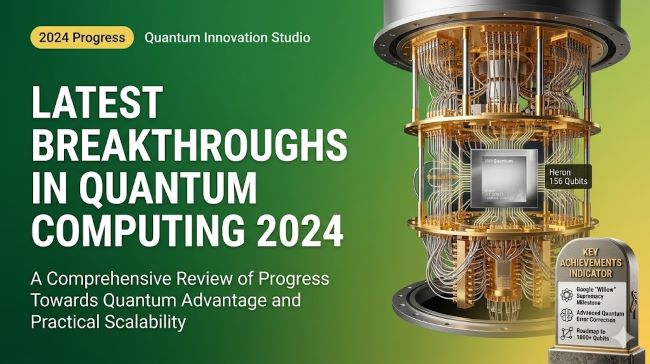
The single most talked about story of the year arrived in December 2024. Google introduced a new quantum chip named Willow. It carries 105 qubits, and it solved a puzzle that had stumped the field since the 1990s.
Here is the puzzle. To protect quantum information, scientists group many physical qubits together to form one stronger unit called a logical qubit. The hope was that bigger groups would make fewer mistakes. For years, the opposite kept happening. Bigger groups added more noise. Researchers spoke of crossing a magic line called the error correction threshold. Cross it, and errors drop as you scale up. Nobody had crossed it until Willow.
Google’s team tested grids of qubits that grew from a 3 by 3 layout, to 5 by 5, to 7 by 7. Each time the grid grew, the error rate fell by about half. That result is what experts mean when they say a system runs below threshold. It proves that a larger quantum computer can also be a more accurate one. This was the holy grail of quantum error correction, and Willow reached it.
Willow showed off its power in another way too. Google ran a test called random circuit sampling. The chip finished a calculation in under five minutes. The fastest classical supercomputer would need an amount of time so large that it dwarfs the age of the universe many times over. The exact figure Google quoted runs into the septillions of years. While critics note that this test was built to favor quantum machines, the gap still stuns most observers.
The Willow news mattered because it pointed at a path. Google framed it as proof that fault tolerant machines are coming. For anyone tracking the latest breakthroughs in quantum computing 2024, Willow sat at the top of the list.
Microsoft and Atom Computing Set a Logical Qubit Record
A month before Willow, in November 2024, Microsoft and a startup named Atom Computing shared their own milestone at the Microsoft Ignite event. Together they entangled 24 logical qubits, the largest number of linked logical qubits anyone had reported.
Their approach used a different kind of hardware. Instead of the superconducting circuits that Google and IBM favor, Atom Computing traps neutral atoms with lasers and uses them as qubits. The team took 256 of these physical atoms and, with Microsoft’s qubit virtualization software, shaped them into 24 reliable logical qubits. They reached a two qubit gate fidelity of 99.6 percent and could spot and fix errors even when an atom went missing.
The pair did more than entangle the qubits. They ran real computations on 20 of them and got cleaner results than they would have from raw physical qubits. That last point carries weight. It shows error correction adding value, not just running in theory. The companies also put the machine up for order, with delivery planned for 2025, which moved the work from lab bench toward product.
This built on a quieter win from earlier in the year. In September 2024, Microsoft teamed with Quantinuum to create 12 reliable logical qubits on a trapped ion machine. Step by step, these results filled out the year’s story. Among the latest quantum computing applications, this hardware aims squarely at chemistry, materials science, and artificial intelligence.
IBM’s Hardware Push and a Roadmap to 2033
IBM took a steady, methodical path through this period. The company has long published a public roadmap, and 2024 saw it deliver on past promises while stretching the plan out to 2033.
At the heart of IBM’s work sits the Heron processor. The first version carried 133 qubits with tunable couplers, a design that cut the crosstalk that muddies calculations. IBM reported that Heron delivered a three to five times jump in performance over its older 127 qubit Eagle chip. Later versions pushed the qubit count to 156. IBM set a goal for Heron to run circuits with 5,000 gates during 2024, and the chip became the base of its plans going forward.
IBM also showed Quantum System Two, a modular machine that links several Heron processors together. Rather than chasing one giant chip, IBM wants to connect many smaller ones. To get there, the company demonstrated new connectors. A proof of concept called Flamingo joined two Heron chips with cables up to a meter long, an early step toward stitching many modules into one large system.
The extended roadmap laid out the years ahead. IBM aims for a system called Starling around 2029 that runs 100 million gates across 200 logical qubits using a new error correcting code. By 2033, it targets a machine named Blue Jay built to run a billion gates on 2,000 logical qubits. These dates show how IBM thinks about the long game. Its quantum computing updates focus less on flashy single results and more on a careful climb toward useful scale.
Quantinuum Breaks Performance Records
Quantinuum spent 2024 collecting records of its own. The company builds trapped ion quantum computers, which hold charged atoms in place with electric fields. This design tends to deliver very high accuracy, and the numbers backed that up.
In March 2024, Quantinuum reported a fix for two stubborn scaling issues known as the wiring problem and the sorting problem. Using a chip arranged in a two dimensional grid, the team showed it could shuffle ions around efficiently without drowning the system in control signals. That work supports the idea that its architecture can grow without hitting a wall.
In April 2024, working again with Microsoft, Quantinuum reported the most reliable logical qubits on record at the time. The team encoded four logical qubits into just 30 physical qubits on its H2 machine. The logical error rates fell well below the physical error rates, which is the whole point of error correction. The company also hit a two qubit gate fidelity of 99.914 percent, crossing what the field calls the three nines mark. That level of accuracy is not a nice extra. It is the floor that error correction needs to work at all.
These results made Quantinuum a regular name in quantum computing news through the year. High fidelity hardware feeds directly into the latest quantum computing applications, since cleaner gates mean researchers can run longer and more useful programs.
The Big Theme: Quantum Error Correction Came of Age
If you step back and look at the latest breakthroughs in quantum computing 2024 as a group, one theme ties them together. This was the year quantum error correction grew up.
Google crossed the error correction threshold with Willow. Microsoft and Atom Computing set a logical qubit record. Quantinuum encoded reliable logical qubits and hit three nines fidelity. IBM built a roadmap that puts error correction at its center. Four leading players, using three different kinds of hardware, all pushed the same frontier in the same year.
Why does this matter so much? Because useful quantum computers need to run billions or trillions of operations without falling apart. You cannot do that with noisy qubits. You need logical qubits that fix their own mistakes. Until 2024, that goal felt distant. After 2024, it feels like an engineering challenge rather than a question of whether it is even possible. That change in mood is the real headline.
Latest Quantum Computing Applications in 2024
Hardware records are exciting, but most people want to know what quantum computers can actually do. The latest quantum computing applications fall into a few clear buckets, and 2024 saw real movement in each.
Drug discovery and chemistry lead the pack. Quantum computers are well suited to simulate how molecules behave, since molecules follow quantum rules themselves. A consulting study from McKinsey projects that quantum computing could unlock between 200 and 500 billion dollars of value in the pharmaceutical sector by 2035. During this stretch, companies like Amgen, Moderna, and Biogen ran pilot projects using quantum and hybrid methods to study peptides, mRNA sequences, and molecules tied to brain diseases.
Materials science follows close behind. Designing better batteries, solar cells, and catalysts means understanding matter at the atomic level. Quantum simulation gives researchers a sharper tool for that work. Several chemistry and materials projects ran on quantum and classical machines working together during the year.
Finance is another active area. Banks and funds want better tools for risk analysis, portfolio choices, and pricing. Quantum algorithms could one day handle these tasks faster than current methods. Optimization problems, like routing trucks or placing power on a grid, also fit the quantum mold well.
Cryptography sits on both sides of the story. Future quantum computers could break some of the encryption that protects data today. That risk has pushed a global effort to build new, quantum safe codes. At the same time, quantum networking made progress in 2024, with experiments linking qubits over distance. That work points toward a future quantum internet built for secure communication.
Quantum Machine Learning and Cloud Access
Two more trends shaped the year and deserve a mention. The first is quantum machine learning. Researchers built quantum versions of familiar tools, including neural networks and support vector machines, and tested them on tasks like image and language processing. The field is young, but it grew fast during this period and stands as one of the more promising directions for quantum computers.
The second trend is access. You no longer need to own a quantum machine to use one. Quantum as a service lets researchers and businesses rent time on quantum computers through the cloud. Platforms from Microsoft, IBM, and others opened the door to far more users. This matters because more hands on the technology means more ideas, more software, and faster progress across the board. Easy access turned out to be a quiet but powerful force behind the year’s gains.
The Challenges That Still Remain
It would be wrong to suggest that quantum computing arrived in full during 2024. The latest breakthroughs in quantum computing 2024 closed some gaps and revealed others. A fair view keeps both in mind.
Scale is still hard. Today’s machines hold dozens to a few thousand physical qubits. A truly useful, fault tolerant computer may need hundreds of thousands or even millions. The path exists, but the climb is long.
Cost and infrastructure pose real hurdles too. Many quantum computers must run near absolute zero, colder than deep space, inside large and pricey cooling systems. That makes the machines expensive to build and run.
Software lags behind hardware in places. Writing programs that squeeze real value from a quantum computer takes rare skill. The field needs more tools, more algorithms, and more trained people. Analysts also note that revenue from quantum computing still trails far behind the money spent building the machines. The technology remains experimental for now, even after a strong year.
None of these points erase the progress. They simply set honest expectations. We are still in what experts call the noisy intermediate scale quantum era. The exit from that era looks closer than it did, but it has not arrived yet.
What the Latest Quantum Computing Updates Mean for the Future
So where does all this leave us? The latest breakthroughs in quantum computing 2024 turned a corner. Error correction works. Logical qubits set records. Roadmaps stretch out with confidence rather than hope. The mood across the field shifted from if to when.
For the years ahead, watch a few signals. Look for the qubit counts to keep rising while error rates keep falling. Look for the first clear cases where a quantum computer solves a real business or science problem better than any classical machine, a moment many call quantum advantage. Look for hybrid systems that pair quantum and classical hardware to tackle jobs neither could handle alone.
The quantum computing updates from this period also remind us to stay grounded. Hype can run ahead of reality in this field. Steady, measured progress tends to win in the end. The companies that posted the biggest results spent years on careful engineering to get there. That pattern is likely to continue.
If you take one idea away, let it be this. Quantum computing crossed from theory toward practice during 2024. The machines are still young and still noisy. But the foundation is now solid, and the builders know what to build next. That is a meaningful place to stand, and it sets the stage for an exciting run in the years to come.
Key Takeaways
- The latest breakthroughs in quantum computing 2024 centered on reliability, with researchers finding ways to add qubits while cutting error rates rather than raising them.
- A quantum computer uses qubits that can act as 0, 1, or a blend of both, which lets it explore many possible answers at once for a small set of very hard problems.
- Google’s 105 qubit Willow chip crossed the error correction threshold, cutting its error rate in half each time the qubit grid grew, a goal the field had chased since the 1990s.
- Willow finished a random circuit sampling test in under five minutes that a top classical supercomputer would need an almost unimaginable span of time to match.
- Microsoft and Atom Computing entangled 24 logical qubits using neutral atoms, the largest such count on record, and offered the machine for commercial order.
- IBM delivered its Heron processor and modular Quantum System Two, then extended its public roadmap out to 2033 with error correction at its core.
- Quantinuum solved key scaling problems and reached a two qubit gate fidelity of 99.914 percent, crossing the important three nines mark for accuracy.
- The latest quantum computing applications focus on drug discovery, chemistry, materials science, finance, optimization, and secure communication, with pilots from major firms underway.
- Quantum machine learning and cloud based quantum as a service expanded access and opened the technology to many more researchers and businesses.
- Real challenges remain in scale, cost, and software, so quantum technology stays experimental for now, though the path to useful machines looks clearer than ever.