Deep Cycle Marine Battery: The Complete Guide to Choosing the Right One
A deep cycle marine battery is built to discharge slowly over long periods and recharge repeatedly. This guide covers battery types, chemistries, group sizes, and how to choose between starting, deep cycle, and dual-purpose marine batteries.
Buying the wrong marine battery is one of those mistakes that announces itself at the worst possible moment: out on the water, running your trolling motor or electronics, with no power left and no way to get back quickly. The deep cycle marine battery market has more options than most people realize, and the terminology that surrounds it (group sizes, reserve capacity, CCA ratings, AGM vs. lithium vs. flooded) is dense enough that a straightforward choice becomes confusing fast. This guide cuts through all of it. It explains what makes a deep cycle battery different from a starting battery, which chemistry is right for your situation, how the group size system works, and what to look for when comparing specific models.
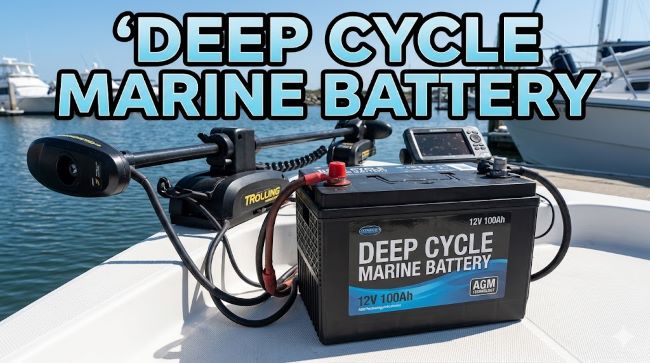
Deep Cycle vs. Starting: The Fundamental Difference
Most confusion about marine batteries starts here, so getting this clear first makes everything else easier.
A marine starting battery delivers a large burst of current for a short period. It is designed to crank an engine to life. The plates inside are thin and numerous, which maximizes the surface area available for rapid chemical reactions. The trade-off is that a starting battery cannot handle being discharged to a low level. Doing so repeatedly damages the plates and shortens the battery’s life significantly.
A deep cycle marine battery delivers current at a lower, sustained rate over a long period. The plates are thicker and fewer, designed to handle repeated deep discharging and recharging without degrading. A deep cycle battery can be discharged to 50 percent (lead-acid) or 80 percent (lithium) of its capacity repeatedly over hundreds or thousands of cycles without damage.
A dual-purpose marine battery is a compromise: it can start an engine and handle moderate deep cycling, but it does neither as well as a dedicated battery. For boats with a single battery, dual-purpose is a practical choice. For boats with separate battery banks (one for starting, one for accessories and trolling), dedicated starting and deep cycle batteries outperform dual-purpose for their specific roles.
The bottom line: if you are running a trolling motor, powering onboard electronics, or running a 12v battery bank for accessories, you need a deep cycle battery. If you need to start the engine, you need a starting battery. Many serious boaters run both.
Battery Chemistries: Flooded, AGM, and Lithium
Within the deep cycle marine battery category, three chemistries are widely available, each with meaningful differences in performance, maintenance, and cost.
Flooded Lead-Acid (FLA)
Flooded marine batteries are the original and still the most affordable option. The electrolyte is a liquid sulfuric acid solution that surrounds the lead plates. These batteries require maintenance: the water in the electrolyte evaporates during charging, and you need to check and top up the electrolyte with distilled water periodically. They also need to be mounted upright and in a ventilated space because they off-gas hydrogen during charging.
The advantages are cost and availability. A quality flooded deep cycle marine battery costs significantly less than AGM or lithium options of equivalent capacity. For boaters who do not mind the maintenance and want to minimize upfront cost, flooded batteries are a practical choice.
Typical lifespan: 3 to 5 years with proper maintenance and care.
AGM (Absorbed Glass Mat)
AGM marine batteries have the electrolyte absorbed into fiberglass mats between the plates. This sealed construction eliminates maintenance, eliminates off-gassing under normal use, and allows the battery to be mounted in any orientation. AGM batteries handle vibration better than flooded batteries, which matters in rough water conditions.
The performance advantages of AGM over flooded are real: faster charge acceptance, better deep cycle performance, and longer cycle life. A quality AGM deep cycle marine battery typically lasts 5 to 8 years under proper conditions.
The trade-off is price. AGM batteries cost roughly twice what flooded batteries cost for equivalent capacity. For most boaters who want a maintenance-free option without paying lithium prices, AGM is the best balance of performance and cost.
Lithium Marine Batteries
Lithium iron phosphate (LiFePO4) marine batteries are the premium option. They cost three to five times more than comparable AGM batteries, but the performance differences are substantial:
- Usable capacity: Lithium can be safely discharged to 80 to 100% of rated capacity. Lead-acid batteries should not go below 50% regularly. This means a 100Ah lithium battery provides roughly the same usable capacity as a 200Ah lead-acid battery.
- Weight: Lithium batteries weigh 40 to 60% less than equivalent lead-acid batteries. On a boat, this matters for performance and fuel efficiency.
- Cycle life: Quality lithium marine batteries are rated for 2,000 to 5,000 charge cycles, compared to 200 to 500 for flooded and 500 to 1,200 for AGM.
- Charge speed: Lithium accepts charge faster and does not need to be charged immediately after use, unlike lead-acid batteries which suffer sulfation if left discharged.
The case against lithium marine batteries is primarily upfront cost. For serious anglers who run trolling motors all day, or liveaboard boaters with significant power demands, the long-term cost per cycle often favors lithium despite the higher purchase price. For weekend boaters with modest power needs, AGM delivers most of the practical benefits at a lower price.
Understanding Battery Group Sizes for Marine Applications
The group size system (Group 24, Group 27, Group 31, etc.) is a standardization from the Battery Council International (BCI) that defines the physical dimensions of a battery case. All Group 27 batteries from any manufacturer have the same footprint and terminal placement, regardless of chemistry.
Group 24 marine battery:
- Dimensions: approximately 10.3 x 6.8 x 9.4 inches
- Typical capacity: 70 to 85 Ah
- Common use: smaller boats, moderate electronics loads, smaller trolling motors
Group 27 deep cycle battery:
- Dimensions: approximately 12.4 x 6.8 x 9.4 inches
- Typical capacity: 85 to 105 Ah
- Common use: mid-size boats, 24-volt trolling motor systems (two batteries), significant electronics loads
- The group 27 deep cycle battery is the most commonly used size for serious freshwater anglers
Group 31 marine battery:
- Dimensions: approximately 13 x 6.8 x 9.4 inches
- Typical capacity: 95 to 130 Ah
- Common use: saltwater fishing, larger boats, high-demand trolling motors, multi-battery banks
Group 34 and Group 4D/8D: Larger commercial and offshore applications with 150 to 230+ Ah capacity.
The group size to choose depends on the physical space in your battery compartment, the amp-hour capacity you need, and the weight limit your boat can handle. Measure your battery box before ordering.
Trolling Motor Battery: What to Look For
The trolling motor battery application is one of the most demanding uses for a deep cycle marine battery. Trolling motors draw sustained current over many hours, which is exactly the scenario that distinguishes deep cycle performance from starting battery performance.
Key specifications to evaluate for a trolling motor battery:
Amp-Hour (Ah) capacity: This determines how long the battery can run your motor before needing recharge. A rough calculation: a 55 lb thrust trolling motor draws approximately 40 to 50 amps at full power. A 100 Ah battery (50% usable for lead-acid = 50 Ah usable) gives roughly one hour at full power, or significantly longer at partial throttle. Most anglers operate at 50 to 70% throttle, which extends run time considerably.
Voltage: Most trolling motors run on 12v, 24v, or 36v. 12v motors use one battery. 24v motors use two 12v batteries wired in series. 36v motors use three. Each 12v battery in a multi-battery system should be identical to balance the load correctly.
Reserve capacity (RC): RC measures how long the battery can deliver 25 amps before dropping below 10.5 volts. Higher RC means longer run time at moderate loads.
Interstate Marine Battery and Other Notable Brands
Several brands have established strong reputations in the marine battery market. Knowing which manufacturers are respected helps narrow the field when comparing specific models.
Interstate marine battery: Interstate is one of the most widely distributed battery brands in North America, with service centers and retailers in most markets. Their marine deep cycle batteries cover flooded and AGM chemistries across all common group sizes. Widely available for in-store purchase.
Optima BlueTop: Optima’s spiral-cell AGM construction produces a particularly vibration-resistant battery, which is one reason the BlueTop is popular in rough-water fishing applications. Available in starting and dual-purpose versions.
Battle Born (LiFePO4): One of the better-established lithium marine battery manufacturers in the US market. Their 100Ah Group 31 lithium batteries are commonly used in tournament fishing and liveaboard applications.
VMAX: Known for high-capacity AGM batteries at competitive prices. Popular for trolling motor applications.
Trojan: Long-established in deep cycle applications across marine, RV, and solar markets. Their T-Series flooded batteries have strong cycle life documentation.
12V Deep Cycle Battery for RV and Dual Use
The 12v deep cycle battery market serves both marine and RV applications. A deep cycle rv battery and a marine deep cycle battery are often the same physical product marketed under different labels. The underlying chemistry and performance specifications are identical.
For boaters who also use the same batteries in an RV, camper, or off-grid solar setup, the compatibility is genuine. Group 27 and Group 31 batteries in particular are commonly used across marine, RV, and solar storage applications.
The main difference between marine-specific and RV-specific labeling tends to be vibration resistance and connector type. Marine batteries may have additional vibration testing to handle rough water, and marine terminals may be studs rather than SAE posts.
Charging Your Deep Cycle Marine Battery Correctly
Battery chemistry determines the correct charger settings. Using the wrong charger damages batteries over time.
- Flooded lead-acid: Charge at 14.4 to 14.8V, with a float voltage around 13.4V. Requires a three-stage charger (bulk, absorption, float).
- AGM: Charge at 14.4 to 14.6V with careful voltage control. AGM batteries are sensitive to overcharging, which damages the plates permanently. Use a charger specifically marked for AGM.
- LiFePO4: Charge at 14.4 to 14.6V with a lithium-compatible charger. Standard lead-acid chargers may not fully charge lithium batteries and can damage the battery management system (BMS) on some models.
Never charge a frozen battery. Store marine batteries above 50% charge during the off-season to prevent sulfation in lead-acid batteries or deep discharge damage in lithium.
For boaters thinking about the broader system design around their battery setup, smart home and system design principles apply to how marine electrical systems are planned and integrated. Tracking the cost of battery replacement cycles and marine equipment over a season is easier with expense tracking tools. And for anyone managing a fleet of boats or rental equipment with multiple batteries, project management tools help track maintenance schedules and replacement timelines.
Key Takeaways
- A deep cycle marine battery is built for sustained, slow discharge and repeated recharge cycles. It differs from a marine starting battery, which delivers short, high-current bursts to start an engine.
- Three chemistries are available: flooded (cheapest, requires maintenance), AGM (maintenance-free, better performance, mid-price), and lithium (most expensive, lightest, longest lifespan, most usable capacity).
- Lithium marine batteries provide 80 to 100% usable capacity vs. 50% for lead-acid, last 2,000 to 5,000 cycles, and weigh significantly less, but cost three to five times more upfront.
- Group 27 deep cycle battery is the most common size for freshwater fishing. Group 31 is preferred for saltwater, larger boats, and high-demand trolling setups.
- For a trolling motor battery, calculate amp-hour needs based on motor thrust, throttle usage, and desired run time. Lead-acid usable capacity is 50% of rated Ah. Lithium usable capacity is 80 to 100%.
- The interstate marine battery lineup is widely available and covers most common applications. Battle Born leads for lithium, Optima BlueTop for vibration resistance, and Trojan for deep cycle flooded.
- A 12v deep cycle battery for marine use is often the same product as an RV or solar storage battery, just marketed differently. Group 27 and 31 sizes work across all three applications.
- Always match your charger to your battery chemistry. AGM and lithium both require chargers specifically designed for their chemistry to avoid damage.