
Which of the Following Best Illustrates Deciding How to Produce a Specific Product?
Which of the following best illustrates deciding how to produce a specific product? This guide explains the three fundamental economic questions, factors of production, capital resources, and how efficient allocation works in any economy.
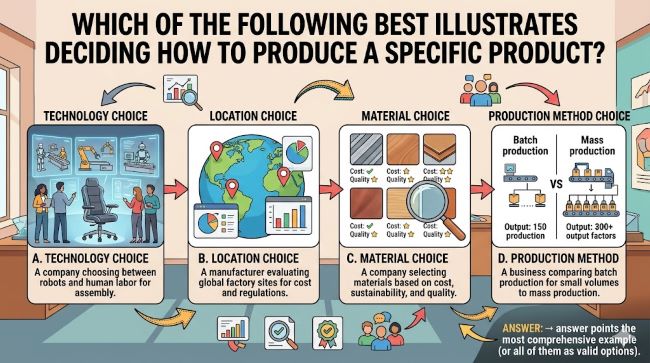
Economics courses at every level return to the same foundational questions eventually, and the one that trips students up most reliably is the “how to produce” question. When you see which of the following best illustrates deciding how to produce a specific product on a quiz or test, the question is not asking about marketing, pricing, or demand. It is asking specifically about production method decisions: the combination of resources a producer chooses to turn inputs into outputs.
Getting this distinction clear makes the entire three-question framework of economics click into place. This guide explains what the “how to produce” question means in practice, what the correct answer looks like compared to the wrong ones, and how it connects to the related concepts of efficient allocation and capital resources.
The Three Fundamental Economic Questions
Every economy, from a household to a national government to a private firm, faces three basic questions about resource allocation. Understanding all three in relation to each other is what makes any one of them clearer.
1. What to produce? This question asks which goods and services should be made. A country or firm cannot produce everything. It chooses based on what people want, what it is capable of producing, and what trade-offs exist between different options. An economy that decides to produce more military equipment and less consumer goods has answered the “what” question in a specific way.
2. How to produce? This is the question at the center of the quiz problem. Once you have decided what to make, you must decide which combination of productive resources (factors of production) to use to make it. Should you use more labor or more machines? Should you source materials locally or import them? Should you use a highly automated process or a more manual one? All of these are “how to produce” decisions.
3. For whom to produce? This asks who receives the goods and services that are produced. Distribution decisions: whether output goes to whoever can pay the most, whoever needs it most, or according to some other system.
A question asking which of the following best illustrates deciding how to produce a specific product is testing whether you can identify the second question from examples that might be confused with the first or third.
What the “How to Produce” Decision Actually Looks Like
The key to answering this question correctly is knowing that “how to produce” is always about the combination of inputs used in production, not about what is made or who gets it.
Correct examples of “how to produce” decisions:
- A bakery deciding whether to mix dough by hand or buy an industrial mixer
- A car manufacturer choosing between a highly automated assembly line and a labor-intensive production process
- A farmer deciding whether to use more workers at harvest time or invest in harvesting machines
- A clothing company deciding whether to manufacture in a high-wage domestic facility or outsource to a lower-wage overseas factory
- A construction company choosing between using prefabricated building components or building everything on-site
In each case, the decision is about which resources to combine and in what proportions. The product being made (bread, cars, wheat, clothes, buildings) is already decided. The question is how to get from raw inputs to finished output most effectively.
Wrong answers that look similar but are not “how to produce”:
- A company deciding whether to make cars or trucks (this is “what to produce”)
- A government deciding whether to subsidize food for low-income households (this is “for whom to produce”)
- A firm deciding what price to charge for its product (this is pricing, not production method)
- A country deciding to increase defense spending (this is “what to produce”)
The distinction seems simple once you see it, but multiple choice questions in economics courses deliberately construct answer choices that blur the line between the three questions. The test is whether you can hold the definition of “how to produce” steady when reading each option.
Which of the Following Will Be Accomplished by Efficient Allocations of the Factors of Production?
The related question about efficient allocation adds another layer to the framework. Which of the following will be accomplished by efficient allocations of the factors of production? The answer is producing the maximum possible output from available resources, or equivalently, avoiding waste in how inputs are combined.
Efficient allocation of factors of production means:
- Getting the most output for a given set of inputs
- Not leaving productive resources idle when they could be contributing to output
- Matching resources to the uses where they generate the most value
- Minimizing waste of labor, capital, land, and entrepreneurship
The four factors of production are land (all natural resources), labor (human effort and skill), capital (man-made tools and equipment used in production), and entrepreneurship (the organizing force that combines the other three into a productive enterprise).
When resources are allocated efficiently, an economy sits on its production possibilities frontier (PPF): the curve that shows the maximum possible combinations of two goods an economy can produce given its resources and technology. Being inside the curve means resources are not being used efficiently. Being on the curve means efficient allocation has been achieved.
Efficient allocation does not mean equal distribution. An economy can be on its PPF while distributing output very unequally. Efficiency is about production maximization, not about fairness in who receives what is produced.
Which of the Following Is an Example of a Capital Resource?
The question about which of the following is an example of a capital resource tests whether you know the specific definition of capital within economics, which differs from the everyday use of the word.
In everyday language, “capital” often means money. In economics, capital is a factor of production: man-made resources that are used to produce other goods and services. Capital is not consumed when you use it. It produces other things.
Examples of capital resources:
- A printing press used to produce newspapers
- A tractor used on a farm to grow crops
- A drill press in a manufacturing facility
- A delivery truck used by a distribution company
- A commercial oven in a restaurant kitchen
- Computer servers used by a software company to run its services
- A forklift in a warehouse
What is NOT a capital resource:
- Money (this is financial capital, not economic capital in the factors of production sense)
- Raw materials like iron ore or timber (these are land/natural resources)
- Workers (these are labor)
- The land a factory sits on (this is land, another factor of production)
- Consumer goods like a personal laptop or a family car (these are not used to produce other things)
The defining characteristic of capital as a factor of production is its role in the production process. If a resource is used to produce other goods and services, it is capital. If it is consumed or enjoyed directly, it is not capital in the economic sense.
A common wrong answer in multiple choice questions is money or financial investment. The question is specifically asking about physical capital (also called real capital), not financial capital. An investor’s stock portfolio is not a capital resource. The factory those stocks represent ownership of is.
Putting It Together: How These Three Concepts Connect
The three quiz concepts connect in a logical chain:
- Factors of production (land, labor, capital, entrepreneurship) are the inputs available to any economy or firm.
- Deciding how to produce is the process of choosing which combination of factors to use for a given output. When a firm decides to use more capital (machines) and less labor (workers), or vice versa, it is making a “how to produce” decision.
- Efficient allocation is what happens when the combination of factors is chosen well, generating maximum output without waste.
A practical example that ties all three together: a tomato producer deciding whether to harvest by machine or by hand is making a “how to produce” decision. The harvesting machine is a capital resource. If the producer correctly calculates that machines produce a higher yield per dollar spent in their specific context, and uses them accordingly, that is an efficient allocation of factors of production.
Why Economics Courses Ask These Questions This Way
The multiple choice format for these questions is designed to test whether you understand the concepts precisely, not just roughly. Students who have a fuzzy understanding of “how to produce” will select options that are about production in a general sense but not specifically about method choice. Students who confuse capital with money will get the capital resource question wrong even if they understand the general concept of factors of production.
The questions also test conceptual transfer: can you take a definition you learned and apply it to a novel scenario you have not seen before? That is why the examples in answer choices are always new situations rather than the examples from your textbook.
Useful study habits for these question types:
- Memorize the exact definitions of all four factors of production and be able to distinguish them from each other with concrete examples
- Practice sorting scenarios into the three economic questions (what, how, for whom) before you need to do it under test conditions
- When evaluating answer choices for the “how to produce” question, ask: is the decision being made about which inputs to combine, or about something else?
- For capital resource questions, apply the test: is this resource used to produce something else, or is it consumed directly?
Understanding how economic decisions are structured connects to broader thinking about how good design and resource decisions affect outcomes. The logic of efficient allocation in economics parallels how project management tools help teams allocate time and resources effectively. And for students building study systems across multiple subjects including economics, browser-based tools for organizing information and study workflows are worth exploring.
Key Takeaways
- Which of the following best illustrates deciding how to produce a specific product? The correct answer is always a scenario where a producer chooses which combination of inputs (labor, capital, land) to use to make something, not a scenario about what to make or who receives it.
- The three fundamental economic questions are: what to produce, how to produce, and for whom to produce. Each has a distinct type of correct answer.
- Which of the following will be accomplished by efficient allocations of the factors of production? Efficient allocation produces the maximum possible output from available resources, placing an economy on its production possibilities frontier. It is about production maximization, not distribution fairness.
- Which of the following is an example of a capital resource? Capital resources are man-made tools and equipment used to produce other goods and services: tractors, printing presses, factory machines, delivery trucks, commercial ovens. Money and raw materials are not capital resources in the economic sense.
- The four factors of production are land (natural resources), labor (human effort), capital (man-made productive tools), and entrepreneurship (the organizing force).
- When answering multiple choice questions about these concepts, apply precise definitions to each answer choice rather than relying on general impressions of which option sounds most “production-related.”