Which of the Following Statements Most Directly Expresses the Author’s Thesis In The Passage? A Complete AP Lang Guide
Struggling with “which of the following statements most directly expresses the author’s thesis in the passage?” This guide covers exactly how to answer this question type in AP Lang unit 4 and unit 8 progress check MCQs with clear, practical strategies.
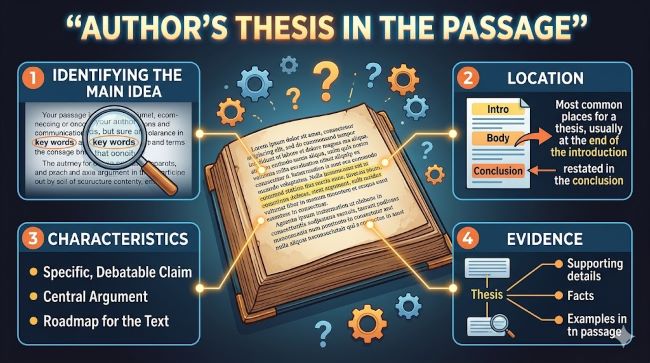
There is a specific type of multiple choice question that trips up more AP Language and Composition students than almost any other: “which of the following statements most directly expresses the author’s thesis in the passage?” It sounds simple until you read the answer choices and find three of them that each feel partially correct. That is not an accident. The question is designed to test whether you understand what a thesis actually does, not just whether you can find a sentence that sounds important in the first or last paragraph. This question type appears regularly in the unit 4 progress check mcq ap lang and unit 8 progress check mcq ap lang assessments, and answering it well requires a specific approach that most students have not been explicitly taught. This guide breaks down exactly what the question is testing, why the wrong answers are designed to look right, and how to identify the correct answer every time.
What the Question Is Actually Testing
Before getting into strategy, it helps to understand what AP Lang examiners mean by “thesis” and why they ask about it this way.
In AP Language and Composition, a thesis is not simply a topic sentence or a statement of the subject. The College Board defines a thesis as the writer’s central claim or argument, the position they are defending and that the entire text works to support. A thesis must be debatable. It must take a position rather than state a fact. And it must be broad enough to account for everything the author does in the passage, not just one section of it.
The phrase “most directly expresses” is significant. The question is not asking you to find the author’s thesis statement, because the thesis may not appear as a single explicit sentence. It is asking you to identify which answer choice most accurately and precisely captures what the author is arguing across the whole passage.
This means you need to read the passage as a whole argument before looking at the answer choices.
Why the Wrong Answers Are Designed to Look Correct
The four or five answer choices in this question type follow a predictable structure once you know what to look for. Understanding why wrong answers seem right is just as useful as knowing how to spot the correct one.
Too narrow: One or two wrong answers will capture something the author argues in a single paragraph or section but not across the whole text. These answers feel right because they are accurate, just not comprehensive enough to be the thesis.
Too broad: One wrong answer often describes the general subject or topic of the passage without taking a position. “The author discusses the effects of technology on modern communication” is a topic summary, not a thesis. A thesis takes a stance.
Outside the text: One wrong answer may express an idea that seems plausible or related to the topic but that the author does not actually argue. These are particularly dangerous because they often align with your prior knowledge or opinions about the subject, pulling you away from what the text actually says.
Partially correct: The most dangerous wrong answer combines something true from the passage with something the author does not claim. The accurate part makes it feel reliable, and the incorrect part slips past if you are not reading carefully.
Knowing these categories means you can sort answer choices before you try to pick the best one.
Step-by-Step Strategy for This Question Type
Step 1: Read the Passage for the Central Argument
Do not skim. The passages in the ap lang unit 4 progress check mcq and unit 8 progress check mcq ap lang assessments are typically 400 to 700 words. Reading them takes three to four minutes, which is time well spent.
As you read, ask: what position is the author defending? What does the author want the reader to believe or understand by the end of this passage? Note the beginning, the middle, and the end. Does the argument build? Does it shift? Where does the author place the most rhetorical energy?
Often the thesis is clearest at the end of the introduction or at the end of the passage. But it is not always stated explicitly, and in AP Lang passages it is common for the thesis to be inferred from the overall argument rather than quoted directly.
Step 2: Write Your Own Answer in One Sentence Before Looking at the Choices
This is the single most effective technique for this question type and the one most students skip because they feel it takes too long.
After reading the passage, cover the answer choices and write or mentally formulate a one-sentence answer to: what is this author arguing? Be as specific as possible. Include the author’s position, not just the topic.
Then uncover the answer choices and look for the one that most closely matches what you said. This prevents the answer choices from rewriting your interpretation of the passage before you have formed one.
Step 3: Sort the Answer Choices Using the Four Wrong-Answer Categories
Go through each choice and identify which category it falls into:
- Is this too narrow (only covers part of the text)?
- Is this a topic statement without a position?
- Does the author actually argue this, or is it adjacent to what they argue?
- Is part of this true but part of it wrong?
You are not looking for the answer that is correct in isolation. You are looking for the answer that most accurately and completely represents the author’s central claim across the whole passage.
Step 4: Test the Finalist Answers Against the Passage
Once you have narrowed to two options, test each one by asking: can I find evidence throughout the passage that supports this specific claim? A true thesis will have support in multiple sections of the text, not just one paragraph.
If one answer only connects to the opening or only to the conclusion, it is likely too narrow. If one answer connects to the overall movement of the argument, including the evidence the author chooses and the way they frame their conclusion, it is likely the thesis.
What Makes AP Lang Thesis Questions in Unit 4 and Unit 8 Different
The unit 4 progress check mcq ap lang focuses primarily on the rhetorical situation and argumentation. Unit 4 in the AP Lang curriculum covers claims, evidence, and commentary, so the thesis questions in this unit tend to involve passages where the argument structure is explicit and the student needs to distinguish the main claim from the supporting claims.
The unit 8 progress check mcq ap lang operates at the synthesis level, where students are expected to understand how arguments function across multiple contexts and to evaluate the complexity and sophistication of an author’s position. Thesis questions in unit 8 often involve passages with more nuanced arguments, where the thesis requires inference rather than direct quotation.
In both units, the core skill being tested is the same: can you read a passage and identify what the author is actually arguing, as distinct from what the author is discussing, what evidence the author uses, or what conclusion the author reaches?
The difference between the conclusion and the thesis is worth clarifying here. A conclusion is the last thing the author says. The thesis is the central claim the whole passage supports. They may be the same sentence. They are often different. A passage about climate policy might conclude with a call to action, but the thesis might be the argument that specific policy types are more effective than others. The call to action supports the thesis; it is not itself the thesis.
Common Mistakes Students Make on This Question Type
Reading only the first and last paragraph. The thesis questions in AP Lang progress checks are designed to test whether you read the whole passage. Answer choices are often constructed to match arguments that appear only in the introduction or only in the conclusion, specifically to catch students who did not read the body.
Choosing the most extreme answer. Students sometimes assume the author’s thesis must be their strongest or most controversial claim. In nonfiction argumentation, the thesis is the central position, which is often measured and qualified rather than extreme.
Choosing familiar ideas over accurate ones. If an answer choice expresses an idea you personally agree with or that you know to be true from outside the passage, you may gravitate toward it even if it does not match what the author actually argues. The only source of information for this question is the text in front of you.
Ignoring qualifiers in the answer choices. The words “all,” “some,” “primarily,” “in certain cases,” and “most effectively” in answer choices change the meaning significantly. An answer that says “technology always improves communication” is different from one that says “technology can improve specific types of communication under particular conditions.” The passage determines which level of qualification is accurate.
Practice Application: Identifying a Thesis in a Sample Structure
Here is a general framework for applying the strategy to any passage you encounter in AP Lang assessments.
Imagine a passage arguing that urban green spaces reduce stress in city populations. The author provides three types of evidence: studies on cortisol levels in park visitors, comparative data on mental health outcomes in neighborhoods with and without green space, and historical analysis of city planning movements.
The thesis is not:
- “Green spaces are pleasant.” (too broad, no debatable position)
- “Studies show cortisol drops in parks.” (too narrow, one piece of evidence)
- “All urban areas should convert parking lots to parks.” (outside the text, unless the author says this)
The thesis is something like: “Access to urban green spaces produces measurable improvements in population mental health outcomes, making them a priority in city planning.”
This covers the full argument, takes a position, and is supported by all three types of evidence the author uses.
Apply this test to the answer choices in your progress check questions. The correct answer will function like a thesis: supportable across the whole text, clearly positioned, and complete rather than partial.
Understanding how to read and evaluate complex arguments connects naturally to broader skills around how to design and structure clear, persuasive content. The typography and presentation of complex written arguments also relates to how typography affects comprehension and engagement. For students building study systems for AP Lang and other exams, effective organization and project tracking tools help manage preparation across multiple units and assessment types.
Key Takeaways
- Which of the following statements most directly expresses the author’s thesis in the passage? is testing your ability to identify the central claim the author defends across the whole text, not just a summary of the topic or a quotation from the conclusion.
- In the unit 4 progress check mcq ap lang, focus on distinguishing main claims from supporting claims within explicitly structured arguments.
- In the unit 8 progress check mcq ap lang, expect passages with more nuanced arguments where the thesis requires inference from the overall text rather than direct quotation.
- Wrong answers follow four patterns: too narrow, too broad (topic statement), outside the text, or partially correct. Identifying which pattern each wrong answer follows speeds up elimination.
- Write your own one-sentence answer before reading the answer choices. This prevents the choices from rewriting your interpretation of the passage before you have formed one.
- Test finalist answers by asking whether they are supported across multiple sections of the passage, not just one paragraph. A true thesis has textual support throughout the argument, not only at the beginning or end.
- Never choose an answer based on your prior knowledge or personal agreement with the idea. The only relevant source is the passage in front of you.