2000s Cartoons: The Complete Nostalgic Guide to the Best Shows of the Era
The best 2000s cartoons spanned Cartoon Network, Disney Channel, Nickelodeon, and PBS. This guide covers the cartoon network shows 2000s fans still talk about, the old kids shows that shaped a generation, and why early 2000s cartoons hold up so well.
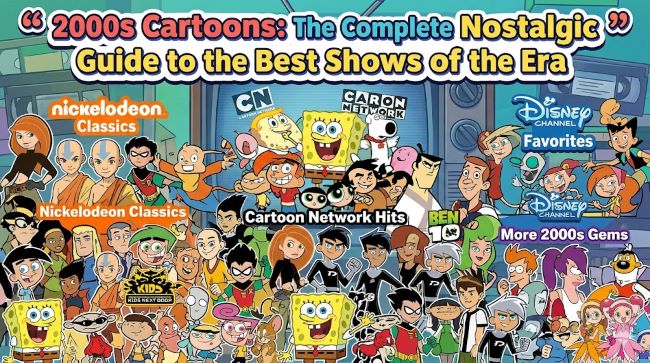
Saturday morning used to mean something. You woke up before your parents, poured a bowl of cereal, and parked in front of the television for a block of programming that felt specifically designed for you. The 2000s cartoons era ran from roughly 2000 to 2010 and produced a generation’s worth of childhood television that people are still rewatching, referencing, and streaming in their late twenties. The shows from this period were not all brilliant, but the best of them were genuinely creative, funny, and built to hold attention in ways that modern kids’ content often does not. This guide covers the essential early 2000s cartoons across every major network, organized by where they aired and what made them worth watching.
Why 2000s Kids Shows Hit Different
Before getting into the shows themselves, it is worth understanding why the 2000 to 2010 kid TV shows period is remembered the way it is.
The early 2000s sat in a productive middle ground for animation. The 1990s boom in animation quality had already happened, raising the standard for what cartoons could look like and how they could be written. Digital tools were becoming more accessible to studios, allowing for visual experiments that were harder to execute in purely traditional animation. And the major networks were investing in original programming specifically for children rather than licensing everything from outside studios.
Cartoon Network, Disney Channel, Nickelodeon, and PBS were all producing original content simultaneously, creating genuine competition that pushed each network to take creative risks. The result was a wider variety of tone, style, and subject matter than any single generation of kids’ television before it.
Cartoon Network Shows 2000s: The Network That Took the Most Risks
Cartoon Network was the most distinctive of the major networks during this period. Its willingness to air programming that was weird, experimental, and occasionally aimed as much at teenagers and adults as at children made it the network that produced the most talked-about shows of the era.
Samurai Jack (2001-2004, 2017): An action show built on art direction rather than dialogue. Samurai Jack follows a warrior displaced in time who fights his way through surreal landscapes hunting the shape-shifting demon who sent him there. The show used long stretches without dialogue, distinctive visual compositions drawn from Japanese art and cinema, and a sustained tonal seriousness that was unusual for early 2000s cartoons. Its revival in 2017 finished the story it started, but the original run is what most people remember.
The Powerpuff Girls (1998-2005): Technically a 90s cartoon that ran deep into the 2000s, it defined what a superhero parody aimed at children could look like. The show worked for parents watching alongside their kids because the humor operated on two levels simultaneously.
Foster’s Home for Imaginary Friends (2004-2009): Created by Craig McCracken, who also created the Powerpuff Girls, Foster’s followed a boy named Mac and his imaginary friend Bloo in a home for imaginary friends whose children have outgrown them. The show’s central premise generated genuine emotional weight alongside its comedy.
Ed, Edd n Eddy (1999-2009): One of the longest-running original Cartoon Network shows, it followed three boys in a cul-de-sac whose schemes to earn money for jawbreakers drove every episode. The animation style was deliberately distorted and rubbery, and the show’s humor was grounded in the social dynamics of childhood in a way that made it more real than most of its contemporaries.
The Grim Adventures of Billy and Mandy (2001-2007): A darker, stranger show than most cartoon network shows old fans discuss. The central premise (two children win a limbo game against the Grim Reaper and force him to be their best friend) sustained six seasons of genuinely odd comedy that veered into horror territory in ways that surprised first-time viewers.
Teen Titans (2003-2006): Teen Titans adapted DC’s superhero team for a younger audience with a visual style influenced by anime and a tonal range from genuinely funny to genuinely dark. It ended without resolution and generated enough demand that it eventually produced a sequel series (Teen Titans Go!) years later.
Codename: Kids Next Door (2002-2008): A spy action parody that cast children as operatives running missions against the adult world. It built out an impressive mythology across its run and treated its premise with more internal consistency than most kids shows 2000s audiences were accustomed to.
2000s Disney Shows: The Channel’s Creative Peak
The 2000s disney shows period coincides with what many fans consider the Disney Channel’s strongest original programming era.
Kim Possible (2002-2007): Kim Possible followed a high school girl who moonlights as a world-saving secret agent. The show ran for four seasons, got cancelled after three, and was brought back by fan demand for a fourth season, which was unusual for the era. The character design, the action sequences, and the consistent comedy made it one of the best-executed 2000s cartoon characters in terms of staying power.
Lilo and Stitch: The Series (2003-2006): A direct spinoff of the 2002 film, it expanded the premise of Earth being used as a dumping ground for alien experiments. Each episode introduced a new experiment with a specific quirk that needed to be rehabilitated.
Dave the Barbarian (2004-2005): A short-lived but genuinely funny parody of fantasy adventure tropes. It is one of the more forgotten 2000s cartoon characters collections from the Disney Channel era.
The Proud Family (2001-2005): One of the first Disney Channel animated series centered on a Black family, it followed teenager Penny Proud and her family through ordinary and extraordinary situations. The show was rebooted in 2022 with Louder and Prouder on Disney+.
American Dragon: Jake Long (2005-2007): A teenage boy secretly serves as the American Dragon, protecting the magical creatures living in New York City. The show leaned into its action sequences more than most Disney Channel animation of the period.
Nickelodeon: The Mix of Weird and Warm
Nickelodeon’s contribution to 2000s cartoons ran parallel to Cartoon Network’s but with a slightly different flavor. Nick’s shows tended to be warmer and more character-driven where CN shows were more conceptually adventurous.
SpongeBob SquarePants (1999-present): The dominant Nickelodeon show of the era by a wide margin. The episodes from the first three seasons (1999-2004) are the ones most people reference when they talk about early 2000s kids shows that were genuinely funny for adults. The show’s writing quality shifted after creator Stephen Hillenburg stepped back briefly, and the first three seasons are treated as the canonical classic era.
The Fairly OddParents (2001-2017): Timmy Turner’s fairy godparents grant wishes that inevitably go wrong in creative ways. The show sustained its central premise with impressive invention across its early seasons.
Danny Phantom (2004-2007): A half-ghost teenager fights supernatural threats in a show that combined superhero conventions with horror elements. It ended without full resolution and has maintained a devoted fanbase that has repeatedly called for a revival.
Invader Zim (2001-2002): Technically a failure in its original run (it was cancelled after less than two seasons), Invader Zim became one of the most significant cartoons from the 2000s in terms of cultural impact. Its dark humor, nihilistic edge, and visual style influenced an enormous amount of alternative internet culture in the years that followed.
PBS Shows 90s and 2000s: The Educational Block That Did Not Feel Educational
PBS’s contribution to old kids shows during this period is often overlooked in nostalgic lists because the network’s programming was more directly educational, but several PBS shows 90s and 2000s generations remember were genuinely excellent.
Arthur (1996-2022): The longest-running animated children’s series in American television history. Arthur dealt with genuinely difficult topics (chronic illness, learning disabilities, cultural identity) in ways that held up because the show treated them with real honesty.
Cyberchase (2002-present): A math-focused adventure series that remains one of the more effective educational shows ever produced because it never tried to hide that it was teaching. Kids who watched it remember the math.
Between the Lions (2000-2010): A literacy-focused show that used puppetry and animation to teach reading. It was less iconic than Arthur but served a distinct educational purpose during a period when early reading intervention was a genuine policy priority.
What Made Old Cartoon Network Shows and Kids TV from This Era Last
The cartoons from the 2000s that people still talk about share a few common features that explain why they lasted beyond their original run.
They trusted their audience. The best early 2000s cartoons did not talk down to children. They used complex vocabulary, developed ongoing storylines that required viewers to remember previous episodes, and included humor and references aimed at older viewers that children simply accepted without fully understanding.
They had visual identities. The most memorable cartoon shows 2000s audiences grew up with looked distinctive. Samurai Jack looked different from Foster’s Home, which looked different from Teen Titans. The era rewarded artistic experimentation in ways that algorithmically optimized modern children’s content often does not.
They built characters over time. The shows that ran for multiple seasons used their runtime to develop characters beyond their initial premise. Kim Possible’s relationship with Ron changed across the series. Ed, Edd n Eddy’s character dynamics deepened with every season. This gave children who grew up with the shows a sense of real investment.
The design and visual language of the 2000s cartoons era reflects broader principles that still apply in animation and character design today. Understanding how animation and visual storytelling communicate character shows why certain 2000s cartoon characters remain so visually recognizable decades later. The color choices in shows like Teen Titans and Kim Possible reflect how color psychology shapes viewer response across an entire episode. And the poster and promotional design language of early 2000s kids TV connects to how animation and film posters communicate tone and audience.
Key Takeaways
- The 2000s cartoons era (2000 to 2010) produced some of the most creatively diverse children’s television in the medium’s history, driven by genuine competition between Cartoon Network, Disney Channel, Nickelodeon, and PBS.
- Cartoon Network shows 2000s highlights include Samurai Jack, Teen Titans, Foster’s Home for Imaginary Friends, Ed Edd n Eddy, Codename: Kids Next Door, and The Grim Adventures of Billy and Mandy.
- 2000s Disney shows standouts include Kim Possible, Lilo and Stitch: The Series, The Proud Family, and American Dragon: Jake Long.
- Early 2000s cartoons from Nickelodeon include SpongeBob’s classic era (Seasons 1-3), Danny Phantom, Fairly OddParents, and the cult-status Invader Zim.
- PBS shows 90s and 2000s included Arthur, Cyberchase, and Between the Lions, all of which treated educational content seriously without hiding that teaching was the goal.
- The old cartoon network shows and kids TV of this period lasted because they trusted their audience, developed distinctive visual identities, and built characters over multiple seasons rather than resetting each episode.
- 2000s cartoon characters from this era remain culturally recognizable because the shows gave them enough screen time to become genuinely three-dimensional over multiple seasons.
- For anyone looking to revisit childhood cartoons, most of the shows listed above are available on streaming platforms including HBO Max (Cartoon Network catalog), Disney+, Peacock, and Paramount+.