There Are Three Different Types of Slings. What Determines Which Type You Use?
Rigging a load incorrectly is one of the fastest ways to turn a routine lift into a serious accident. The sling is the connection point between the crane and the load, and choosing the wrong one for the job puts everything at risk: the load, the equipment, the people nearby. There are three different types of slings — wire rope, chain, and synthetic — and what determines which type you use comes down to a set of specific factors: the weight and shape of the load, the surface condition of the material, the working environment, and the hitch configuration. This guide breaks down each type, explains what each one is built for, and covers how the most common accidents which occur when using cranes can be reduced through correct sling selection and rigging practice.
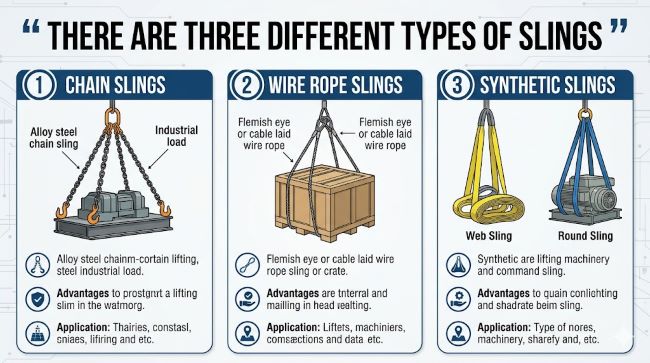
The Three Types of Lifting Slings
Before getting into selection factors, it helps to understand what each type is made of and what it is inherently good at.
1. Wire Rope Slings
Wire rope slings are made from multiple strands of steel wire wound together to form a rope, which is then configured into a sling using end fittings such as eyes, hooks, or thimbles. They are the most common rigging slings used in heavy industrial environments.
What they are good for:
- High-temperature environments (up to around 400°F / 200°C without significant capacity loss)
- Loads with sharp or abrasive edges when used with edge protection
- Heavy, rough loads that would damage synthetic slings
- Applications where some resistance to crushing is needed
Limitations:
- Wire rope can kink permanently if mishandled, which reduces its load rating
- Damaged wire rope is dangerous and requires close visual inspection before every use
- Not suitable for use on polished or finished surfaces without protection, as the wire can scratch or mark the load
- Heavier to handle than synthetic alternatives
Wire rope slings are available in single-leg, two-leg, three-leg, and four-leg configurations, and can be used in straight (vertical), choker, or basket hitches depending on the lift requirements.
2. Chain Slings
Chain slings use alloy steel chain links and are the most durable of the three types of lifting slings. They can be adjusted in length, repaired by replacing individual links, and withstand the harshest working conditions.
What they are good for:
- Extreme temperature environments (suitable for use in foundries, steel mills, and other high-heat applications where wire rope would fail)
- Loads with rough, irregular, or sharp surfaces
- Repeated heavy lifts in abusive environments where other sling types would wear out quickly
- Applications requiring adjustable sling length
Limitations:
- The heaviest sling type to handle, which increases physical demand on riggers
- Chain slings must be inspected closely for stretched or deformed links, which indicate overload damage
- More expensive upfront than wire rope or synthetic options
- Can damage fragile or finished load surfaces if contact protection is not used
Chain slings carry a grade designation. Grade 80 and Grade 100 are the standard ratings for lifting slings in most industrial settings. Grade 100 chain has a higher working load limit for the same chain size as Grade 80, which makes it useful when weight reduction in rigging equipment matters.
3. Synthetic Slings
Synthetic slings include two main types: web slings (made from polyester or nylon webbing) and round slings (also called endless round slings or soft slings, made from synthetic fiber bundles encased in a protective jacket). Both use synthetic materials rather than metal, which changes their behavior and application significantly.
What they are good for:
- Loads with polished, painted, or easily damaged surfaces (machinery, equipment, fabricated components)
- Lightweight loads where the sling’s own weight would be a burden on the rigger
- Applications requiring flexibility in how the sling conforms to the shape of the load
- Environments where metal sparks are a hazard (round slings are non-sparking)
Limitations:
- Cannot be used in high-temperature environments; polyester slings lose capacity at temperatures above 194°F (90°C) and nylon at similar thresholds
- Susceptible to cuts from sharp edges: a synthetic sling that contacts a sharp edge without protection can fail catastrophically
- Susceptible to chemical damage from acids, caustics, and certain solvents
- UV degradation over time if stored in sunlight
Web slings and round slings are both color-coded by capacity in most standard systems, which helps riggers quickly identify the working load limit (WLL) of each sling at the point of use.
What Determines Which Type You Use?
The selection process comes down to six factors. Walk through each one for every lift and the right sling type becomes clear.
1. Weight of the Load
The working load limit (WLL) of the sling must meet or exceed the load weight, accounting for the hitch configuration. A basket hitch increases the WLL compared to a choker hitch with the same sling. Rigging calculators and load charts determine the actual load on each sling leg when a multi-leg configuration is used and the lift angle comes into play.
2. Shape and Surface Condition of the Load
Irregular shapes with sharp edges require wire rope or chain slings, or synthetic slings with proper edge protection. Smooth, finished, or easily scratched surfaces call for synthetic slings. Rough, abrasive, or extremely heavy loads call for wire rope or chain.
3. Working Temperature
High-heat environments eliminate synthetic slings from consideration and may push beyond wire rope’s operating range into chain sling territory. Cold environments are generally fine for all three types, though very cold temperatures can affect some synthetic materials.
4. Chemical Environment
If the lift takes place in an environment where the sling contacts chemicals, check the manufacturer’s chemical compatibility chart. Acids can attack nylon. Caustics can attack polyester. Neither harms chain or wire rope in most cases, though specific chemicals may affect any material.
5. Hitch Type and Geometry
The three standard hitch configurations are:
- Vertical (straight) hitch: The sling runs straight from the hook to the load. The WLL equals 100% of the sling’s rated capacity.
- Choker hitch: The sling wraps around the load and passes through itself or an end fitting. This reduces the effective WLL to around 75-80% of rated capacity for most slings. It also controls the load’s rotation.
- Basket hitch: The sling passes under the load with both ends attached to the crane hook. This can increase the effective WLL up to twice the single-leg rating, depending on the sling angle.
Sling angle matters in a basket hitch. As the angle between the sling legs and the horizontal decreases, the load on each leg increases significantly. At a 30-degree angle from horizontal, the tension in each sling leg reaches twice the vertical load component. Rigging slings at angles below 30 degrees from horizontal is generally not recommended without careful load calculation.
6. Frequency and Duration of Use
For one-time or infrequent lifts on a budget, web slings can be cost-effective. For daily heavy lifts in tough conditions, the durability and repairability of chain slings often make them the better long-term choice despite their higher upfront cost.
How Can the Most Common Accidents Which Occur When Using Cranes Be Reduced?
The question of how can the most common accidents which occur when using cranes be reduced comes up alongside sling selection because the two are directly connected. A significant percentage of crane and rigging incidents trace back to sling failure, incorrect rigging, or overloading, all of which are preventable.
The most common crane and rigging accidents:
- Sling failure due to overload: Using a sling beyond its working load limit, or failing to account for sling angle reducing effective capacity. Prevention: use load charts, calculate actual sling load for the hitch configuration, and include a safety factor.
- Sling failure due to damage: Using a sling that has visible wear, cuts, kinks, broken wires, deformed links, or chemical damage. Prevention: inspect all rigging slings before every lift. OSHA and ASME B30.9 standards specify rejection criteria for each sling type.
- Dropped loads from improper hitching: A choker hitch that is not properly positioned, a basket hitch that allows the load to shift, or end fittings that are not properly seated. Prevention: verify hitch configuration before the lift begins and confirm load balance.
- Crane overload: Attempting to lift a load that exceeds the crane’s rated capacity for that boom angle and radius. Prevention: know the crane’s load chart and never exceed it.
- Struck-by incidents: People in the path of a moving load or a failed sling. Prevention: establish exclusion zones, keep non-essential personnel clear of the lift area, and never stand under a suspended load.
- Communication failures: Misunderstood signals between the rigger and the crane operator. Prevention: use standardized hand signals or radio communication with one designated signal person.
Correct sling selection is one part of a broader rigging safety system. The right sling for the job, properly inspected, correctly hitched, and matched to a crane with sufficient capacity, removes the majority of failure risk from any lift.
Inspection: The Step That Saves Lives
Every sling type has a rejection standard. Knowing when to remove a sling from service is as important as knowing which sling to use.
Wire rope sling rejection criteria include:
- Ten randomly distributed broken wires in one rope lay, or five broken wires in one strand of a rope lay
- Kinking, crushing, bird-caging, or other distortion
- Heat damage
- End fitting damage or deformation
Chain sling rejection criteria include:
- Wear exceeding 10% of the original dimension at any point
- Stretch: a chain that measures longer than its original length has been overloaded
- Bent, twisted, or opened links
- Any crack or nick
Synthetic sling rejection criteria include:
- Cuts or tears
- Holes, abrasion, or acid/caustic burns
- Melting or charring
- Snags that distort the sling profile
- Broken or worn stitching in load-bearing areas
Remove any sling from service the moment it meets a rejection criterion. There is no acceptable risk when rigging is involved.
Understanding the design principles behind safety-critical tools connects to broader thinking about how design affects performance and reliability. For professionals managing rigging equipment inventories and inspection schedules, project management tools for tracking equipment status keep inspection records organized and auditable. And for teams communicating safety protocols across job sites, clear and effective visual communication tools ensure that critical information reaches the people who need it in a format they can act on.
Key Takeaways
- There are three different types of slings: wire rope, chain, and synthetic (web and round). What determines which type you use is a combination of load weight, surface condition, temperature, chemical exposure, hitch type, and frequency of use.
- Wire rope slings handle moderate to heavy loads, tolerate heat, and are versatile across industrial environments but require edge protection on sharp loads.
- Chain slings are the most durable rigging slings, suited for high-heat, abrasive, and repeated heavy-lift applications. Grade 80 and Grade 100 are the standard lifting ratings.
- Synthetic slings protect finished surfaces, are lightweight, and flexible but cannot tolerate heat, sharp edges without protection, or certain chemicals.
- Sling angle in a basket hitch directly affects the load on each leg. Angles below 30 degrees from horizontal create dangerous load multiplication and require careful calculation.
- How can the most common accidents which occur when using cranes be reduced? Through correct sling selection, thorough pre-lift inspection, proper hitch configuration, load chart compliance, exclusion zones, and clear communication between rigger and operator.
- Inspect every lifting sling before every use. Remove any sling from service the moment it shows a rejection criterion. No lift is worth a damaged sling.