Direct Characterization: The Complete Guide for Students and Writers
What is direct characterization? This complete guide covers the direct characterization definition, examples from literature, direct vs indirect characterization, dynamic characters, and how authors use both techniques together.
If you are studying literature or working on your own fiction writing, understanding direct characterization is one of those foundational concepts that makes everything else click. It sounds technical, but the idea is simple, and once you can identify it in what you read and use it intentionally in what you write, your understanding of how characters work deepens considerably. This guide covers the direct characterization definition, what it looks like in practice, how it compares to indirect characterization, and why skilled authors use both.
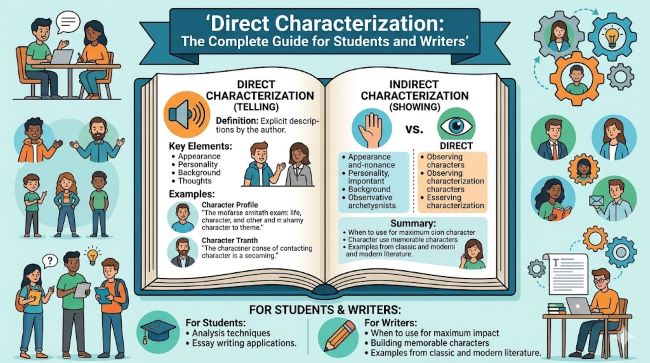
What Is Direct Characterization?
Direct characterization is when an author tells the reader about a character’s traits, personality, or appearance in an explicit, straightforward way. There is no reading between the lines required. The author simply states something about the character, and the reader accepts it as established fact about that person.
The direct characterization definition in literature refers to any passage where the narrator, another character, or the author directly describes who a character is, what they are like, or how they behave, without requiring the reader to draw inferences.
Here is a simple example:
“Maria was the most patient teacher in the school. She never raised her voice, and no question was too small for her attention.”
There is nothing hidden in that sentence. The author tells you directly: Maria is patient, calm, and attentive. You do not need to observe her actions or interpret her behavior to know this. The character information is handed to you clearly.
Direct Characterization Definition Literature: The Technical Breakdown
In literary terms, direct characterization sits on one side of a binary that defines how authors convey character information. The technical direct characterization definition in literature is: the method of characterization in which the author or narrator explicitly describes a character’s attributes, personality traits, physical appearance, or moral qualities.
Direct characterization can come from three sources in a text:
1. The narrator or author: The storytelling voice describes the character directly. This is the most common form.
“He was a dishonest man who had spent thirty years masking his true feelings behind a pleasant expression.”
2. Another character in the story: One character describes another in explicit terms.
“Don’t trust him,” she whispered. “He’ll charm you first and steal from you second. That’s just who he is.”
3. The character themselves: A character makes a direct statement about their own nature.
“I’ve always been stubborn. My mother used to say I argued with the sunrise.”
In all three cases, the character information is delivered, not implied. The reader receives it directly, without interpretation.
One Way an Author Uses Direct Characterization Is By Telling the Reader About the Character Through
The phrase “one way an author uses direct characterization is by telling the reader about the character through” appears often in literature assessments, and it points to something worth unpacking. There are several specific vehicles through which direct characterization is delivered:
Narrative description: The narrator pauses the action to tell you who the character is. This is the most common approach in third-person narration.
Another character’s dialogue: A character speaks about someone else in explicit terms. This method does double work: it tells you about the person being described and reveals something about the speaker’s perspective.
A character’s self-description: The character explicitly reflects on or states their own qualities. This works well in first-person narration and can be unreliable when the author intends to show that the character lacks self-awareness.
An omniscient narrator’s commentary: The all-knowing narrator steps in to tell the reader something about a character that no one inside the story knows. This is more common in classic literature and gives the author complete control over how a character is perceived.
Each of these methods tells the reader what to think about a character rather than showing behavior and letting the reader draw conclusions. That distinction is the heart of the direct vs indirect characterization debate.
Direct vs Indirect Characterization: The Core Difference
Understanding what is the difference between direct and indirect characterization is essential for literary analysis and for writing craft.
Direct characterization tells. The author hands you the information.
Indirect characterization shows. The author presents evidence, and you draw conclusions.
Both methods aim to reveal who a character is. The difference is in the mechanism.
A famous way to remember indirect characterization uses the acronym STEAL:
- S peech: What a character says and how they say it
- T houghts: What a character thinks, their inner world
- E ffect: How a character affects other people
- A ctions: What a character does, especially under pressure
- L ooks: Physical appearance and how a character presents themselves
In indirect characterization, you observe these elements and form your own judgment. The author never tells you “she was kind.” Instead, you see her give her lunch to a stranger and know she is kind from that action.
Direct characterization example:
“James was selfish. He had never once in his adult life done anything that did not serve his own interests first.”
Indirect characterization example showing the same quality:
James took the last two pieces of bread without asking whether anyone else was still hungry. He ate both slices and pushed back his chair with the satisfied look of a man who had never once considered that other people might be waiting.
The first version tells you James is selfish. The second shows you, through action and detail, and lets you arrive at “selfish” yourself. Both convey the same trait. The reader’s experience of arriving at that conclusion is different.
Examples of Direct Characterization in Literature
Looking at concrete examples of direct characterization from well-known texts helps you recognize the technique in practice.
Charlotte’s Web by E.B. White:
“Wilbur was a very young pig, and he was not very big. He had a friendly, lively personality.”
White tells the reader directly: Wilbur is young, small, and has a friendly, lively personality. No inference required.
The Great Gatsby by F. Scott Fitzgerald:
“I am one of the few honest people that I have ever known.”
Nick Carraway says this about himself directly in the novel’s opening pages. This is an example of self-characterization, and it is interesting because the novel goes on to complicate that claim. But as a direct characterization technique, it establishes his stated quality clearly.
Harry Potter and the Sorcerer’s Stone by J.K. Rowling:
“Mr. and Mrs. Dursley, of number four, Privet Drive, were proud to say that they were perfectly normal, thank you very much.”
Rowling uses the narrator’s voice to tell us directly that the Dursleys are proud of their normalcy. The word “proud” and the tone of “thank you very much” tell us something about their self-image immediately.
Romeo and Juliet by Shakespeare:
Characters in Shakespeare often describe each other directly through dialogue, which serves as both exposition and character revelation. When Benvolio describes Romeo to his parents as “sad” and “heavy,” that is direct characterization delivered through one character speaking about another.
Examples of Indirect Characterization
For comparison, here are examples of indirect characterization showing the same level of character information delivered through behavior, dialogue, and action rather than stated description.
The Catcher in the Rye by J.D. Salinger:
Holden Caulfield is never directly described as alienated or confused. Instead, Salinger shows him wandering New York alone, picking fights with strangers, and narrating with a voice that contradicts itself constantly. The reader builds a picture of his character through his actions and speech patterns.
To Kill a Mockingbird by Harper Lee:
Atticus Finch’s integrity is rarely described directly. Instead, Lee shows him sitting in front of the jail at night, defending Tom Robinson when no one else will, and speaking to his children with complete honesty about difficult things. His character is assembled through behavior.
1984 by George Orwell:
Winston Smith’s rebellious inner nature is revealed through his secret diary writing, his decision to buy the paperweight, and the way he observes those around him. Orwell shows Winston’s nonconformity rather than announcing it.
Direct Characterization and the Dynamic Character
One of the most important concepts to understand alongside characterization is the dynamic character. A dynamic character is one who undergoes significant internal change over the course of a story. They are different at the end than they were at the beginning, and that difference is meaningful.
Understanding how direct characterization interacts with dynamic characters is useful for both literary analysis and writing:
Early in a story, an author might use direct characterization to establish a character’s starting traits clearly. This gives readers a baseline.
As the story progresses, indirect characterization shows the character’s behavior, which may begin to contradict or complicate those established traits.
At a key turning point, another character or the narrator might again use direct characterization to name what has changed.
Consider this arc:
Opening: “Ben was a man who had never asked anyone for help. Pride was as natural to him as breathing.” (direct characterization establishing a starting point)
Middle: Ben’s actions throughout the story show that pride working against him. He loses opportunities, damages relationships. (indirect characterization showing consequences)
Resolution: A trusted friend says to him, “You’ve changed. You used to be too proud to ask for anything. Now you’re asking for what you need.” (direct characterization naming the shift)
The dynamic character’s journey is shown through indirect characterization but anchored at key moments by direct statements that name what has changed or is changing. This is how direct and indirect characterization work together rather than in opposition.
When to Use Direct Characterization as a Writer
Understanding the theory is one thing. Knowing when to actually use direct characterization in your own writing is where the craft knowledge becomes practical.
Use direct characterization when:
- You need to establish character information quickly, especially at the start of a story
- A minor character appears briefly and you do not have space to develop them through action
- You want to anchor a major shift in a character’s nature with explicit language
- The narrator’s voice is strong and authoritative, and editorial commentary feels natural
- You are writing in a genre where readers expect clear, efficient character setup (middle grade fiction, genre fiction, screenplay)
Be careful with direct characterization when:
- You are relying on it as a substitute for showing character through action. If you tell readers that a character is brave but never show them doing anything courageous, the characterization feels hollow.
- You want readers to form their own emotional connection to a character. Telling readers how to feel about someone can create distance. Showing them behavior and letting them draw conclusions creates more powerful reader investment.
- The character’s stated traits contradict their actions, and you do not intend that contradiction. Unintentional inconsistency between told and shown traits confuses readers.
The best fiction writers use direct and indirect characterization strategically. Direct characterization sets up the expectation. Indirect characterization either confirms it through consistent behavior or subverts it through contradiction, which creates complexity and surprise.
Why Both Types Matter for Strong Writing and Literary Analysis
The distinction between direct and indirect characterization is not just a literary classification exercise. It shapes the reader’s experience at a fundamental level.
When an author tells you who a character is, you start from a position of knowing. When an author shows you, you start from a position of observing. The first is efficient. The second is immersive. Both are tools, and the best writing uses them with purpose.
In literature assessments and essays, being able to identify which technique is at work in a passage and explain why the author made that choice is what separates a surface-level reading from a deeper one. When you can say not just “this is direct characterization” but “the author uses direct characterization here to quickly establish the character’s baseline nature before subverting it through action,” you are reading and writing at a much higher level.
Understanding how writers build their craft through technique and intentional choice is part of what makes fiction study meaningful. The choices authors make about when to tell and when to show are the same choices that shape how readers trust, invest in, and remember characters long after the book is finished. Exploring how design and creative communication choices build a stronger connection with an audience is a related idea: whether in writing or visual communication, the method of delivering information shapes how the audience receives it. And thinking about how storytelling techniques function in professional and brand contexts shows just how transferable these concepts are beyond literature class.
Key Takeaways
- Direct characterization is when an author explicitly states a character’s traits, personality, or appearance rather than showing them through behavior.
- What is direct characterization? It is the tell side of “show, don’t tell.” The author delivers character information directly.
- Direct characterization definition literature: The explicit description of a character’s attributes by the narrator, another character, or the character themselves.
- One way an author uses direct characterization is by telling the reader about the character through the narrator’s voice, another character’s dialogue, or the character’s own self-description.
- Direct vs indirect characterization: Direct tells. Indirect shows through speech, thoughts, actions, appearance, and effects on others (STEAL).
- What is the difference between direct and indirect characterization? Direct requires no inference. Indirect requires the reader to draw conclusions from evidence.
- Dynamic characters change over the course of a story. Direct characterization often anchors their starting point and key turning moments, while indirect characterization shows the process of change.
- Skilled authors use both techniques intentionally: direct characterization for efficiency and clarity, indirect characterization for immersion and reader investment.
- Strong literary analysis explains not just what technique is present but why the author chose it and what effect it creates.