COALESCE SQL: What It Does, How It Works, and When to Use It
Every developer who works with relational databases eventually hits the same wall: NULL values. They show up where data is missing, optional, or never entered, and they cause unexpected results in calculations, string concatenations, and conditional logic. COALESCE SQL is the function that handles this cleanly. It’s one of those tools that seems simple at first and keeps revealing new practical uses the more you work with it. This guide explains exactly what COALESCE does in SQL, how the function works, when to use it over ISNULL, and gives you real usage examples you can apply right away.
What Does COALESCE Do in SQL?
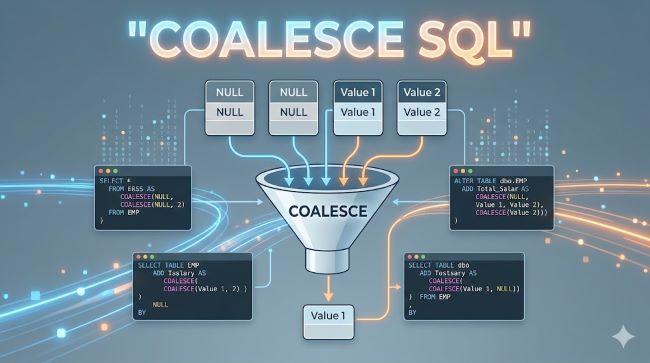
What does COALESCE do in SQL? It evaluates a list of expressions in order and returns the first non-NULL value it finds. If every expression in the list is NULL, COALESCE returns NULL.
The syntax is:
COALESCE(expression1, expression2, expression3, ...)You can pass two expressions or twenty. SQL evaluates them left to right and stops at the first one that isn’t NULL. That’s the whole mechanism. The power comes from how many practical problems that simple behaviour solves.
Here’s a basic example. Say you have a contacts table where some people have a work phone, some have a mobile, some have both, and some have neither. You want to return whichever phone number is available:
SELECT
    first_name,
    COALESCE(work_phone, mobile_phone, 'No phone on file') AS contact_number
FROM contacts;
For each row, SQL checks work_phone first. If it’s NULL, it checks mobile_phone. If that’s also NULL, it returns the string ‘No phone on file’. One line of code handles three different data states cleanly.
The COALESCE Function in SQL: A Closer Look
The COALESCE function in SQL is defined in the ANSI SQL standard, which means it works across SQL Server, MySQL, PostgreSQL, Oracle, SQLite, and most other relational databases. This portability is one reason many developers prefer it over database-specific alternatives.
Under the hood, COALESCE is equivalent to a CASE expression:
CASE
    WHEN expression1 IS NOT NULL THEN expression1
    WHEN expression2 IS NOT NULL THEN expression2
    ELSE expression3
END
The optimizer in most database engines treats them identically. The COALESCE syntax is just cleaner and faster to write.
One important behaviour to know: COALESCE uses short-circuit evaluation. It stops evaluating expressions as soon as it finds a non-NULL value. This matters when expressions have side effects or are expensive to compute, like subqueries. If the first expression returns a value, the rest are never evaluated.
SQL ISNULL vs COALESCE: What’s the Difference?
SQL ISNULL is a SQL Server-specific function that takes exactly two arguments:
ISNULL(expression, replacement_value)It returns the replacement_value if expression is NULL, and returns expression if it isn’t NULL.
COALESCE accepts two or more arguments and is part of the ANSI SQL standard.
The practical differences:
| Feature | ISNULL | COALESCE |
|---|---|---|
| Arguments | Exactly 2 | 2 or more |
| Standard | SQL Server only | ANSI SQL (all major databases) |
| Return type | Type of first argument | Type of highest precedence argument |
| Short-circuit | Yes | Yes |
| Subquery support | Limited | Full |
The return type difference is worth understanding. With ISNULL, the return type is always the type of the first argument. With COALESCE, SQL determines return type by the type precedence of all expressions. This can cause unexpected type conversions if you’re not careful.
Example:
SELECT ISNULL(NULL, 'default');    -- Returns 'default' as varchar
SELECT COALESCE(NULL, 'default');  -- Returns 'default' as varchar
Both return the same result here. But:
SELECT ISNULL(NULL, 3.14);    -- Returns 3 (integer, because NULL is treated as int)
SELECT COALESCE(NULL, 3.14);  -- Returns 3.14 (decimal)
This is why COALESCE is the safer default for mixed-type scenarios. If you’re writing code that might run across different database platforms, always use COALESCE over ISNULL.
SQL Coalesce Function Usage Examples
Here are SQL coalesce function usage examples that cover the most common real-world scenarios.
Example 1: Replacing NULLs in Calculations
NULL values in arithmetic operations produce NULL results. COALESCE prevents this:
SELECT
    product_name,
    price * COALESCE(discount_rate, 0) AS discount_amount
FROM products;
Without COALESCE, any row where discount_rate is NULL would produce a NULL discount_amount even though the correct answer is 0.
Example 2: Concatenating Strings with Possible NULLs
String concatenation with NULL produces NULL in most databases:
-- This returns NULL when middle_name is NULL
SELECT first_name + ' ' + middle_name + ' ' + last_name AS full_name
FROM employees;

-- COALESCE fixes it
SELECT
    first_name + ' ' + COALESCE(middle_name + ' ', '') + last_name AS full_name
FROM employees;
The inner COALESCE returns middle_name followed by a space if it exists, or an empty string if it’s NULL.
Example 3: Fallback Values Across Multiple Columns
SELECT
    order_id,
    COALESCE(shipped_date, estimated_date, order_date) AS best_available_date
FROM orders;
This returns the most specific date available for each order without needing a complex CASE statement.
Example 4: Aggregations with COALESCE
SELECT
    department,
    SUM(COALESCE(bonus, 0)) AS total_bonus_paid
FROM employee_compensation
GROUP BY department;
SUM ignores NULL values in SQL, but using COALESCE here makes the intent explicit and prevents issues if the aggregation behaviour changes in edge cases.
Example 5: Dynamic Default from Another Table
SELECT
    p.product_name,
    COALESCE(p.custom_price, c.default_price, 0) AS final_price
FROM products p
LEFT JOIN category_defaults c ON p.category_id = c.category_id;
This pulls from product-level pricing first, falls back to category defaults, then falls back to zero. Three levels of fallback logic in one readable line.
Example 6: COALESCE in a WHERE Clause
SELECT *
FROM customers
WHERE region = COALESCE(@region_filter, region);
When @region_filter is NULL (no filter applied), COALESCE returns the region column itself, which means the condition is always true and all rows are returned. When a filter is passed, only matching rows return. This pattern handles optional filters without dynamic SQL.
SQL Server COALESCE: Specific Behaviour Notes
SQL Server COALESCE follows the ANSI standard with a few implementation details worth knowing.
Performance vs ISNULL in SQL Server: In SQL Server, ISNULL is slightly faster than COALESCE in simple two-argument scenarios because COALESCE is internally rewritten as a CASE expression. In practice, this difference is negligible except in extremely high-volume scenarios.
COALESCE with subqueries in SQL Server:
SELECT
    employee_id,
    COALESCE(
        (SELECT TOP 1 project_name FROM projects WHERE lead_id = e.employee_id ORDER BY start_date DESC),
        'No active project'
    ) AS current_project
FROM employees e;
This works correctly in SQL Server. The subquery is only executed if needed due to short-circuit evaluation.
NULL propagation in SQL Server: Remember that COALESCE(NULL, NULL) returns NULL. Always include a concrete fallback as the last argument unless NULL is an acceptable result.
Common Mistakes with COALESCE
Forgetting data type precedence: Mixing integers and strings in COALESCE arguments causes implicit conversions that can produce errors or unexpected results. Keep your argument types consistent.
Using COALESCE when NULLIF is the right tool: NULLIF converts a specific value to NULL. COALESCE replaces NULL with a value. They’re complementary, not interchangeable:
-- NULLIF: turn zero into NULL to avoid division by zero
SELECT total_sales / NULLIF(total_orders, 0) AS avg_order_value
FROM sales_summary;
Nesting COALESCE unnecessarily: COALESCE(COALESCE(a, b), c) is identical to COALESCE(a, b, c). The nested version adds no value and reduces readability.
Relying on COALESCE to fix bad data: COALESCE handles NULL in queries. If your data has systematic NULL problems, address them at the schema level with DEFAULT constraints and NOT NULL definitions rather than patching every query.
COALESCE Across Other Databases
Since COALESCE is ANSI standard, it works consistently:
- MySQL: Full support. Use instead of IFNULL for multi-argument scenarios.
- PostgreSQL: Full support. Identical behaviour to SQL Server.
- Oracle: Full support. NVL is Oracle’s two-argument equivalent, but COALESCE is preferred.
- SQLite: Full support. IFNULL is the two-argument alternative but COALESCE is more versatile.
Understanding how data tools and their functions work across different platforms is increasingly relevant as teams work across multiple data environments simultaneously. SQL functions like COALESCE that behave consistently across platforms reduce the cognitive overhead of switching between systems.
When to Choose COALESCE Over Other Approaches
Use COALESCE when:
- You need a fallback value for NULL across one or more expressions
- You’re writing cross-database compatible SQL
- You need more than two fallback levels
- You want clean, readable code instead of nested CASE expressions
Use ISNULL when:
- You’re writing SQL Server-only code and have exactly two expressions
- You need the return type to match the first argument precisely
Use CASE when:
- Your logic is more complex than “return first non-NULL value”
- You need different outcomes for different value conditions, not just NULL vs non-NULL
Good data tooling and a solid grasp of SQL fundamentals go hand in hand: functions like COALESCE are the kind of foundation-level knowledge that separates analysts who can write clean, maintainable queries from those who build fragile pipelines that break on NULL-heavy data.
Key Takeaways
- COALESCE SQL returns the first non-NULL value from a list of expressions. It evaluates left to right and stops at the first hit.
- What does COALESCE do in SQL: replaces NULL values with a fallback, across as many expressions as you need.
- SQL ISNULL takes exactly two arguments and is SQL Server-specific. COALESCE is ANSI standard and works across all major databases.
- The COALESCE function in SQL is equivalent to a CASE expression internally, but is cleaner to write and read.
- SQL coalesce function usage examples include NULL replacement in calculations, string concatenation, multi-column fallbacks, aggregation clarification, and optional filter patterns in WHERE clauses.
- SQL Server COALESCE supports subqueries, uses short-circuit evaluation, and follows ANSI type precedence rules.
- Always include a concrete non-NULL final argument in COALESCE unless NULL is an acceptable return value.
- Use COALESCE by default. Switch to ISNULL only when you need SQL Server-specific type behaviour with exactly two arguments. Keeping your developer toolkit sharp includes knowing which SQL functions to reach for in each situation, and COALESCE earns its place in almost every non-trivial query.