What Font Are Scripts Written In?
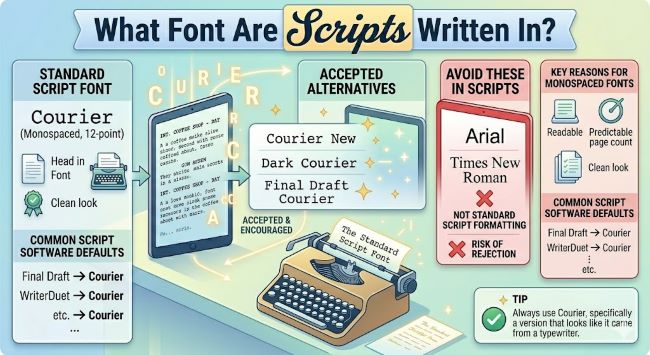
Wondering what font scripts are written in ? The industry standard is Courier Prime or Courier Final Draft at 12pt. Here is why that is, and what it means for your screenplay formatting.
If you are writing a screenplay for the first time, or you have been asked to submit a script and want to make sure it looks right, the font question comes up almost immediately. What font are scripts written in? The answer is Courier, specifically a 12 point monospaced version of it, and the reason goes deeper than tradition.
This post covers the standard font for screenplays, why it matters, which version to use, and what happens when you deviate from it.
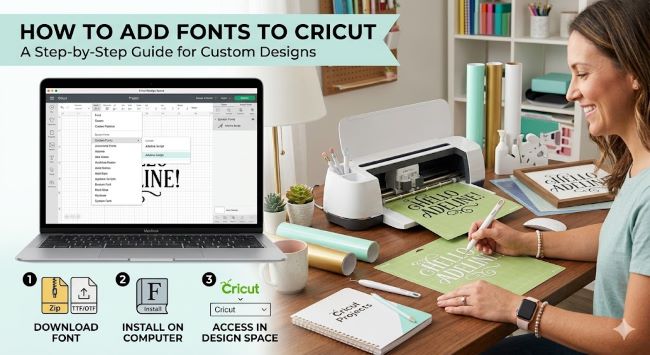
How to Add Fonts to Cricut
Learn how to add fonts to Cricut Design Space step by step. Covers installing system fonts, Google Fonts, and accessing them in your Cricut.
The Standard Script Font: Courier 12pt
Every professional screenplay, whether it is a feature film, a TV pilot, or a short, is written in Courier 12 point font. This is not a stylistic preference. It is an industry standard with a practical reason behind it.
Courier is a monospaced font, which means every character takes up the same amount of horizontal space. A narrow letter like “i” and a wide letter like “m” both occupy the same width. That consistency is what makes Courier useful for scripts specifically.
In a properly formatted screenplay, one page equals approximately one minute of screen time. That rule only holds when the font is Courier 12pt. Switch to a proportional font like Times New Roman and the character spacing changes, the page count shifts, and the one-page-per-minute rule breaks down. For a 110-page feature, that breakdown matters.
Courier vs. Courier New vs. Courier Prime
Not all versions of Courier are the same, and this is where writers sometimes get tripped up.
Courier New is the version that ships with Microsoft Windows. It works, and many writers use it. But it was designed for screen readability, not print, and some argue it reads slightly looser on the page.
Courier Prime is a free, updated version of Courier designed for screenwriting. It was created by John August, a professional screenwriter, specifically to look better on screen while maintaining the correct spacing for script formatting. Courier Prime is the version most screenwriters use today, and it is available as a free download from the Courier Prime website.
Courier Final Draft is the version built into Final Draft, the industry-standard screenwriting software. It is essentially the same as Courier Prime in spacing and appearance, optimized for that specific application.
For most purposes, any of these three will work. If you are submitting to a production company, agency, or competition, Courier Prime at 12pt is the safest and most current choice.
Why Changing the Script Font Is a Problem
Submitting a script in the wrong font is one of those things that signals inexperience to anyone who reads scripts professionally. Readers and development executives look at hundreds of scripts. A script in Times New Roman, Arial, or any other non-Courier font stands out immediately, and not in a good way.
Beyond perception, there is a practical issue. If a reader or producer uses page count to estimate runtime and the font is wrong, their estimate will be off. A 95-page script in Times New Roman might only represent 80 minutes of actual screen time, or it might be longer. Nobody wants to find that out during production.
The font rule exists to create a shared, reliable standard. Sticking to it is a sign that you understand the industry you are writing for.
What About Stage Plays and Other Script Formats?
Stage play formatting is less rigid than screenplay formatting. Playwrights have more flexibility with font choice, though Courier and Times New Roman 12pt are both common. The one-page-per-minute rule does not apply to stage plays the same way, so the font choice is more about readability than timing.
For TV scripts, the standard is the same as features: Courier 12pt. Sitcom scripts are sometimes formatted slightly differently with wider margins, but the font stays the same.
For audio dramas and radio scripts, formatting conventions vary more, and Times New Roman is sometimes used alongside Courier. Check the submission guidelines for whatever you are writing for.
Script Formatting Software and Font Defaults
If you use dedicated screenwriting software, the font question is handled for you:
- Final Draft defaults to Courier Final Draft 12pt
- Highland 2 defaults to Courier Prime 12pt
- WriterDuet defaults to Courier Prime 12pt
- Fade In defaults to Courier Prime 12pt
- Celtx defaults to Courier New 12pt
All of these are correct for industry submission. If you are writing in Microsoft Word or Google Docs, you need to set the font to Courier Prime or Courier New at 12pt and apply proper screenplay margins and formatting manually, or use a script formatting template.
The Short Answer
Scripts are written in Courier 12pt font. For new writers, Courier Prime is the best version to use: it is free, well-designed, and the current standard among working screenwriters. Set it once, format your script correctly, and the font becomes one less thing to think about. What matters after that is the writing itself.