
Gary Heminger and Kathy Warden
Some CEOs spend their whole careers inside one company. Others move between employers, picking up skills before they land the top job. Gary Heminger and Kathy Warden represent both paths, and their stories show how different routes can lead to the same seat.
Heminger joined Marathon Oil in 1975 and stayed for more than four decades, eventually running Marathon Petroleum, one of the largest oil refiners in the United States. Warden worked at General Dynamics and Veridian before joining Northrop Grumman in 2008, where she now serves as chair, CEO, and president of one of the world’s biggest defense contractors.
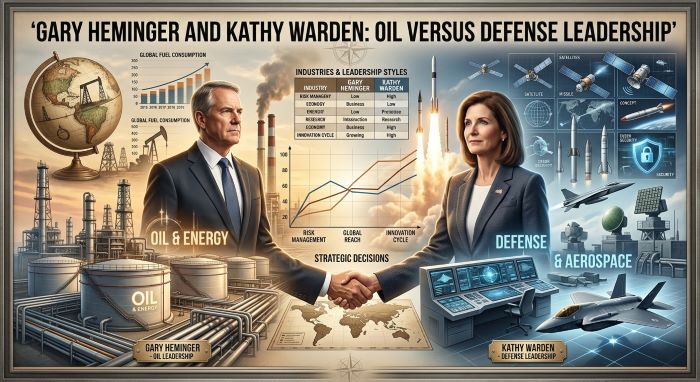
They never worked together, and there is no public record of a deal between them. But comparing Gary Heminger and Kathy Warden gives a useful look at two industries under heavy pressure: energy and defense. This article covers their backgrounds, their biggest moves, the challenges they faced, and what other leaders can take from both.
Two Different Starting Points
Gary Heminger: A Company Lifer From Ohio
Heminger joined Marathon Oil in 1975 and earned his bachelor’s degree in accounting from Tiffin University in 1976 while already working there. He later earned an MBA from the University of Dayton in 1982 and completed the Advanced Management Program at Wharton.
His early years were in finance and administration. He spent three years in London as an audit supervisor on a North Sea project, then eight years with Emro Marketing, the company that became Speedway. He went on to lead Marathon Pipe Line Company and held senior roles in supply, transportation, and marketing.
Kathy Warden: A Technology Leader Who Moved Around
Warden earned her bachelor’s degree from James Madison University and an MBA from George Washington University. Before Northrop Grumman, she worked at General Dynamics and Veridian, building experience in defense technology and intelligence work.
She joined Northrop Grumman in 2008 and moved up through several business units, including leading the company’s mission systems and information systems work. She later became president and chief operating officer.
Here’s the first big contrast between Gary Heminger and Kathy Warden. Heminger learned one company from the inside over decades. Warden built skills across several employers before taking the helm.
Side by Side Comparison
| Gary Heminger | Kathy Warden | |
|---|---|---|
| Industry | Oil refining and fuel marketing | Aerospace and defense |
| Company | Marathon Petroleum | Northrop Grumman |
| Joined company | 1975 (Marathon Oil) | 2008 |
| Became CEO | July 2011 | January 2019 |
| Chair role | 2016 to March 2020 | Since 2019 |
| Signature move | Acquired Andeavor in 2018 | Scaled up B-21 Raider production |
| Biggest pressure | Activist investor Elliott Management | Program costs, including Sentinel ICBM |
| Status in 2026 | Retired, serves on boards and as Ohio State trustee | Chair, CEO, and president of Northrop Grumman |
Rise to the Top
Heminger Takes Over a New Spinoff
In July 2011, Marathon Oil split off its refining and marketing business as Marathon Petroleum Corporation. Heminger became the new company’s first president and CEO, and he added chairman in 2016.
He led Marathon Petroleum through years of growth. The company expanded its refining network, built up its pipeline affiliate MPLX, and grew its Speedway gas station chain.
Warden Steps Into the Top Job
Warden became CEO of Northrop Grumman in January 2019 and took on the chair role later that year. She took over a company with major programs in stealth aircraft, space systems, missiles, and cyber defense.
When you look at Gary Heminger and Kathy Warden at the start of their CEO terms, both inherited strong businesses. The real test was what they would do with them.
The Big Moves
Heminger’s Andeavor Deal
Heminger’s boldest decision was buying Andeavor, a large West Coast refiner, in a deal worth about $23 billion that closed in 2018. The merger made Marathon Petroleum the largest refiner in the United States by capacity.
The idea was scale. A bigger refining and retail network meant more buying power, more locations, and more ways to move fuel. But integrating Andeavor proved harder than expected, and the company’s stock lagged after the deal.
Warden’s Bet on Big Defense Programs
Warden’s tenure is tied to some of the largest defense programs in the country. The most visible is the B-21 Raider, a new stealth bomber for the US Air Force. Northrop Grumman unveiled it in December 2022, and it first flew in November 2023. In 2026, the company is receiving $4.5 billion in federal funds to speed up B-21 production.
Under her leadership, Northrop Grumman also built up its space and missile businesses. In 2025, the company reported $42 billion in revenue and has about 100,000 employees.
The contrast between Gary Heminger and Kathy Warden is clear here. Heminger grew through a large acquisition. Warden grew by winning and delivering on big government programs.
The Pressures They Faced
Heminger and the Activist Push
After the Andeavor deal, investors grew unhappy with Marathon Petroleum’s performance. In 2019, activist investor Elliott Management called for a major overhaul, including splitting the company into three parts.
On October 31, 2019, Marathon announced that Heminger would retire after the 2020 shareholder meeting. The company also said it would separate Speedway. Michael Hennigan became CEO in March 2020. Speedway was later sold to 7-Eleven in a deal valued at about $21 billion.
Warden and Program Cost Pressure
Warden’s pressures come from the nature of defense work. Large fixed price contracts can turn into losses if costs rise. The Sentinel program, which is meant to replace the country’s aging Minuteman III nuclear missiles, faced major cost growth. In 2024, the Pentagon reported that the program’s cost had risen sharply, triggering a formal review under a federal law that tracks cost overruns. The program continued after the review, but it remains under close scrutiny.
She also leads through shifting defense budgets, supply chain strain, and competition for skilled workers. Even with those challenges, Northrop Grumman raised its 2026 sales forecast in July to as much as $44.25 billion.
Gary Heminger and Kathy Warden faced very different kinds of pressure. One came from Wall Street investors. The other comes from government customers, budgets, and the cost of building some of the most complex systems in the world.
Leadership Styles
Heminger: Operations and Finance First
With his accounting background and decades in operations, Heminger focused on scale, efficiency, and building out assets. He knew the refining and retail business in detail. That knowledge helped him grow the company but also made the Andeavor bet a test of whether bigger meant better.
Warden: Technology and Execution
Warden’s background is in technology and government programs. She focuses on execution, delivering on complex contracts, and investing in new capabilities. She also chairs Catalyst, a nonprofit that works to advance women in the workplace, and serves on Merck’s board. In 2026, Fortune ranked her No. 72 on its list of the world’s most powerful women.
Common Questions About Gary Heminger and Kathy Warden
Did they ever work together? No. There is no public record of a shared deal, board seat, or partnership.
Who led their company longer as CEO? Heminger ran Marathon Petroleum from 2011 to 2020, a bit under nine years. Warden has led Northrop Grumman since 2019, which puts her at a similar mark in 2026.
What is Heminger doing now? He serves as an Ohio State University trustee, with a term that runs into 2027, and has held board seats at Fifth Third Bancorp, PPG Industries, and JobsOhio.
What is next for Warden? Her focus remains on B-21 production, space and missile programs, and managing costs on large government contracts.
Lessons for Leaders
Looking at Gary Heminger and Kathy Warden side by side offers practical lessons.
- Deep company knowledge is powerful, but not a shield. Heminger knew Marathon better than almost anyone. That didn’t stop investors from pushing for change when results fell short.
- Big deals need fast integration. The Andeavor merger made sense on paper. The hard part was turning size into results.
- Know who your real customer is. Heminger answered to shareholders and fuel buyers. Warden answers to the Pentagon as much as to investors.
- Fixed price contracts carry real risk. Defense leaders must price long programs carefully, or cost overruns can hit earnings for years.
- Varied experience builds range. Warden’s time at several companies gave her a wide view of defense technology before she ran a major contractor.
Key Takeaways
- Gary Heminger and Kathy Warden led two major US companies in two high pressure industries: oil refining and defense.
- Heminger joined Marathon Oil in 1975, became the first CEO of Marathon Petroleum in July 2011, and added chairman in 2016.
- His biggest move was the roughly $23 billion Andeavor acquisition in 2018, which made Marathon Petroleum the largest US refiner.
- Pressure from activist investor Elliott Management led to his retirement announcement in October 2019. He stepped down in March 2020, and Speedway was later sold to 7-Eleven.
- Warden worked at General Dynamics and Veridian before joining Northrop Grumman in 2008. She became CEO in January 2019 and also serves as chair and president.
- Her tenure includes the B-21 Raider, which first flew in November 2023, and the Sentinel missile program, which faced major cost growth.
- Northrop Grumman reported $42 billion in 2025 revenue and raised its 2026 forecast to as much as $44.25 billion.
- Core lessons: company knowledge doesn’t protect against weak results, big deals need strong integration, and leaders must understand who their real customers are.