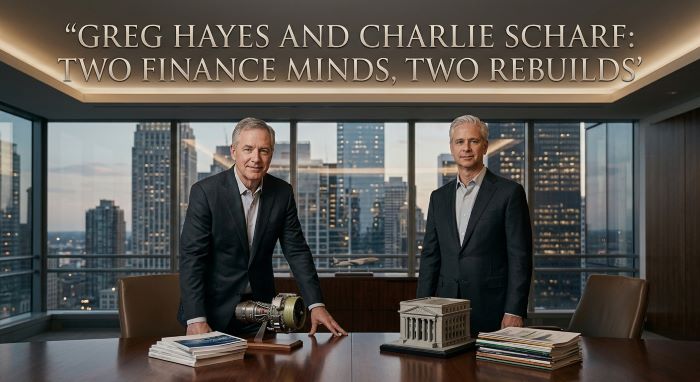
Greg Hayes and Charlie Scharf
Most people picture a CEO as a visionary founder or a charismatic salesperson. But some of the biggest corporate overhauls of the last decade came from leaders who started out reading balance sheets. Greg Hayes and Charlie Scharf fit that mold.
Hayes spent years as a finance chief before he took over United Technologies and then led the merger that created RTX, one of the largest aerospace and defense companies in the world. Scharf, a former CFO himself, ran Visa and BNY Mellon before stepping in to fix Wells Fargo after its fake accounts scandal.
They work in different industries and never ran a company together. Still, Greg Hayes and Charlie Scharf share a playbook worth studying. This article compares their backgrounds, their biggest moves, the problems they faced, and what leaders can learn from both.
From the Numbers to the Corner Office
Greg Hayes: The Aerospace CFO
Greg Hayes joined United Technologies (UTC) in 1999 when it acquired Sundstrand, where he worked in finance. He rose through UTC’s finance team and became chief financial officer in 2008. In November 2014, the board named him CEO.
UTC at the time was a sprawling conglomerate. It owned jet engine maker Pratt & Whitney, aircraft parts supplier Collins, elevator giant Otis, and heating and cooling company Carrier. Hayes knew every line of that business from the finance side.
Charlie Scharf: The Banker Who Learned From Jamie Dimon
Charlie Scharf was born in 1965 in New York City. He earned a BA from Johns Hopkins University in 1987 and an executive MBA from NYU Stern in 1991. He started his career in a back office role at Commercial Credit, the company where Jamie Dimon was building what would become Citigroup.
Scharf followed that path for years. He served as CFO of Salomon Smith Barney, then of Citigroup’s global corporate and investment bank, and then of Bank One. When Bank One merged with JPMorgan Chase, he ran JPMorgan’s retail business from 2004 to 2011, including the 2008 takeover of Washington Mutual.
Both men learned to lead by understanding where every dollar went. That shaped how they ran their companies later.
Side by Side
| Greg Hayes | Charlie Scharf | |
|---|---|---|
| Industry | Aerospace and defense | Banking and payments |
| Finance background | CFO of UTC, 2008 to 2014 | CFO roles at Salomon Smith Barney, Citigroup unit, Bank One |
| CEO roles | UTC (from 2014), RTX (2020 to 2024) | Visa (2012 to 2016), BNY Mellon (2017 to 2019), Wells Fargo (since 2019) |
| Signature move | Broke up UTC and merged with Raytheon | Rebuilt Wells Fargo’s risk and controls |
| Biggest challenge | Pratt & Whitney engine problems | Regulatory asset cap and scandal fallout |
| Status in 2026 | Retired from RTX board in April 2025 | Chairman and CEO of Wells Fargo |
The Big Moves
Hayes Breaks Up a Conglomerate
The defining decision of Hayes’s career was to take UTC apart. He spun off Carrier and Otis as separate public companies and merged the remaining aerospace business with Raytheon in 2020. The new company, Raytheon Technologies, later renamed itself RTX in 2023.
The logic was simple. Investors had grown tired of conglomerates, and each business could grow faster on its own. Combining Pratt & Whitney and Collins with Raytheon’s missiles and defense systems created a giant built for both commercial and military aerospace.
The timing was rough. The merger closed in April 2020, just as COVID shut down air travel and crushed demand for commercial jets and engines. Hayes had to steer a newly combined company through one of the worst years in aviation history.
Scharf Rebuilds Wells Fargo
Scharf’s biggest test came when he took over Wells Fargo in October 2019. The bank was still reeling from its fake accounts scandal, in which employees opened millions of unauthorized accounts to hit sales goals. In 2018, the Federal Reserve capped the bank’s total assets until it fixed its governance and risk controls.
Scharf treated the cleanup as his central job. He brought in new executives, overhauled risk management, and cut costs. Progress was slow, and regulators added more penalties along the way. But in June 2025, the Federal Reserve lifted the asset cap. Analysts largely gave Scharf credit for the turnaround. In October 2025, the board named him chairman in addition to CEO.
When you compare Greg Hayes and Charlie Scharf on their biggest moves, you see two different kinds of rebuild. Hayes reshaped what his company owned. Scharf reshaped how his company operated.
The Problems That Tested Them
Hayes and the Pratt & Whitney Engine Issue
In 2023, RTX disclosed a manufacturing problem involving powdered metal used in parts for Pratt & Whitney’s geared turbofan engines. Airlines had to pull planes from service for inspections, and RTX took a charge of about $3 billion. It was a major blow late in Hayes’s tenure and showed how a single quality issue can ripple across global fleets.
Scharf and Regulatory Pressure
Scharf’s challenge was less about a single event and more about time. Fixing a bank’s culture and controls under constant regulatory scrutiny took years. He also faced criticism in 2020 for comments about diversity in hiring, and he apologized. Pay also drew attention, with reported compensation of $26 million in 2023 and $31.2 million in 2024.
Handing Off and Staying On
Hayes Steps Back
In May 2024, Christopher Calio, RTX’s president and chief operating officer, took over as CEO. Hayes stayed on as chairman until April 30, 2025, when he left the board. Calio became chairman as well. Hayes stayed on as a special advisor to Calio into early 2026.
Scharf Stays at the Helm
Scharf remains chairman and CEO of Wells Fargo. With the asset cap gone, his focus has shifted from repair to growth, including expanding in areas the cap had held back, such as investment banking and trading.
Greg Hayes and Charlie Scharf are now in different chapters. One has finished his run and handed off a reshaped company. The other is moving from fixing a company to growing it.
Shared Leadership Traits
Despite their different industries, these two leaders share a few clear habits.
- They lead with the numbers. Both came from finance and built their strategies around capital, costs, and returns.
- They aren’t afraid of big structural change. Hayes broke up a decades old conglomerate. Scharf rebuilt a bank’s entire risk function.
- They play the long game. Neither turnaround happened in a year or two. Both required steady focus over most of a decade.
- They faced public scrutiny. Engine recalls and regulatory penalties put both men in the spotlight.
Lessons for Leaders
Studying Greg Hayes and Charlie Scharf offers practical lessons for anyone running a business or a team.
- Know your business at the numbers level. A finance background helped both men see which parts of their companies created value and which held them back.
- Simplify when complexity hurts. Hayes showed that splitting a company can unlock more value than keeping it together.
- Fix the foundation before chasing growth. Scharf put controls first, even when it slowed growth. That patience paid off when the asset cap came off.
- Expect bad timing. The RTX merger closed into a pandemic. Plans need room for shocks.
- Quality and culture are financial issues. An engine defect and a sales scandal both turned into billion dollar problems.
Why These Two Get Compared
There’s no deal or partnership between Greg Hayes and Charlie Scharf. People compare them because they represent a type: the finance executive who becomes CEO and takes on a massive, messy rebuild. Their stories show both the strengths of that background and the limits of what spreadsheets alone can solve.
Common Questions About Greg Hayes and Charlie Scharf
Did they ever work together? No. There is no public record of a joint venture, shared board seat, or deal between them. The comparison comes from their similar paths and leadership styles.
Which one had the harder job? It depends on how you measure it. Hayes had to merge two giant companies during a pandemic that wiped out air travel. Scharf had to fix a bank under strict regulatory limits, with every step watched by the Federal Reserve and the public. Both took years of steady work.
How did investors react? Investors generally welcomed the UTC breakup and the Raytheon merger, though the engine problems in 2023 hurt RTX shares. Wells Fargo’s stock gained strength as the bank moved closer to lifting the asset cap, and analysts praised the progress when it came off.
Why does a finance background matter for a CEO? It helps a leader see which parts of a business earn real returns and which drain cash. The careers of Greg Hayes and Charlie Scharf show that this skill is useful in very different industries, from jet engines to consumer banking.
What comes next? Hayes has stepped away from RTX. Scharf now has room to grow Wells Fargo after years of repair work.
Key Takeaways
- Greg Hayes and Charlie Scharf both moved from senior finance roles to CEO and led major corporate rebuilds.
- Hayes became UTC’s CFO in 2008 and CEO in November 2014. He spun off Carrier and Otis and merged UTC’s aerospace business with Raytheon in April 2020, forming the company now called RTX.
- Scharf was CEO of Visa and BNY Mellon before taking over Wells Fargo in October 2019. He became chairman in October 2025.
- Hayes’s biggest late career challenge was a Pratt & Whitney engine parts problem that led to a charge of about $3 billion in 2023.
- Scharf’s central task was fixing Wells Fargo after its fake accounts scandal. The Federal Reserve lifted the bank’s asset cap in June 2025.
- Christopher Calio succeeded Hayes as RTX CEO in May 2024, and Hayes left the board in April 2025.
- Shared lessons: understand the numbers, simplify when complexity hurts, fix foundations before chasing growth, and treat quality and culture as financial priorities.