
Diane von Furstenberg and Henrik Fisker
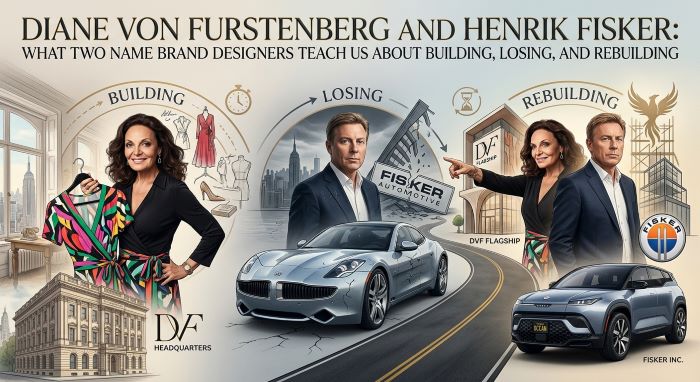
One made a dress. The other drew cars. On paper, Diane von Furstenberg and Henrik Fisker have almost nothing in common. She works in silk jersey and prints. He works in carbon fiber, battery packs, and sheet metal. Yet if you line up their careers side by side, the pattern is hard to miss.
Both put their own names on the door. Both turned one striking design into a famous product. Both watched their companies slip out of their hands. And both kept going after the kind of setback that ends most careers.
This article compares Diane von Furstenberg and Henrik Fisker as designers and as founders. We’ll look at where each started, the products that made them, what went wrong, and the lessons anyone building a brand can take from their stories.
Two Very Different Starting Points
Diane von Furstenberg: From Brussels to Seventh Avenue
Diane von Furstenberg was born in Brussels in 1946. She married Prince Egon von Fürstenberg in 1969 and moved to New York, where she started her fashion business in 1972. She had no formal design degree. What she had was an eye for what working women wanted to wear and a willingness to sell it herself, trunk show by trunk show.
Henrik Fisker: From Denmark to the Design Studio
Henrik Fisker was born in Denmark in 1963. Unlike von Furstenberg, he took the classic training route. He studied transportation design at ArtCenter College of Design and joined BMW, where he worked on the Z8 roadster. He later became design director at Aston Martin, leading the work on the DB9 and V8 Vantage. Those two cars are still seen as some of the best looking sports cars of the 2000s.
So one founder learned on the job, and the other came up through big automaker studios. That difference shaped how each approached business later.
The Signature Product
Every name brand needs a hero product. For both designers, one design did most of the heavy lifting.
The Wrap Dress
In 1974, von Furstenberg released the jersey wrap dress. It had no buttons and no zipper, it fit many body types, and you could wear it from the office to dinner. It sold in huge numbers, and by 1976 she was on the cover of Newsweek. The wrap dress became tied to a message about confidence and independence, which gave the brand meaning beyond the fabric.
The Fisker Karma
Fisker’s hero product came in 2011 with the Fisker Karma, a plug in hybrid luxury sedan built by his company Fisker Automotive. It was long, low, and dramatic in a way few electrified cars were at the time. Celebrities bought them. Design critics praised them. For a moment, the Karma looked like proof that green cars didn’t have to look dull.
Here’s the key point when you compare Diane von Furstenberg and Henrik Fisker: both hero products sold an idea as much as an object. The wrap dress sold freedom. The Karma sold the idea that sustainability could be beautiful.
Side by Side: A Quick Comparison
| Diane von Furstenberg | Henrik Fisker | |
|---|---|---|
| Born | 1946, Brussels, Belgium | 1963, Denmark |
| Training | Self taught in fashion | ArtCenter College of Design |
| Company founded | 1972 | Fisker Automotive (2007), Fisker Inc. (2016) |
| Hero product | Jersey wrap dress (1974) | Fisker Karma (2011), Fisker Ocean (2023) |
| Biggest setback | Overexpansion and loss of brand control in the late 1970s and 1980s | Bankruptcies in 2013 and 2024 |
| Comeback | Relaunched wrap dress in 1997 | Relaunched as Fisker Inc. after the first failure |
| Industry role | CFDA president from 2006 to 2019 | Car designer and EV founder |
Where Things Went Wrong
This is where the stories get useful. Success is easy to admire, but failure teaches more.
Von Furstenberg’s Licensing Trap
After the wrap dress boom, von Furstenberg expanded fast. Her name went onto cosmetics, luggage, eyewear, and many other products through licensing deals. Money came in, but she lost control of how the brand looked and where it sold. Department stores filled up with wrap dresses, and the market got saturated. By the 1980s, the brand had lost much of its shine, and she sold off large parts of the business.
The lesson is simple. A name on too many products starts to mean nothing.
Fisker’s Supply Chain and Cash Problems
Fisker’s first company ran into a chain of hard hits. Its battery supplier, A123 Systems, went bankrupt in 2012. That same year, Hurricane Sandy flooded a port in New Jersey and destroyed a large batch of Karmas waiting for delivery. With production stalled and cash running low, Fisker Automotive filed for bankruptcy in 2013. Its assets went to China’s Wanxiang Group, and the Karma later came back as the Karma Revero under a new company.
Fisker tried again with Fisker Inc., founded in 2016 with his wife, Geeta Gupta Fisker. The company went public in 2020 and launched the Fisker Ocean, an electric SUV built under contract by Magna Steyr in Austria. Deliveries began in 2023, but software bugs, recalls, and weak sales piled up. Fisker Inc. filed for bankruptcy in June 2024, sold its remaining Ocean inventory, and liquidated its other assets. The SEC opened an investigation into the company but closed it in September 2025.
The lesson here is different. Great design can’t save a company that doesn’t control its supply chain, software, and cash runway.
The Comeback Question
When people search for Diane von Furstenberg and Henrik Fisker, they often want to know how each one came back. The answer differs a lot between them.
Von Furstenberg: Rebuilding From the Core Product
In 1997, von Furstenberg bought back control and relaunched the wrap dress. She didn’t invent a new hero product. She returned to the one that already carried her story and sold it to a new generation who had never seen the original. It worked. The relaunch brought the brand back into top stores and onto red carpets.
She also built influence beyond her label. She served as president of the Council of Fashion Designers of America from 2006 to 2019, and she founded the DVF Awards in 2010 to support women leaders. In 2025, the company brought its business back in house to regain control of its identity. In May 2026, it named Henry Zankov, a former DVF designer, as artistic director, with his first collection set for New York Fashion Week in September 2026.
Fisker: Starting Over From Scratch
Fisker’s comeback path was harder. Car companies need billions in capital, factories, and supplier networks. After the first bankruptcy, he couldn’t relaunch the Karma because he no longer owned it. So he started a brand new company with a brand new product. That gave him a clean slate, but also meant facing every startup risk again.
What Their Design Philosophies Share
Strip away the industries and you find three shared beliefs.
- Design leads, not follows. Both started with the look and feel of the product. Von Furstenberg designed around how a woman moves. Fisker designed around how a car looks from 20 feet away.
- The product tells a story. The wrap dress says confidence. The Karma and Ocean said sustainability with style. Both founders sold meaning first.
- The founder is the face. Their names are the brand. That builds trust when things go well, and it puts their reputations on the line when things go badly.
Lessons for Founders and Brand Builders
Comparing Diane von Furstenberg and Henrik Fisker gives anyone building a business a short list of practical takeaways.
- Protect the core. Von Furstenberg’s comeback worked because the wrap dress still meant something. Guard your hero product’s quality and story.
- Control what you can’t afford to lose. Licensing cost her brand control. Outsourced batteries and manufacturing left Fisker exposed. Know which parts of your business must stay in house.
- Industry economics matter. Fashion lets you restart with a sewing room and a strong idea. Cars do not. Your comeback options depend on how much capital your industry needs.
- A name brand cuts both ways. It gives you visibility, but every stumble lands on your personal reputation.
- Timing counts. Von Furstenberg relaunched when nostalgia for the 1970s was building. Fisker launched the Ocean during an EV price war, which squeezed weaker players.
Why People Compare These Two
You won’t find a business deal or collaboration between Diane von Furstenberg and Henrik Fisker. The interest comes from the parallels. Both are European born designers who made it big in the United States. Both built companies on the strength of one beautiful product. And both show what happens when design talent meets the hard math of running a company.
For students of design, the comparison of Diane von Furstenberg and Henrik Fisker is a reminder that talent opens doors, but business structure decides how long you stay in the room.
Key Takeaways
- Diane von Furstenberg and Henrik Fisker both built companies on their own names and on one standout design: the wrap dress in 1974 and the Fisker Karma in 2011.
- Von Furstenberg was self taught and started her business in 1972. Fisker trained at ArtCenter College of Design and designed the BMW Z8, Aston Martin DB9, and V8 Vantage before founding his own car companies.
- Von Furstenberg’s setback came from overlicensing, which weakened her brand in the late 1970s and 1980s.
- Fisker faced two bankruptcies: Fisker Automotive in 2013 after supplier failure and storm losses, and Fisker Inc. in June 2024 after problems with the Ocean SUV. The SEC closed its probe into Fisker Inc. in September 2025.
- Von Furstenberg came back in 1997 by relaunching the wrap dress. Fisker came back by starting a new company with a new product.
- In 2025, DVF brought its business back in house, and in May 2026 it named Henry Zankov artistic director.
- Shared lessons: protect your hero product, keep control of the parts of the business that matter most, and match your growth to the economics of your industry.