Women’s March Madness: How the Tournament Works, 2026 Results, and What Comes Next
Each spring, college basketball takes over American sports for three weeks. The women’s side of that event has grown faster than almost anything else in sports. Arenas sell out. TV ratings rival and sometimes beat the men’s games. Stars become household names. Women’s March Madness is the NCAA Division I women’s basketball tournament, a single-elimination event that crowns the national champion.
This guide explains how the tournament works, how teams get in, and what happened in 2026. It also covers the conference tournaments that set the stage, with a close look at the SEC, and previews the big format change coming in 2027.
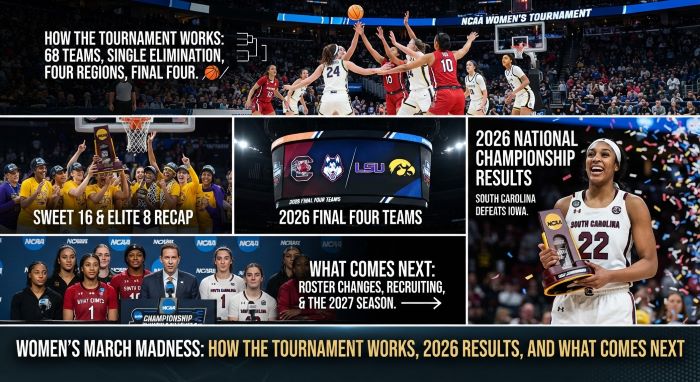
What Is It?
The NCAA has run a Division I women’s basketball tournament since 1982. The field grew to 64 teams in 1994 and to 68 teams in 2022. That same year, the NCAA began to use the “March Madness” name and branding for the women’s event as well as the men’s.
The format is simple. Lose once, and your season is over. Win six games in a row, or seven if you start in the opening round, and you are the national champion.
How Teams Qualify
Through 2026, the field held 68 teams.
- Automatic bids: Each Division I conference sends its champion. In nearly every league, that is the winner of the conference tournament.
- At-large bids: A selection committee fills the rest of the field with the best remaining teams.
The committee studies each team’s full season. It looks at wins and losses, strength of schedule, results against top opponents, road performance, and a ranking tool called the NET. It then seeds the whole field and places teams into four regions, with seeds 1 through 16 in each.
The bracket is revealed on Selection Sunday, a few days before the first games.
Tournament Rounds Explained
| Round | Teams Left | Where It Is Played |
|---|---|---|
| Opening round (First Four through 2026) | 68 | Campus sites |
| First round | 64 | Campuses of the top 16 seeds |
| Second round | 32 | Campuses of the top 16 seeds |
| Sweet 16 | 16 | Two regional host cities |
| Elite Eight | 8 | Two regional host cities |
| Final Four | 4 | One neutral arena |
| National championship | 2 | Same arena as the Final Four |
Two features set the women’s event apart from the men’s. First, the top 16 overall seeds host the first and second rounds on their home courts, which rewards a strong regular season and fills the stands. Second, the regionals take place at two sites, with eight teams at each, not at four separate sites.
2026 at a Glance
| Detail | 2026 Result |
|---|---|
| Champion | UCLA |
| Runner-up | South Carolina |
| Title game score | UCLA 79, South Carolina 51 |
| Title game date | Sunday, April 5, 2026 |
| Final Four city | Phoenix, Arizona |
| No. 1 seeds | UCLA, South Carolina, UConn, Texas |
| Most Outstanding Player | Lauren Betts, UCLA |
| Champion’s record | 37 wins, 1 loss |
| Title game TV | ABC |
The 2026 Tournament in Review
Women’s March Madness 2026 belonged to the favorites. All four No. 1 seeds, UCLA, South Carolina, UConn, and Texas, reached the Final Four in Phoenix. That left no room for a Cinderella run, but it set up a weekend of heavyweight games.
The semifinals. On Friday, April 3, South Carolina beat UConn 62 to 48. UCLA then edged Texas 51 to 44 in a defensive battle. The win was sweet for the Bruins, since their only loss of the season had come against Texas in a November tournament.
The title game. On Sunday, April 5, UCLA ran away from South Carolina, 79 to 51. Gabriela Jaquez had 21 points, 10 rebounds, and 5 assists. Lauren Betts, the 6-foot-7 center, added 16 points and 11 rebounds and was named Most Outstanding Player. The 28-point margin came close to the record for a women’s title game, which is 33 points.
What it meant. The title was the first NCAA women’s basketball championship in UCLA history. Coach Cori Close, in her 15th season in Westwood, finished the year at 37 and 1. South Carolina, coached by Dawn Staley, ended at 36 and 4 and lost in the championship game for the second year in a row.
Why Conference Tournaments Matter
The week before Selection Sunday is often called Championship Week. Every conference holds its own tournament, and the winner earns an automatic bid. These events shape the national bracket in three ways.
- Automatic bids. A team with a poor record can win its conference tournament and steal a spot.
- Seeding. A strong run can lift a team a seed line. An early loss can drop one.
- The bubble. Teams on the edge of the field often need one or two wins to feel safe.
For fans, conference tournaments also work as a preview. The best leagues stage games that look a lot like Elite Eight matchups.
The SEC Tournament and Its Role
No league has shaped the modern women’s game more than the Southeastern Conference. The SEC basketball tournament for women is one of the toughest events of the season. It has 16 teams, since Texas and Oklahoma joined the league for the 2024 to 2025 season. The top four seeds receive byes into the quarterfinals. In recent years, it has been held at Bon Secours Wellness Arena in Greenville, South Carolina.
The men’s SEC basketball tournament is a separate event held the following week, most often in Nashville. Both hand out an automatic NCAA bid.
2026 SEC Women’s Tournament Results
| Round | Matchup | Score |
|---|---|---|
| Quarterfinal | No. 1 South Carolina def. No. 9 Kentucky | 87 to 64 |
| Quarterfinal | No. 7 Ole Miss def. No. 2 Vanderbilt | 89 to 78 |
| Quarterfinal | No. 3 Texas def. No. 11 Alabama | 83 to 60 |
| Quarterfinal | No. 4 LSU def. No. 5 Oklahoma | 112 to 78 |
| Semifinal | No. 1 South Carolina def. No. 4 LSU | 83 to 77 |
| Semifinal | No. 3 Texas def. No. 7 Ole Miss | 85 to 68 |
| Championship | No. 3 Texas def. No. 1 South Carolina | 78 to 61 |
The event ran from March 4 through March 8. Texas opened the final on a 14 to 0 run and never looked back. Madison Booker led the Longhorns with 18 points. It was the first SEC tournament title for Texas, and it ended a streak of three straight titles for South Carolina.
The results carried straight into the national bracket. Texas and South Carolina both earned No. 1 seeds. Vanderbilt’s quarterfinal loss to Ole Miss likely cost the Commodores a shot at the top line. A month later, two of the four teams in the Final Four came from the SEC. Anyone who watched the SEC basketball tournament in March had a good idea of what April would look like.
Recent National Champions
| Year | Champion | Runner-Up |
|---|---|---|
| 2026 | UCLA | South Carolina |
| 2025 | UConn | South Carolina |
| 2024 | South Carolina | Iowa |
| 2023 | LSU | Iowa |
| 2022 | South Carolina | UConn |
| 2021 | Stanford | Arizona |
| 2019 | Baylor | Notre Dame |
| 2018 | Notre Dame | Mississippi State |
| 2017 | South Carolina | Mississippi State |
No tournament took place in 2020 because of the pandemic. UConn holds the record with 12 national titles, and Tennessee is next with 8.
The Growth of the Women’s Tournament
The event has changed a great deal in a few years.
- Branding. The NCAA extended the March Madness name to the women’s event in 2022, after a 2021 review exposed gaps between how the two tournaments were run.
- TV audience. The 2024 title game between South Carolina and Iowa drew close to 19 million viewers. It was the first time the women’s final drew more viewers than the men’s final in the same year.
- Media deal. ESPN holds the rights through 2032 under an eight-year deal worth about $920 million. The title game has aired on ABC since 2023.
- Payouts. Starting in 2025, conferences began to earn money, known as units, for each game their women’s teams play in the tournament.
- Star power. Players such as Caitlin Clark, Angel Reese, Paige Bueckers, and JuJu Watkins drew new fans, and many stayed.
- NIL. Name, image, and likeness deals let players earn money while in college, which has kept more stars in school longer.
What Changes in 2027: A 76-Team Field
In May 2026, the NCAA announced that both the men’s and women’s tournaments will grow to 76 teams, starting in 2027.
- The First Four is replaced by an Opening Round of 12 games.
- Twenty-four teams play in that round: the 12 lowest-seeded automatic qualifiers and the 12 lowest-seeded at-large teams.
- The 12 winners join 52 other teams in the usual 64-team bracket.
- For the women, the Opening Round games will be played on the campuses of 12 of the top 16 seeds.
Supporters say the change gives more players a taste of the event. Critics worry that it waters down the regular season. Either way, more bubble teams will hear their names called.
Key Dates for 2027
| Event | Date | Location |
|---|---|---|
| Selection Sunday | March 14, 2027 | Televised reveal |
| Opening Round | March 17 and 18 | Campus sites |
| First round | March 19 and 20 | Campus sites |
| Second round | March 21 and 22 | Campus sites |
| Sweet 16 and Elite Eight | March 26 to 29 | Philadelphia and Las Vegas |
| Final Four | Friday, April 2 | Nationwide Arena, Columbus, Ohio |
| National championship | Sunday, April 4 | Nationwide Arena, Columbus, Ohio |
Dates come from the NCAA’s published schedule and could change.
How to Watch
ESPN’s family of networks carries every game. Early rounds are spread across ESPN, ESPN2, ESPNU, ESPNews, and ABC. The national championship airs on ABC. You can stream games through the ESPN app with a TV login or through live TV streaming services that carry those channels.
To attend in person, buy early-round tickets through the host school. Regional and Final Four tickets are sold through the NCAA’s official ticket site. Final Four seats sell fast, so plan months ahead.
How to Fill Out a Bracket
Picking a women’s bracket takes a different approach than picking a men’s bracket.
- Respect the top seeds. Top seeds advance more often in the women’s event, partly because they play the first two rounds at home. In 2026, all four No. 1 seeds made the Final Four.
- Look for upsets in the middle. Games between No. 5 and No. 12 seeds, No. 6 and No. 11 seeds, and No. 7 and No. 10 seeds are where surprises happen.
- Check conference tournament form. A team that just won a tough league event is often peaking.
- Check injuries. One missing star can sink a contender.
- Value defense and rebounding. Both travel well in March.
- Favor experienced guards. Late in close games, ball handlers decide the result.
- Pick a champion from the top two seed lines. History strongly favors them.
Terms to Know
- Selection Sunday: The day the bracket is revealed.
- Seed: A team’s rank within its region, from 1 to 16.
- Bubble: Teams on the edge of making the field.
- At-large bid: A spot given by the committee, not earned by winning a conference tournament.
- Automatic bid: A spot earned by winning a conference.
- Cinderella: A low seed that makes a deep run.
- Chalk: A bracket where the favorites win.
- Sweet 16, Elite Eight, Final Four: The rounds with 16, 8, and 4 teams left.
- Most Outstanding Player: The award for the best player at the Final Four.
Programs to Know
- UConn: The record holder with 12 titles, led by coach Geno Auriemma.
- Tennessee: Eight titles, all under the late Pat Summitt.
- South Carolina: Three titles since 2017 under Dawn Staley, and a fixture in the Final Four.
- UCLA: The reigning champion after its first NCAA title in 2026.
- Texas: The 2026 SEC tournament champion and a Final Four team.
- LSU: The 2023 champion.
- Stanford, Baylor, and Notre Dame: Past champions with deep tournament histories.
Frequently Asked Questions
Who won women’s March Madness 2026? UCLA beat South Carolina 79 to 51 on April 5, 2026, in Phoenix.
How many teams play in the tournament? There were 68 teams through 2026. The field grows to 76 teams in 2027.
Who hosts the early games? The top 16 seeds host the first and second rounds on their own campuses.
When did the women’s tournament start? The first NCAA women’s tournament was held in 1982.
Which school has the most titles? UConn, with 12.
Who won the SEC women’s tournament in 2026? Texas beat South Carolina 78 to 61 in Greenville for its first SEC tournament title.
Where is the 2027 Final Four? Nationwide Arena in Columbus, Ohio, on April 2 and April 4.
What channel shows the games? ESPN networks carry the tournament, and the title game airs on ABC.
Is the women’s tournament as popular as the men’s? The gap has narrowed sharply. In 2024, the women’s final drew more viewers than the men’s final.
Final Thoughts
Women’s March Madness has moved from the edge of the sports calendar to its center. The format rewards great regular seasons, the stars are known by first name, and the games draw huge crowds.
Women’s March Madness 2026 gave UCLA its first NCAA title, confirmed the strength of the SEC, and sent all four top seeds to Phoenix. Next year brings a 76-team field and a Final Four in Columbus. Whether you follow one team or fill out a bracket for fun, women’s March Madness offers three weeks of basketball that are hard to beat. Mark Selection Sunday on your calendar, and watch the conference tournaments for clues.
Key Takeaways
- Women’s March Madness is the NCAA Division I women’s basketball tournament, a single-elimination event held each March and April.
- Conference champions earn automatic bids, and a committee picks and seeds the rest of the field.
- The top 16 seeds host the first two rounds, and regionals are played at two sites.
- UCLA won women’s March Madness 2026 by beating South Carolina 79 to 51 in Phoenix. All four No. 1 seeds reached the Final Four.
- Texas won the 2026 SEC women’s tournament, and the SEC sent two teams to the Final Four.
- The field expands from 68 to 76 teams in 2027, with a new 12-game Opening Round.
- The 2027 Final Four is set for April 2 and 4 in Columbus, Ohio.