What Is Triamcinolone Cream 0.1 Used to Treat
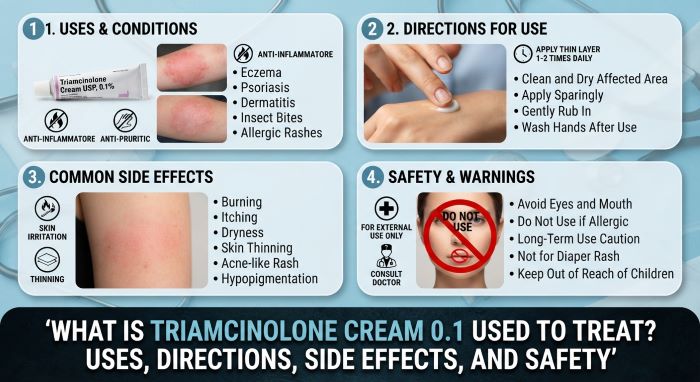
Your doctor hands you a prescription for a small tube of white cream. The label reads “triamcinolone acetonide cream USP, 0.1%.” You may wonder what it does and whether it is safe. So what is triamcinolone cream 0.1 used to treat? In short, it is a prescription steroid cream that calms inflamed, itchy skin. Doctors prescribe it for eczema, psoriasis, contact rashes, and many other skin problems that respond to steroids.
This guide explains what the cream treats, how it works, how to apply it, and what side effects to watch for. It also covers where you should not use it and when to call your doctor. A list of sources appears at the end.
This article is for general education. It does not replace advice from your own doctor or pharmacist. Always follow the directions on your prescription.
What Is Triamcinolone Acetonide Cream?
Triamcinolone acetonide is a corticosteroid, often called a topical steroid when it is used on the skin. It is a lab-made version of hormones your adrenal glands produce. It is not the same as the anabolic steroids some athletes misuse.
The “0.1%” tells you the strength. Each gram of cream holds one milligram of the drug. The cream also comes in a weaker 0.025% strength and a stronger 0.5% strength. The 0.1% cream is the one doctors prescribe most often.
In the United States, you need a prescription for it. Brand names listed by MedlinePlus include Kenalog, Triderm, and Trymex, though most people receive a generic.
The Short Answer
The FDA label states that the cream is “indicated for the relief of the inflammatory and pruritic manifestations of corticosteroid-responsive dermatoses.” In plain words, it eases swelling, redness, and itching in skin conditions that get better with steroids.
MedlinePlus puts it this way: the drug treats the itching, redness, dryness, crusting, scaling, inflammation, and discomfort of various skin conditions, including psoriasis and eczema.
The cream treats symptoms. It does not cure the root condition, and it does not kill germs.
How It Works
When skin is irritated, the immune system releases chemicals that cause redness, heat, swelling, and itch. Triamcinolone enters skin cells and turns down the making of those chemicals. Blood vessels in the area narrow. Swelling goes down. The itch fades, which helps break the cycle of scratching and more damage.
Many people notice less itch within a few days. Thick or long-standing patches can take longer.
Conditions Doctors Commonly Treat With It
| Condition | What It Looks Like | How the Cream Helps |
|---|---|---|
| Atopic dermatitis (eczema) | Dry, itchy, red or dark patches | Calms flares and itch |
| Contact dermatitis | Rash from an irritant or allergen, such as nickel or soap | Reduces redness and swelling |
| Poison ivy, oak, or sumac rash | Itchy, streaky, blistered rash | Eases itch and swelling in mild to moderate cases |
| Psoriasis | Thick, scaly plaques | Thins plaques and reduces scale |
| Seborrheic dermatitis | Flaky, greasy, red patches | Calms inflammation, usually short term |
| Nummular eczema | Coin-shaped itchy patches | Reduces itch and helps patches clear |
| Stasis dermatitis | Irritated skin on the lower legs | Eases inflammation |
| Lichen simplex chronicus | Thick, leathery skin from scratching | Breaks the itch and scratch cycle |
| Insect bite reactions | Swollen, very itchy bumps | Reduces swelling and itch |
| Dyshidrotic eczema | Small itchy blisters on hands and feet | Calms flares |
A review in American Family Physician lists atopic dermatitis, nummular eczema, seborrheic dermatitis, and stasis dermatitis among the conditions that medium-potency steroids treat. Your doctor decides whether the cream fits your case. Do not use this table to diagnose yourself.
What It Does Not Treat
Anyone who asks what is triamcinolone cream 0.1 used to treat should also learn what it cannot treat. Knowing the limits matters as much as knowing the uses. Steroid creams can make some problems worse.
- Fungal infections: Ringworm, athlete’s foot, jock itch, and yeast rashes may look better at first and then spread.
- Bacterial infections: Impetigo and infected cuts need other treatment.
- Viral infections: Cold sores, shingles, chickenpox, and warts should not be treated with it.
- Acne: Steroids can trigger or worsen acne.
- Rosacea: Steroids often make it worse.
- Perioral dermatitis: This rash around the mouth can be caused by steroid creams.
- Scabies and lice: These need medicines that kill the parasites.
- Diaper rash: Do not use it under a diaper unless a doctor tells you to.
- Open wounds and burns: Mayo Clinic advises against use on cuts, scrapes, or burns.
If a rash does not improve or gets worse, the diagnosis may be wrong. See your doctor.
How Strong Is the 0.1% Cream?
Doctors sort topical steroids into seven classes. Class 1 is the strongest and class 7 the weakest. Triamcinolone acetonide 0.1% cream sits in the medium range.
| Potency | Examples | Typical Use |
|---|---|---|
| Super high (class 1) | Clobetasol 0.05% | Thick plaques, short courses |
| High (classes 2 and 3) | Fluocinonide 0.05%, triamcinolone 0.5% cream, triamcinolone 0.1% ointment | Stubborn rashes on thick skin |
| Medium (classes 4 and 5) | Triamcinolone 0.1% cream and lotion | Body and limb rashes |
| Low (classes 6 and 7) | Hydrocortisone 1%, desonide 0.05% | Face, skin folds, children |
The form changes the strength. Ointments hold the drug against the skin better than creams, so the 0.1% ointment acts as a stronger product than the 0.1% cream. That is one reason you should not swap forms without asking.
For readers who ask what is triamcinolone cream 0.1 used to treat compared with drugstore hydrocortisone, the answer is that it handles rashes that are too stubborn for the weaker cream.
How to Apply It
Follow your prescription label first. General directions from the FDA label and MedlinePlus are as follows.
- Wash your hands.
- Clean and gently dry the affected skin.
- Squeeze out a small amount.
- Apply a thin film to the affected area only.
- Rub it in gently until it vanishes.
- Wash your hands again, unless your hands are the treated area.
- Do not cover the area with a bandage or wrap unless your doctor tells you to.
The FDA label for the 0.1% cream says to apply it two to three times a day. Some sources give a range of two to four times a day for triamcinolone products in general. Use the schedule your doctor wrote.
How Much to Use: The Fingertip Unit
Doctors measure steroid cream by the fingertip unit. One unit is a line of cream from the tip of an adult index finger to the first crease. That amount covers an area about the size of two adult hands.
Using more does not work better. It only raises the chance of side effects. A thin film is enough.
How Long Can You Use It?
Use it for the shortest time that clears the rash. Many flares settle in one to two weeks. The American Family Physician review gives 12 weeks as the upper limit for medium and high-potency steroids, and far less on thin skin.
Call your doctor if the rash has not improved after about two weeks. Do not keep refilling an old tube for a new rash without a check.
For chronic conditions such as eczema or psoriasis, doctors often set a plan: daily use during a flare, then a break or a weaker product.
Where to Be Careful
Some skin absorbs far more of the drug than other skin.
- Face: Skin is thin. Use only if your doctor says so, and only briefly.
- Eyelids and around the eyes: Avoid. Steroids near the eye can raise eye pressure and lead to glaucoma or cataracts.
- Groin and underarms: Skin folds trap the drug. Mayo Clinic advises against use there unless directed.
- Under tight clothing or diapers: These act like a bandage and raise absorption.
- Broken skin: More of the drug enters the body.
Never put the cream in your eyes, nose, or mouth. A separate dental paste form of triamcinolone exists for mouth sores. The skin cream is not a substitute.
Common Side Effects
Most people who use the cream as directed for a short time have no problems. MedlinePlus and the FDA label list these possible local effects.
- Burning, stinging, or itching where applied
- Dryness or irritation
- Redness
- Acne or small bumps
- Inflamed hair follicles
- Unwanted hair growth
- Lighter or changed skin color
- Red bumps or rash around the mouth
Less Common and Serious Side Effects
Longer use, stronger steroids, and thin skin raise the risk of these effects.
- Thinning skin that bruises easily
- Stretch marks
- Visible small blood vessels
- Skin infection
- Allergic contact rash from the cream itself
MedlinePlus says to call your doctor right away if you have a severe rash or signs of skin infection, such as redness, swelling, or oozing pus, where you applied the cream.
Can the Drug Reach the Rest of the Body?
Yes, in small amounts. The FDA label warns that topical steroids can pass through the skin and suppress the body’s own steroid system, called the HPA axis. The risk rises when you:
- Treat a large area
- Use it for a long time
- Cover it with an airtight dressing
- Apply it to broken or inflamed skin
Signs of too much steroid in the body can include weight gain in the face and trunk, high blood sugar, and unusual tiredness. These effects are uncommon with normal use of a medium-strength cream on a small area.
Use in Children
Children absorb more through the skin for their size. The prescribing information notes a higher risk of adrenal suppression and slowed growth in children. Doctors use the smallest amount for the shortest time. MedlinePlus warns against tight diapers or plastic pants over treated skin in the diaper area. Give the cream to a child only on a doctor’s direction.
Pregnancy and Breastfeeding
Tell your doctor if you are pregnant, plan to become pregnant, or are breastfeeding. Doctors weigh the benefits and risks and usually keep the area small and the course short. If you breastfeed, do not apply the cream to the breast or nipple area unless told to, and wash it off before nursing.
Who Should Not Use It
- Anyone allergic to triamcinolone or any ingredient in the cream
- Anyone with an untreated skin infection in the area, unless a doctor has added treatment for it
Tell your doctor if you have diabetes, Cushing’s syndrome, glaucoma, cataracts, or problems with your immune system. Also list all the medicines and other steroid products you use.
Triamcinolone 0.1% vs. Hydrocortisone 1%
| Feature | Triamcinolone 0.1% Cream | Hydrocortisone 1% Cream |
|---|---|---|
| Strength | Medium | Low |
| Availability | Prescription | Over the counter |
| Best for | Body and limb rashes, moderate flares | Mild rashes, face, short use |
| Side effect risk | Moderate with long use | Lower |
A stronger cream is not always better. The right choice depends on the body site, the condition, and the age of the patient.
Cream, Ointment, or Lotion?
- Cream: Light and not greasy. Good for moist or weepy rashes and for daytime.
- Ointment: Greasy and more potent. Good for dry, thick, scaly patches.
- Lotion: Thin and easy to spread. Good for hairy areas.
- Spray: Useful for hard-to-reach spots.
Tips for Better Results
- Use a plain, fragrance-free moisturizer every day. Ask your doctor or pharmacist how to time it with the steroid.
- Take short, lukewarm showers.
- Use mild, soap-free cleansers.
- Find and avoid your triggers, such as harsh soaps, wool, or certain metals.
- Do not scratch. Keep nails short.
- Apply the cream at the same times each day.
Missed Doses
If you miss a dose, apply it when you remember. If it is almost time for the next one, skip the missed dose. Do not apply extra to make up for it.
Storage and Disposal
Keep the tube closed tight at room temperature, 68 to 77 degrees Fahrenheit. Do not freeze it. Keep it away from children and pets. Do not use it past the date on the tube. Ask your pharmacist how to dispose of unused medicine.
If Someone Swallows It
If someone swallows the cream, call Poison Control at 1-800-222-1222 in the United States. Call emergency services if the person collapses, has a seizure, or has trouble breathing.
Stopping the Cream
After short courses, most people can simply stop. After long, frequent use, doctors may advise a gradual step down. Some people who use steroid creams heavily for a long time report a flare of redness and burning after stopping, often called topical steroid withdrawal. If you have used the cream for many weeks, ask your doctor how to stop.
When to Call Your Doctor
- The rash has not improved in about two weeks.
- The rash spreads or gets worse.
- You see pus, crusting, or increasing pain.
- You have severe burning or blistering.
- Your skin looks thin, shiny, or streaked.
- You notice vision changes.
- A child using the cream seems unwell or is not growing as expected.
Frequently Asked Questions
What is triamcinolone cream 0.1 used to treat most often? Eczema, contact dermatitis, and psoriasis.
Is it an antifungal or an antibiotic? No. It does not kill fungi or bacteria. A combination product with nystatin exists for some yeast rashes, but it is a different medicine.
Can I use it on my face? Only if your doctor says so, and only for a short time.
Can I use it for poison ivy? Doctors often prescribe it for mild to moderate cases. Severe or widespread rashes may need other treatment.
Can I use it for acne or a pimple? No. It can make acne worse.
How fast does it work? Many people feel less itch within a few days.
Can I buy it over the counter? Not in the United States.
Can I use it on my dog or cat? Not without a veterinarian’s advice. Pets can lick it off and swallow it.
Is it safe for long-term use? Long-term use raises the risk of skin thinning and other effects. Follow your doctor’s plan.
Final Thoughts
So, what is triamcinolone cream 0.1 used to treat? It treats the redness, swelling, and itch of steroid-responsive skin conditions, such as eczema, psoriasis, and contact dermatitis. It is a medium-strength prescription steroid that works well when used in a thin layer, on the right kind of rash, for a limited time.
It is not for infections, acne, or rosacea, and it needs extra care on the face, in skin folds, and on children. If you still wonder what is triamcinolone cream 0.1 used to treat in your own case, ask the doctor or pharmacist who knows your history. Bring up any rash that fails to improve. A clear answer to what is triamcinolone cream 0.1 used to treat starts with the right diagnosis.
Key Takeaways
- The question “what is triamcinolone cream 0.1 used to treat” has a simple answer: inflamed, itchy skin conditions that respond to steroids.
- Common uses include eczema, contact dermatitis, psoriasis, and poison ivy rash.
- It is a medium-potency prescription corticosteroid, stronger than over-the-counter hydrocortisone.
- Apply a thin film to the affected area two to three times a day, or as your doctor directs.
- Do not use it on fungal, bacterial, or viral infections, acne, or rosacea.
- Take extra care on the face, eyelids, groin, underarms, and on children.
- Call your doctor if the rash does not improve in about two weeks or shows signs of infection.
Sources
- MedlinePlus: Triamcinolone Topical, U.S. National Library of Medicine
- Mayo Clinic: Triamcinolone (Topical Application Route)
- Triamcinolone Acetonide Cream USP, 0.1%: FDA prescribing information, via PrescriberPoint
- Drugs.com: Triamcinolone Acetonide (Topical) Monograph
- Stacey SK, McEleney M. Topical Corticosteroids: Choice and Application. American Family Physician, 2021