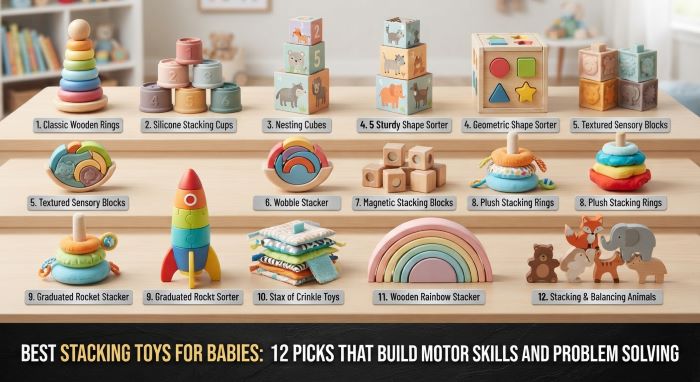
Best Stacking Toys for Babies: 12 Picks That Build Motor Skills and Problem Solving
Hand a baby a set of cups, and you will see a small scientist at work. The cups get banged together, dropped, chewed, and knocked over. Months later, the same baby sets one cup on top of another and looks up with pride. Stacking is one of the first real problems a child solves. The best stacking toys for babies make that work fun, safe, and just hard enough.
These simple toys have stayed popular for generations because they grow with the child. A ring stacker is a teether at six months, a puzzle at twelve, and a color sorting game at two. This guide lists 12 specific picks, compares them in a table, and explains what to choose at each age.
Why Stacking Matters
Stacking looks simple, but it calls on many skills at once.
- Fine motor control: The child must grasp, carry, place, and let go.
- Hand-eye coordination: The hand has to land where the eye is looking.
- Problem solving: Which piece goes next? Why did the tower fall?
- Size and order: Big goes under small.
- Cause and effect: A push makes it fall.
- Early math: More, less, taller, shorter, first, last.
- Language: You name colors, sizes, and actions as you play.
- Focus and patience: The child tries again after a fall.
What to Look For
- Age fit. Check the label, and match it to what your baby can do.
- Size. Pieces should be too large to fit through a toilet paper tube.
- Safe materials. Look for BPA-free plastic, food-grade silicone, or solid wood with non-toxic, water-based paint.
- Easy grip. Chunky, light pieces suit small hands.
- Easy cleaning. Babies mouth everything.
- Forgiving design. Early stackers should work in any order.
- Open-ended use. The best toys can be used in many ways.
Every pick on our list of the best stacking toys for babies meets most of these points.
Comparison Table: 12 Stacking Toys at a Glance
| Toy | Type | Best Age | Material | Price Range | Best For |
|---|---|---|---|---|---|
| Fisher-Price Rock-a-Stack | Ring stacker | 6 months and up | Plastic | Under $10 | Best first stacker |
| The First Years Stack Up Cups | Nesting cups | 6 months and up | Plastic | Under $10 | Best value |
| Fat Brain Toys Tobbles Neo | Weighted spheres | 6 months and up | Plastic | About $35 | Most forgiving |
| Mushie Stacking Cups | Nesting cups | Birth and up | Plastic | $15 to $20 | Best design |
| Sassy Stacks of Circles | Ring stacker | 6 months and up | Plastic | $10 to $15 | Best textures |
| Melissa & Doug Soft Pineapple Stacker | Soft stacker | Birth and up | Fabric | $15 to $25 | Best for young babies |
| Infantino Squeeze and Stack Block Set | Soft blocks | 6 months and up | Soft plastic | $10 to $15 | Best soft blocks |
| Mega Bloks First Builders Big Building Bag | Building blocks | 12 months and up | Plastic | $15 to $25 | Best first blocks |
| Melissa & Doug Rainbow Stacker | Wooden rings | 18 months and up | Wood | About $10 | Best wooden rings |
| Le Toy Van Forest Stacker | Wooden tower | 12 months and up | Rubberwood | About $25 | Best eco pick |
| Grimm’s Large Rainbow | Wooden arches | 12 months and up | Wood | Higher | Best open-ended toy |
| Djeco Topanifarm Stacking Cubes | Nesting boxes | 18 months and up | Heavy cardboard | About $28 | Best stacking boxes |
Prices are rough guides and change often. Age labels come from the makers. Check the box before you buy.
1. Fisher-Price Rock-a-Stack
This is the classic ring stacker, and it is still one of the best. Five bright rings fit on a cone-shaped post. The base rocks, so the tower wobbles and rights itself. The top ring has beads inside that rattle. Rings are light, easy to hold, and safe to chew.
Because the post is a cone, the rings only fit in size order all the way down. That gives a child a real puzzle around the first birthday. It costs less than a fast food meal.
2. The First Years Stack Up Cups
Eight cups nest inside one another or flip over to build a tall tower. They have numbers on the base and holes for water play. Babies can stack them, hide things under them, fill them with sand, and take them in the bath.
They are light, which means towers fall with no harm. They are also very hard to break. For the price, no toy gives more play.
3. Fat Brain Toys Tobbles Neo
Tobbles are six weighted, textured spheres that nest on each other at any angle. They tilt, spin, and balance without falling off easily. That makes them forgiving for a baby who cannot yet place a piece with care.
They feel good in the hand, with a grippy surface. Older children build odd, leaning towers and spin them. They cost more than basic stackers, but they hold interest for years.
4. Mushie Stacking Cups
These cups do the same job as other nesting cups, in soft, muted colors that many parents like. They are made in Denmark from BPA-free plastic. Each cup has a different cutout shape in the base, which makes for good water play.
5. Sassy Stacks of Circles
This ring stacker uses a straight post, so rings fit in any order. That is ideal for a first success. Each of the nine rings has a different texture and weight, and one has beads inside. The chunky shape is easy to hold and chew. The mix of textures feeds a baby’s need to explore by touch.
6. Melissa & Doug Soft Pineapple Stacker
This fabric stacker has soft, padded rings that slide over a plush core. Each layer has a different texture, crinkle, or sound. Nothing is hard, so it is safe for a young baby who is still unsteady while sitting.
Mother & Baby rates it as a sensory-rich choice and good value. Older toddlers may outgrow it sooner than a wooden set.
7. Infantino Squeeze and Stack Block Set
These soft blocks are easy to squeeze and gentle when they fall. Each has raised shapes, numbers, or animals on its sides. They can go in the bath. Babies of six months chew and bang them. By ten or twelve months, they start to set one on top of another.
Soft blocks are the best way to introduce block stacking, since a falling tower will not hurt or startle.
8. Mega Bloks First Builders Big Building Bag
These oversized blocks snap together with a light push and pull apart easily. The bag holds 80 pieces. Once a child can stack loose blocks, snap blocks add a new step: pieces that stay put.
They suit children from about one year. They also keep their value for years of building.
9. Melissa & Doug Rainbow Stacker
This is the wooden version of the classic ring toy: eight smooth, colored rings on a solid post with a rocking base. It is sturdy and looks good on a shelf. Mother & Baby praises the quality and grip, while noting that the paint can chip with heavy use.
The maker labels it for 18 months and up.
10. Le Toy Van Forest Stacker
This tower is made of chunky rubberwood pieces in forest shapes and colors, and it comes with a cotton storage bag. The pieces are large and easy for small hands. It is a good choice for families who prefer wood from sustainable sources.
11. Grimm’s Large Rainbow
The Grimm’s rainbow is a set of nested wooden arches. It has no rules. Children stack the arches, line them up as tunnels, build bridges, make fences for toy animals, and rock dolls in them. It is a favorite in Montessori and Waldorf homes.
It costs more than the other picks. In return, it stays in use from about age one well into grade school.
12. Djeco Topanifarm Stacking Cubes
These sturdy cardboard boxes nest inside each other and stack into a tall tower. Each side shows farm animals, numbers, or scenes. The set often includes small animal figures. A toddler can build a tower taller than their own body, which is a thrill.
Cardboard shows wear over time and should not get wet. Keep the small figures away from children under three unless the label says otherwise.
Stacking Milestones by Age
| Age | What Most Babies Do | Good Toys |
|---|---|---|
| 4 to 6 months | Grasp, mouth, and bang | Soft stacker, single rings and cups |
| 6 to 9 months | Pass a toy hand to hand, take rings off a post | Rock-a-Stack, Stack Up Cups |
| 9 to 12 months | Put things in and take them out, knock towers down | Nesting cups, soft blocks, Tobbles |
| 12 to 15 months | Stack two blocks, put rings on a post | Ring stackers, Mega Bloks |
| 15 to 18 months | Stack three or four blocks | Wooden blocks, wooden stackers |
| 18 to 24 months | Stack six blocks, start to sort by size | Rainbow stacker, nesting boxes |
Children grow at their own pace. These ages are general guides. If you have worries about your child’s motor skills, talk with your pediatrician.
When you shop for the best stacking toys for babies, remember that taking apart comes before putting together. A seven-month-old who pulls every ring off the post is doing exactly the right thing.
Types of Stacking Toys
Ring stackers: Rings on a post. Great for grasp and release.
Nesting cups: Cups that fit inside each other or stack up. The most flexible type.
Soft blocks: Squeezable cubes for early tower building.
Wooden blocks: The classic. Best from about 12 months.
Weighted or balance stackers: Pieces that tilt and wobble, such as Tobbles.
Nesting boxes: Large cubes that make tall towers.
Arches and open-ended sets: Shapes with no fixed order, such as a wooden rainbow.
Wood vs. Plastic vs. Silicone vs. Fabric
| Material | Pros | Cons | Best For |
|---|---|---|---|
| Plastic | Light, cheap, easy to clean, bath safe | Less charm | First stackers |
| Wood | Sturdy, long lasting, pleasant weight | Heavy if thrown, paint can chip, not for water | 12 months and up |
| Silicone | Soft, safe to chew, dishwasher safe | Picks up lint, floppy towers | Teething babies |
| Fabric | Softest, safe for the youngest | Harder to clean, less stable | Under 9 months |
There is no single right choice. The best stacking toys for babies come in all four materials. Many families start with plastic or fabric and add wood after the first birthday.
How to Play Together
- Show, then wait. Stack two pieces slowly. Then hand one to your baby and pause.
- Start with knocking down. Build a tower and let your baby topple it. It teaches cause and effect and it is fun.
- Use fewer pieces. Offer two or three rings at first, not the full set.
- Name what you see. “Big cup. Little cup. On top. Uh oh, it fell.”
- Praise effort. Clap for the try, not only the success.
- Follow your baby’s lead. If the rings become bracelets, play along.
- Add small tests later. “Can you find the red one?” “Which one is biggest?”
Ten Ways to Use Nesting Cups
- Stack them into a tower.
- Nest them from large to small.
- Hide a small toy under one and ask where it went.
- Pour water in the bath.
- Scoop sand outdoors.
- Sort them by color.
- Count them.
- Roll a ball into them.
- Use them as molds for play dough.
- Line them up as pretend teacups.
Safety Tips
- Check that every piece is too large to be a choking risk.
- Inspect toys often for cracks, chips, and loose parts.
- Throw out wooden pieces with flaking paint.
- Keep sets with small figures away from children under three.
- Buy from known brands that meet U.S. toy safety standards.
- Watch for recalls on the Consumer Product Safety Commission website.
- Stay close during play, most of all with heavy wooden pieces.
- Keep older siblings’ small building bricks out of reach.
Cleaning and Care
- Plastic and silicone: Wash in warm, soapy water or on the top rack of the dishwasher if the label allows.
- Wood: Wipe with a damp cloth and mild soap. Do not soak it. Let it air dry.
- Fabric: Follow the label. Many can go in the washing machine.
- Cardboard: Wipe gently with a dry or barely damp cloth.
Clean toys more often when your baby is sick or teething.
How Many Stacking Toys Does a Baby Need?
Two or three is enough. You do not need to own all of the best stacking toys for babies. Choose one ring stacker, one set of cups, and one set of blocks. Put out one at a time. A baby with fewer choices plays longer and more deeply with each. Swap toys every week or two to keep them fresh.
Beyond Stacking
Stackers are one part of a good toy shelf. Around the first birthday, children are also ready for push toys, shape sorters, balls, and board books. For a wider list, see this guide to the best toys for 1 year old.
Hands-on play should come first in the early years. When your child is older and you want to add a little screen time, choose with care. This list of the best educational YouTube channels for kids points to calm, well-made options. Real objects in real hands still teach the youngest children best.
Frequently Asked Questions
When can babies start to use stacking toys? Babies can hold and mouth the pieces from about four to six months. Most begin to place rings on a post or set one block on another around 12 months.
What are the best stacking toys for babies at 6 months? The Fisher-Price Rock-a-Stack, The First Years Stack Up Cups, and a soft fabric stacker.
Are wooden stacking toys better than plastic? Not better, just different. Wood lasts longer and feels nice. Plastic is lighter, cheaper, and safer when thrown.
Are stacking toys Montessori? Many fit Montessori ideas, since they are simple, hands-on, and let the child correct their own mistakes.
My baby only knocks towers down. Is that normal? Yes. Knocking down comes well before building up.
How many blocks should a toddler stack? Many children stack two blocks at around 12 to 15 months and about six by age two. Ranges are wide.
Can stacking toys go in the bath? Plastic cups and soft plastic blocks can. Wood, cardboard, and fabric should stay dry.
Final Thoughts
The best stacking toys for babies are simple, sturdy, and open to many kinds of play. A ring stacker, a set of nesting cups, and a few soft blocks cover the whole first year for very little money. Add wooden pieces and snap blocks after the first birthday.
Sit on the floor, build a small tower, and let your baby knock it down. Then do it again. Those minutes of play build skill, focus, and confidence. With two or three of the best stacking toys for babies and a patient adult nearby, your child has all the tools needed to learn through play.
Key Takeaways
- Stacking builds fine motor skill, hand-eye coordination, problem solving, and early math ideas.
- The best stacking toys for babies are large, light, easy to grip, and safe to chew.
- The Fisher-Price Rock-a-Stack and The First Years Stack Up Cups are the best low-cost starters.
- Babies take things apart and knock them down before they can build. That is a normal stage.
- Start with plastic or fabric before 12 months, and add wooden sets after the first birthday.
- Two or three stacking toys are enough. Rotate them to keep interest high.
- Check pieces for size and damage, and stay close during play.