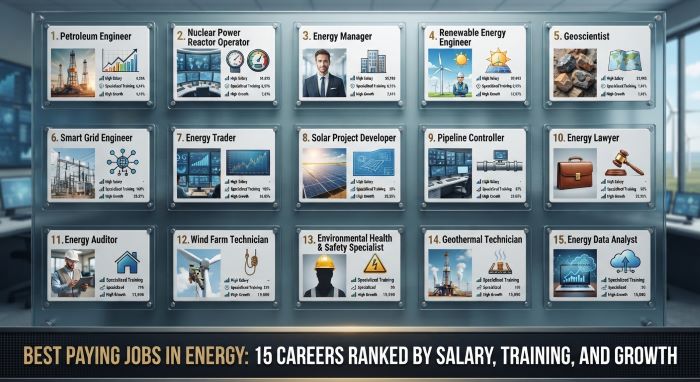
Best Paying Jobs in Energy: 15 Careers Ranked by Salary, Training, and Growth
The energy sector keeps the lights on, the cars moving, and the data centers humming. It also pays very well. Oil and gas, nuclear power, the electric grid, wind, and solar all need skilled people, and many of those roles pay far more than the typical American job. The best paying jobs in energy range from engineers with six-figure salaries to skilled trade workers who earn close to $100,000 without a college degree.
This guide ranks 15 specific careers by pay. It uses median salary figures from the U.S. Bureau of Labor Statistics for 2025, the latest year on record. You will see what each job involves, what training it takes, and how fast it is growing. A comparison table puts all of it in one place.
How We Ranked These Careers
We ranked each role by its national median annual wage. The median is the midpoint. Half of workers in the job earn more, and half earn less. For context, the median wage for all U.S. jobs was $50,980 in 2025.
We also list the usual entry-level education and the projected job growth from 2025 to 2035. Pay alone does not make a good career. A job with strong pay but few openings can be hard to enter. A job with lower pay but fast growth can be a smart way in.
Keep three points in mind as you read.
- Pay varies by state, employer, and experience.
- Many energy jobs add overtime, bonuses, and per diem pay on top of base wages.
- Some of these roles exist in other industries too. Pay inside energy is often higher than the national figure.
Comparison Table: 15 Energy Careers at a Glance
| Rank | Job | Median Pay (2025) | Typical Entry Education | Projected Growth, 2025 to 2035 |
|---|---|---|---|---|
| 1 | Architectural and engineering manager | $171,270 | Bachelor’s degree plus experience | 6% |
| 2 | Petroleum engineer | $144,910 | Bachelor’s degree | 2% |
| 3 | Nuclear engineer | $133,970 | Bachelor’s degree | 0% |
| 4 | Chemical engineer | $125,040 | Bachelor’s degree | 5% |
| 5 | Nuclear power reactor operator | $122,890 | High school diploma plus long training | Decline for the group |
| 6 | Electrical engineer | $120,630 | Bachelor’s degree | 8% |
| 7 | Environmental engineer | $107,110 | Bachelor’s degree | 6% |
| 8 | Power distributor and dispatcher | $106,730 | High school diploma plus long training | Decline for the group |
| 9 | Mining and geological engineer | $106,220 | Bachelor’s degree | 4% |
| 10 | Mechanical engineer | $104,110 | Bachelor’s degree | 11% |
| 11 | Power plant operator | $102,040 | High school diploma plus long training | Decline for the group |
| 12 | Geoscientist | $101,920 | Bachelor’s degree | 5% |
| 13 | Electrical power-line installer and repairer | $95,320 | High school diploma plus apprenticeship | 10% |
| 14 | Wind turbine service technician | $64,120 | Technical school certificate | 30% |
| 15 | Solar photovoltaic installer | $53,140 | High school diploma | 37% |
Source: U.S. Bureau of Labor Statistics, Occupational Outlook Handbook, 2025 wage data. Power plant operators, distributors, and dispatchers are projected to decline 4 percent as a group, though about 3,400 openings a year are still expected.
1. Architectural and Engineering Manager
Median pay: $171,270
Engineering managers lead teams of engineers and technicians. In energy, they run refinery upgrades, plan new power plants, direct grid projects, and manage budgets and schedules. They hire staff, set technical goals, and answer to senior leaders.
Most start as working engineers. After five or more years, they move into lead roles and then into management. A bachelor’s degree in engineering is standard. Many add a master’s degree in engineering management or business.
This is the top-paid role on the list, and it rewards people who pair technical skill with leadership.
2. Petroleum Engineer
Median pay: $144,910
Petroleum engineers design ways to get oil and gas out of the ground. They plan wells, choose drilling methods, and find ways to pull more from older fields. Some work in offices. Others spend long stretches at drill sites or on offshore platforms.
A bachelor’s degree in petroleum, mechanical, or chemical engineering is the usual start. Pay is even higher inside oil and gas extraction, where the median reached $180,080.
Growth is slow at 2 percent, and hiring rises and falls with oil prices. Still, about 1,000 openings a year are expected as workers retire.
3. Nuclear Engineer
Median pay: $133,970
Nuclear engineers design and monitor the systems that produce nuclear power. They work on reactor cores, radiation shielding, fuel handling, and waste disposal. Many also work in research labs, the federal government, and the Navy’s nuclear program.
A bachelor’s degree in nuclear engineering is standard, and research roles often need a graduate degree. Some jobs call for a security clearance.
BLS projects little or no change in total jobs through 2035. About 800 openings a year should come from retirements. Interest in small modular reactors and plant restarts could shift that picture, so watch the field.
4. Chemical Engineer
Median pay: $125,040
Chemical engineers turn raw materials into useful products. In energy, they run refineries, design processes for fuels and petrochemicals, and work on batteries, hydrogen, biofuels, and carbon capture.
A bachelor’s degree in chemical engineering is required. Internships and co-op programs help a great deal with hiring.
Growth of 5 percent is faster than average. The skill set transfers well, so chemical engineers can move between oil and gas, clean energy, and manufacturing.
5. Nuclear Power Reactor Operator
Median pay: $122,890
Reactor operators control nuclear reactors. They adjust control rods, watch gauges and alarms, and respond when readings fall out of range. The job demands focus and calm.
This is one of the highest paid jobs you can get without a college degree. Most operators start with a high school diploma, though many have Navy nuclear training or some college. New hires go through years of plant training and must pass a licensing exam from the U.S. Nuclear Regulatory Commission. They also retrain and retest on a regular basis.
Shift work is the norm, since plants run around the clock.
6. Electrical Engineer
Median pay: $120,630
Electrical engineers design the systems that generate, move, and control power. In energy, they work on substations, transmission lines, solar and wind farms, battery storage, and grid controls.
A bachelor’s degree in electrical engineering is the entry point. A Professional Engineer license helps for utility and consulting roles.
Electrical and electronics engineering jobs are projected to grow 8 percent, much faster than average. Rising power demand, grid upgrades, and new data centers all drive hiring.
7. Environmental Engineer
Median pay: $107,110
Environmental engineers help energy companies meet air, water, and waste rules. They design systems to cut emissions, clean up spills, manage water at drill sites, and plan the safe closing of old plants and wells.
A bachelor’s degree in environmental, civil, or chemical engineering is typical. The role suits people who want to work on pollution and climate problems from inside the industry.
8. Power Distributor and Dispatcher
Median pay: $106,730
Dispatchers, also called system operators, control the flow of electricity from plants to substations to customers. They watch the grid on large control boards, balance supply with demand, and reroute power when a line fails or a storm hits.
A high school diploma plus long on-the-job training is the usual path. Many roles require certification from the North American Electric Reliability Corporation.
The job carries real pressure, since a wrong call can cause an outage. It also offers strong pay for a role that does not require a degree.
9. Mining and Geological Engineer
Median pay: $106,220
Mining engineers design safe, efficient mines. In energy, they work on coal and uranium, and more and more on lithium, copper, cobalt, and other minerals that batteries and power lines need.
A bachelor’s degree in mining or geological engineering is standard. Jobs are often in remote places, and travel is common.
10. Mechanical Engineer
Median pay: $104,110
Mechanical engineers design and maintain machines. In energy, that means turbines, pumps, compressors, boilers, drilling gear, and wind turbine parts. It is one of the broadest engineering fields, so it opens doors across oil and gas, power plants, and renewables.
A bachelor’s degree in mechanical engineering is the entry point. Many who start here later move into project lead and management roles.
11. Power Plant Operator
Median pay: $102,040
Power plant operators run the equipment that makes electricity at gas, coal, hydro, and other plants. They start and stop generators, watch meters, and adjust output as demand changes.
A high school diploma plus years of on-the-job training is typical. Strong math and mechanical skills help. Shift work, including nights and weekends, is standard.
Total jobs in this group are projected to decline 4 percent as plants automate and older units close. Even so, retirements should open about 3,400 jobs a year across operators, distributors, and dispatchers.
12. Geoscientist
Median pay: $101,920
Geoscientists study the earth to find and assess resources. In energy, they locate oil and gas deposits, map sites for geothermal plants, and study rock layers for carbon storage. They split time between field work, labs, and offices.
A bachelor’s degree in geology or a related field is the minimum. Many roles prefer a master’s degree. Growth of 5 percent is faster than average.
13. Electrical Power-Line Installer and Repairer
Median pay: $95,320
Lineworkers build and fix the power lines that carry electricity to homes and businesses. They climb poles and towers, work from bucket trucks, and restore power after storms. The work is physical and can be dangerous, since it involves heights and high voltage.
Most lineworkers enter through a paid apprenticeship of up to three years after high school. A commercial driver’s license is often required. Storm work and overtime can push pay well above the median.
Jobs are projected to grow 10 percent, with about 13,600 new positions. Grid upgrades and data center demand are major drivers. For anyone who wants high pay without a four-year degree, this is one of the best paying jobs in energy to consider.
14. Wind Turbine Service Technician
Median pay: $64,120
Wind techs inspect, maintain, and repair wind turbines. They climb towers that stand hundreds of feet tall, test electrical and hydraulic systems, and replace worn parts.
Most complete a certificate program at a technical school, which often takes about a year, then train on the job. Comfort with heights and tight spaces is a must.
Pay is lower than the roles above, but growth of 30 percent makes this one of the fastest growing jobs in the country. With experience, techs can move into lead, site manager, and training roles that pay more.
15. Solar Photovoltaic Installer
Median pay: $53,140
Solar installers put solar panels on roofs and in ground-mounted arrays. They measure and plan the layout, mount the panels, and connect them to the electrical system.
A high school diploma is enough to start. Some installers take short courses or learn on the job. With 37 percent growth, it is the fastest growing role on this list.
The pay is the lowest here, but the job is a common first step. Installers often go on to become electricians, crew leads, system designers, or sales staff, all of which pay more.
Best Paying Roles Without a Four-Year Degree
College is not the only path. Five jobs on this list need only a high school diploma plus training or an apprenticeship.
| Job | Median Pay (2025) | How You Train |
|---|---|---|
| Nuclear power reactor operator | $122,890 | Plant training and federal license |
| Power distributor and dispatcher | $106,730 | On-the-job training and certification |
| Power plant operator | $102,040 | On-the-job training |
| Power-line installer and repairer | $95,320 | Apprenticeship |
| Solar photovoltaic installer | $53,140 | Short course or on-the-job training |
These trade and operator roles show that the best paying jobs in energy are not limited to engineers. They do ask for long training periods, shift work, and a strong safety record.
Oil and Gas vs. Renewables: Where Is the Money?
Right now, the highest base salaries sit in oil, gas, and nuclear. Petroleum engineers, nuclear engineers, and reactor operators all earn well above $120,000 at the median.
The fastest growth sits in renewables and the grid. Solar installer and wind tech jobs are growing at 37 and 30 percent. Lineworker and electrical engineer jobs are also growing fast as the country builds out its power network.
Many skills cross over. A drilling engineer can move into geothermal. A refinery chemical engineer can work on hydrogen or biofuels. An electrician can install solar or battery systems. If you want both high pay and long-term security, build skills that transfer.
What Affects Your Pay
- Location: Texas, Alaska, North Dakota, and Gulf Coast states often pay more for oil and gas roles. Lineworkers tend to earn more in states with strong unions and high living costs.
- Experience: Entry-level engineers earn far less than the median. Senior specialists earn far more.
- Overtime: Lineworkers, operators, and field crews can add tens of thousands of dollars in overtime.
- Working conditions: Offshore, remote, and hazardous jobs pay premiums.
- Licenses: A Professional Engineer license, an NRC license, or a NERC certification raises your value.
- Union membership: Many utility trade jobs are union roles with set wage scales and strong benefits.
- Commodity prices: Oil and gas hiring and bonuses rise and fall with energy prices.
How to Start a Career in Energy
- Pick a track. Choose between engineering, skilled trades, plant operations, or science.
- Get the right training. That may be a four-year degree, a technical certificate, or an apprenticeship.
- Look for internships and co-ops. Energy companies hire heavily from their own intern pools.
- Earn safety credentials. OSHA training and first aid certificates help for field jobs.
- Apply to utilities and contractors. Local utilities, cooperatives, and their contractors are steady employers.
- Consider the military. Navy nuclear training is a well-known route into reactor operator jobs.
- Keep learning. Add licenses and certificates as you go.
Skills Employers Want
- Strong math and problem solving
- A serious attitude toward safety
- Comfort with computers and control systems
- Mechanical and electrical aptitude
- Clear communication and teamwork
- Willingness to work shifts, travel, or work outdoors
- Physical fitness for trade and field roles
Benefits Beyond the Paycheck
Energy employers often offer more than a high wage. Utilities are known for stable jobs, pensions or strong retirement plans, and good health coverage. Field workers may get per diem pay, housing, and rotation schedules with long blocks of time off. Many companies pay for training and licenses.
The Trade-Offs
High pay comes with costs. Be honest with yourself about them.
- Hazards: Lineworkers, wind techs, and drill crews face real physical risk.
- Schedules: Plants and grids run all day, every day. Nights, weekends, and holidays are part of the job.
- Remote sites: Oil fields, mines, wind farms, and offshore rigs are often far from home.
- Boom and bust cycles: Oil and gas hiring can swing sharply.
- Weather: Storm crews work in the worst conditions.
Is Energy the Right Field for You?
Energy suits people who like technical work, clear rules, and tangible results. It is not for everyone. If you prefer people-centered work, a caring career may fit better. Roles such as direct support professional jobs offer a very different kind of reward, with a focus on helping others live more independent lives. Compare both paths before you commit to training.
Frequently Asked Questions
What is the highest paid job in energy? Among the roles ranked here, engineering managers lead at a median of $171,270. Top executives and some senior specialists earn more, but those roles are few.
Which of the best paying jobs in energy need no degree? Nuclear reactor operator, power dispatcher, power plant operator, and lineworker. All four have medians near or above $95,000.
Which energy jobs are growing fastest? Solar installer at 37 percent and wind turbine technician at 30 percent.
Is energy a good career path? For many people, yes. Pay is above average, and demand for electricity keeps rising. Check the outlook for your specific role, since some are shrinking.
Do renewable jobs pay less than oil and gas? Entry-level installer and technician roles do. Engineers and managers in renewables earn pay similar to peers in other parts of the sector.
How long does it take to qualify? A lineworker apprenticeship takes up to three years. An engineering degree takes four. Reactor operator training takes several years inside a plant.
Are these salaries the same everywhere? No. These are national medians. Local pay can be much higher or lower.
Final Thoughts
The best paying jobs in energy fall into three groups. Engineers and managers earn the most and need a degree. Operators and lineworkers earn close to or above six figures with a diploma and long training. Wind and solar roles pay less at the start but are growing faster than almost any other job in the country.
Choose a path that fits your strengths, your tolerance for risk and shift work, and the time you can give to training. Look at growth as well as pay. With the right plan, the best paying jobs in energy can offer strong income and steady work for decades. Start by checking the outlook for your target role, then map the training you need to reach one of the best paying jobs in energy.
Key Takeaways
- The best paying jobs in energy are led by engineering managers at a median of $171,270, then petroleum engineers at $144,910 and nuclear engineers at $133,970.
- Several roles pay near or above $100,000 without a four-year degree, including nuclear reactor operator, power dispatcher, power plant operator, and lineworker.
- Solar installers and wind turbine technicians have lower pay but the fastest growth, at 37 and 30 percent through 2035.
- Lineworker and electrical engineer jobs are growing fast as the grid expands to meet rising power demand.
- Pay varies by state, experience, overtime, licenses, and working conditions.
- High pay often comes with shift work, remote sites, physical risk, and hiring cycles tied to energy prices.
- Compare pay and growth together, and pick skills that transfer across oil and gas, nuclear, and renewables.