
Direct Support Professional Jobs: A Complete Career Guide
Direct support professional (DSP) jobs are among the most consistently in-demand roles in the healthcare and social services sector, and also among the most meaningfully impactful for the people you work with day to day. DSPs provide hands-on assistance to people with intellectual and developmental disabilities, helping them live as independently as possible while supporting their daily needs, community engagement, and personal goals. This guide covers what the work actually involves, what qualifications are typically required, what it pays, and how to build a career in the field.
What Direct Support Professionals Do
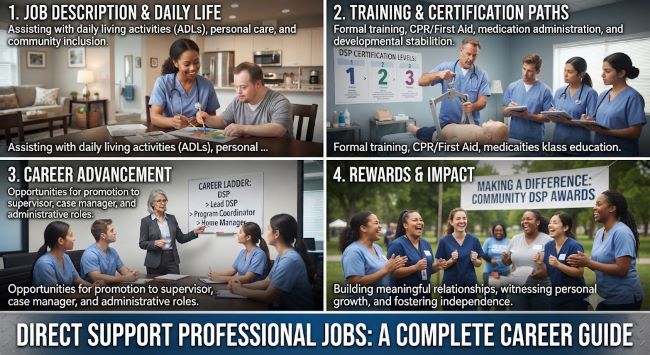
The day-to-day work of a DSP varies depending on the setting and the specific needs of the individuals being supported, but generally includes:
Personal care assistance. Helping with daily living activities such as bathing, dressing, grooming, and mobility for individuals who need varying levels of support with these tasks.
Medication management. Administering or reminding individuals to take prescribed medications according to their care plan, and documenting compliance accurately.
Community integration support. Accompanying individuals to medical appointments, social activities, shopping, employment, and community events, helping them participate fully in community life.
Skill development. Working with individuals on developing or maintaining life skills — cooking, budgeting, communication, social skills — as part of their individualized service plan.
Behavioral support. Implementing behavior support plans developed by clinical staff, helping de-escalate challenging situations, and documenting behavioral patterns for the broader care team.
Documentation and care plan compliance. Maintaining accurate records of daily activities, incidents, progress toward goals, and any changes in health or behavior, which inform ongoing care planning.
Advocacy. Supporting individuals in expressing their preferences and needs, and helping ensure their rights and choices are respected within the care setting.
Where Direct Support Professionals Work
Group homes and residential settings. Many DSPs work in residential facilities where small groups of individuals with disabilities live together with around-the-clock staff support.
In-home support. DSPs working through home care agencies provide support directly in an individual’s own home or family home, helping them remain in a familiar environment rather than a facility setting.
Day programs. Community-based day programs provide structured activities, skill-building, and social engagement for individuals during daytime hours, often as a complement to residential or in-home support.
Supported employment settings. Some DSPs specifically support individuals in workplace settings, helping them succeed in competitive or supported employment positions.
Hospitals and specialized care facilities. Some DSP roles exist within larger healthcare institutions supporting patients with intellectual and developmental disabilities during medical care.
Qualifications and Requirements
Entry requirements for direct support professional jobs are generally more accessible than many healthcare roles, making it a common entry point into the broader human services and healthcare field:
Education. Most positions require a high school diploma or GED. Some employers prefer or require some college coursework in psychology, social work, or a related field, though this isn’t universal.
Certification and training. Most states require completion of a state-approved DSP training program covering topics like person-centered planning, medication administration, CPR/First Aid, abuse and neglect reporting, and crisis intervention. Many employers provide this training as part of onboarding rather than requiring it before hire.
Background check. Given the vulnerable population served, all DSP positions require a thorough background check, and many states maintain specific disability services employment exclusion lists that disqualify certain prior offenses.
Driver’s license. Often required or strongly preferred, particularly for community integration and transportation support responsibilities.
Physical requirements. The role can involve physical tasks including lifting or assisting with mobility, so reasonable physical capability is typically required, with specifics varying by the needs of the individuals supported.
National certifications. The National Alliance for Direct Support Professionals (NADSP) offers a credentialing program (DSP-Registered, DSP-Certified, DSP-Specialist) that’s increasingly recognized industry-wide and can support career advancement and higher pay in many states and organizations.
What Direct Support Professional Jobs Pay
Compensation varies by region, employer type, and experience level:
Entry level: $13-$17 per hour in most markets, with some lower-cost-of-living regions starting closer to minimum wage and higher-cost states starting higher.
Experienced DSPs (2+ years): $15-$20 per hour.
DSPs with specialized certifications (NADSP credentials, medication administration certification, behavioral specialist training): $17-$24 per hour.
Supervisory and lead DSP roles: $20-$28 per hour.
Shift differentials: many employers offer additional pay for evening, overnight, and weekend shifts, which can meaningfully increase total compensation for DSPs willing to work less desirable hours.
The DSP field has historically struggled with wage levels that don’t always reflect the demands and importance of the work, and advocacy efforts at state and federal levels continue to push for wage increases tied to Medicaid reimbursement rates, which fund much of the disability services sector.
How to Find Direct Support Professional Job Openings
Indeed, LinkedIn, and ZipRecruiter. Searching “direct support professional” or “DSP” plus your location surfaces current openings across agencies and care providers.
State developmental disability agency websites. Most states maintain resources connecting jobseekers with licensed disability services providers in their area.
Specific agency websites. Major national and regional disability services organizations (such as Easterseals, ARC chapters, and numerous regional providers) post openings directly on their own career pages.
NADSP resources. The National Alliance for Direct Support Professionals offers career resources and connects jobseekers with credentialing information relevant to the field.
Career Advancement in Direct Support
DSP roles offer a genuine career ladder for those who want to build a long-term career in human services: progression from direct support professional to lead DSP, to house manager or program supervisor, to program director, with some DSPs eventually pursuing case management, social work licensure, or clinical roles supported by further education. Many agencies offer tuition assistance or partnerships with local colleges for DSPs interested in pursuing degrees in social work, psychology, or healthcare administration while working.
For related entry-level career paths with similarly accessible qualification requirements, data entry jobs offers a different career direction worth considering if you’re weighing options across accessible entry-level fields with different day-to-day demands than direct, hands-on care work.
Key Takeaways
- Direct support professional jobs involve hands-on assistance with daily living, medication management, community integration, and skill development for people with intellectual and developmental disabilities
- DSPs work across group homes, in-home care settings, day programs, supported employment, and specialized healthcare facilities
- Most positions require only a high school diploma plus state-approved DSP training, background check, and often a driver’s license, making it an accessible entry point into human services careers
- Pay ranges from $13-$17 per hour entry level to $20-$28 per hour for supervisory roles, with specialized certifications and shift differentials increasing compensation
- The NADSP credentialing program (DSP-Registered, Certified, Specialist) is increasingly recognized for career advancement and pay differentiation in the field
- Find openings through Indeed, LinkedIn, state developmental disability agency websites, and direct agency career pages from organizations like Easterseals and regional ARC chapters
- Clear advancement paths exist from direct care to supervisory and program management roles, with many agencies offering tuition assistance for further education in social work or healthcare administration