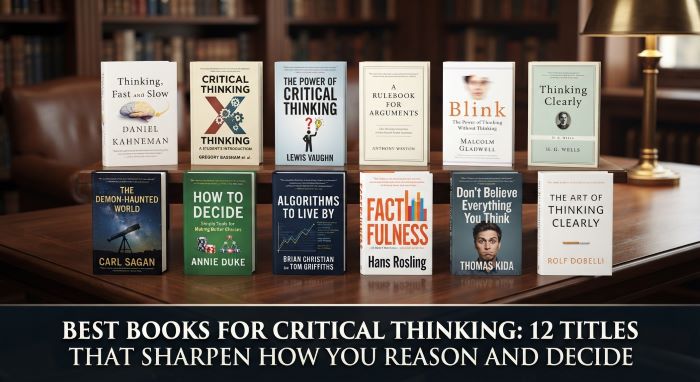
Best Books for Critical Thinking: 12 Titles That Sharpen How You Reason and Decide
Every day you face claims that want your trust. A headline says a food causes cancer. A coworker insists a plan cannot fail. A video promises to double your savings. Sorting good claims from bad ones is a skill, and like any skill, you can train it. The best books for critical thinking give you tools to do that work: how to ask sharper questions, how to notice your own blind spots, and how to change your mind when the evidence calls for it.
This guide lists 12 specific titles, compares them in a table, and explains who should read each one. You will also find a reading order, tips for getting more from each book, and answers to common questions.
What Critical Thinking Really Means
Critical thinking is the habit of judging a claim by its reasons and evidence. It is not the same as being negative or doubting everything. A good critical thinker does five things well.
- Asks what exactly is being claimed.
- Looks for the evidence behind the claim.
- Checks whether the reasoning holds together.
- Considers other explanations.
- Stays willing to update when better information arrives.
Books help because they slow you down. A feed pushes you to react. A book gives you 300 pages with one careful mind.
How We Chose These Books
We looked for titles that meet four tests. First, the book must teach a skill you can use, not just entertain. Second, a general reader must be able to follow it without a degree in philosophy or statistics. Third, the book should have stood up to years of readers and reviewers. Fourth, the list as a whole should cover different angles: logic, psychology, numbers, and decisions.
We also flag weak spots. Some famous titles lean on studies that later failed to replicate. A list of the best books for critical thinking should practice what it preaches, so we note those issues where they apply.
Comparison Table: 12 Books at a Glance
| Book | Author | First Published | Main Focus | Difficulty | Best For |
|---|---|---|---|---|---|
| Thinking, Fast and Slow | Daniel Kahneman | 2011 | Cognitive bias | Medium to hard | Deep readers |
| The Demon-Haunted World | Carl Sagan | 1995 | Scientific skepticism | Medium | Science fans |
| Asking the Right Questions | M. Neil Browne and Stuart Keeley | 1981 | Evaluating arguments | Easy to medium | Students |
| The Art of Thinking Clearly | Rolf Dobelli | 2013 | Thinking errors | Easy | Busy readers |
| Superforecasting | Philip Tetlock and Dan Gardner | 2015 | Prediction and probability | Medium | Analysts and planners |
| Factfulness | Hans Rosling | 2018 | Data and world view | Easy | News readers |
| Calling Bullshit | Carl Bergstrom and Jevin West | 2020 | Misleading data | Medium | Anyone online |
| Thinking in Bets | Annie Duke | 2018 | Decisions under uncertainty | Easy to medium | Leaders and investors |
| The Scout Mindset | Julia Galef | 2021 | Motivated reasoning | Easy | Self-improvers |
| Being Logical | D.Q. McInerny | 2004 | Formal logic basics | Easy | Beginners |
| Predictably Irrational | Dan Ariely | 2008 | Behavioral economics | Easy | Curious general readers |
| How to Read a Book | Mortimer Adler and Charles Van Doren | 1940, revised 1972 | Active reading | Medium | Serious learners |
1. Thinking, Fast and Slow by Daniel Kahneman
Kahneman won the Nobel Prize in economics for work on how people judge and choose. His book splits the mind into two modes. System 1 is fast, automatic, and emotional. System 2 is slow, careful, and lazy. Most errors happen when System 1 answers a question that needed System 2.
You will learn about anchoring, loss aversion, the planning fallacy, and the trap of trusting a vivid story over a dull statistic. The book is long and dense in places. Read one chapter at a time.
One honest caution: the chapter on priming rests on studies that later failed to replicate, and Kahneman himself said he placed too much faith in them. The core ideas on bias and loss aversion remain well supported.
2. The Demon-Haunted World by Carl Sagan
Sagan wrote this book as a defense of science as a way of thinking. Its most famous chapter offers a “baloney detection kit,” a set of tools for testing claims. Seek independent confirmation. Encourage debate. Do not trust authority alone. Form more than one hypothesis. Ask whether the claim can be proved false.
Sagan covers alien abduction stories, faith healers, and witch trials, but his real subject is how ordinary people fool themselves. The writing is warm and clear. If you want one book to hand to a teenager, this is a strong choice.
3. Asking the Right Questions by M. Neil Browne and Stuart Keeley
This is the classic college text on evaluating arguments, and it has gone through many editions. Each chapter gives you one question to ask. What are the issue and the conclusion? What are the reasons? Which words are ambiguous? What are the hidden assumptions? Are there fallacies? How good is the evidence? What important information is left out?
It reads like a workbook, with practice passages after each chapter. It is the most practical title on this list for students who must write essays or read research.
4. The Art of Thinking Clearly by Rolf Dobelli
Dobelli gives you 99 short chapters, each two or three pages, on one thinking error. Survivorship bias, sunk cost, confirmation bias, social proof, and the rest each get a quick story and a plain lesson.
The book is easy to read in spare minutes. It does not go deep, and critics have noted that it borrows heavily from other writers, including Nassim Taleb and Kahneman. Treat it as a field guide and a starting point.
5. Superforecasting by Philip Tetlock and Dan Gardner
Tetlock ran a large research project that asked thousands of volunteers to forecast world events. A small group beat the rest by a wide margin, and they did it without secret information. This book explains how.
Superforecasters think in probabilities, not yes or no. They break big questions into small ones. They start with base rates. They update often and in small steps. They keep score and study their misses. These are habits anyone can copy.
6. Factfulness by Hans Rosling
Rosling, a Swedish doctor and statistician, tested audiences around the world on basic facts about health, income, and education. Most people scored worse than random guessing. They believed the world was poorer and sicker than the data showed.
He names ten instincts that distort our view, such as the gap instinct, the negativity instinct, and the fear instinct. Each chapter ends with a simple rule for keeping it in check. The book is hopeful without being naive.
7. Calling Bullshit by Carl Bergstrom and Jevin West
Two University of Washington professors turned their popular course into this book. It targets the modern kind of nonsense: the kind dressed up in charts, statistics, and scientific language.
You will learn to question where data came from, to spot selection bias, to read a misleading graph, and to tell correlation from causation. You do not need advanced math. The authors argue that you can often spot a bad claim by checking what went into the analysis, even if you cannot follow the analysis itself.
8. Thinking in Bets by Annie Duke
Duke is a former professional poker player with graduate training in cognitive psychology. Her main point is that a good decision and a good outcome are different things. Judging a choice only by how it turned out is a mistake she calls “resulting.”
She shows how to state your confidence as a percentage, how to seek out people who will challenge you, and how to plan for ways a decision could go wrong. The book is short and full of practical exercises.
9. The Scout Mindset by Julia Galef
Galef contrasts two ways of thinking. A soldier defends a position. A scout tries to draw an accurate map. Most of us slip into soldier mode without noticing, hunting for reasons to believe what we already want to believe.
The book gives tests you can run on yourself. Would you judge this evidence the same way if it pointed the other way? Can you name a time you were wrong and changed course? It is one of the kindest books on the list, because it treats being wrong as normal and useful.
10. Being Logical by D.Q. McInerny
This slim book covers the basics of logic in about 130 pages. It explains what an argument is, how premises support a conclusion, and what makes reasoning valid. The final section lists common fallacies with short examples.
It is a good first book if terms like “begging the question” or “false dilemma” are new to you. Some readers find the tone a bit old-fashioned, but the content is sound and quick to finish.
11. Predictably Irrational by Dan Ariely
Ariely uses simple experiments to show how people stray from rational choices in steady, repeatable ways. Why does “free” feel so powerful? Why do we overvalue what we own? Why do high prices make a product seem better?
The book is fun and easy to read. One caution matters here. Ariely has faced serious questions about data in some of his research, and at least one of his papers has been retracted. Read the book for its questions and its general themes, and check any specific finding before you rely on it. That exercise is good practice in itself.
12. How to Read a Book by Mortimer Adler and Charles Van Doren
Critical thinking starts with understanding what an author really said. Adler lays out four levels of reading: elementary, inspectional, analytical, and syntopical, which means comparing many books on one subject.
He teaches you to find a book’s main argument, to state it in your own words, and to hold off on judgment until you can say “I understand.” Only then, he says, have you earned the right to agree or disagree. The prose is formal, but the method improves every other book you read.
Which Book Should You Read First?
Your starting point depends on your goal and your free time. Among the best books for critical thinking, some suit a weekend and others need a month.
- If you are new to the subject: Start with Being Logical or The Art of Thinking Clearly.
- If you are a student: Start with Asking the Right Questions.
- If you follow the news closely: Start with Factfulness, then Calling Bullshit.
- If you make big decisions at work: Start with Thinking in Bets, then Superforecasting.
- If you want the deepest treatment: Read Thinking, Fast and Slow.
- If you want to change your own habits of mind: Read The Scout Mindset.
A Suggested Reading Order
Here is a path that builds skill step by step over about six months.
- Being Logical, to learn the vocabulary.
- The Demon-Haunted World, to see the scientific attitude in action.
- Factfulness, to practice with real data.
- The Scout Mindset, to turn the tools on yourself.
- Thinking in Bets, to apply them to choices.
- Thinking, Fast and Slow, for depth once you have the basics.
Add the remaining six as your interests lead you.
How to Get More From Each Book
Reading about reasoning does not make you reason better on its own. Practice does. Even the best books for critical thinking only work if you use them. Try these habits.
- Take notes by hand. Write the main claim of each chapter in one sentence.
- Apply one idea a week. Pick a single concept, such as base rates, and look for it in your daily life.
- Argue the other side. After a chapter, write the best objection you can think of.
- Keep a decision journal. Record what you decided, why, and how sure you were. Review it later.
- Discuss it. Explain an idea to a friend. If you cannot explain it, you have not learned it yet.
- Check the sources. Look up one study from each book and see whether it has held up.
Common Thinking Errors These Books Cover
| Error | What It Means | Book That Explains It Well |
|---|---|---|
| Confirmation bias | Favoring evidence that supports what you believe | The Scout Mindset |
| Anchoring | Relying too much on the first number you hear | Thinking, Fast and Slow |
| Survivorship bias | Studying only the winners | The Art of Thinking Clearly |
| Resulting | Judging a choice by its outcome | Thinking in Bets |
| Base rate neglect | Ignoring how common something is | Superforecasting |
| Correlation taken as cause | Assuming one thing causes another | Calling Bullshit |
| Negativity instinct | Noticing bad news more than good | Factfulness |
| Appeal to authority | Trusting a claim because of who said it | The Demon-Haunted World |
Critical Thinking and Personal Development
Clear thinking supports every other kind of growth. It helps you choose better goals, judge advice, and avoid wasted effort. If you want to widen your reading beyond reasoning skills, this list of the best books for personal growth is a good next step.
Reason and emotion also work together. Strong feelings can bend your judgment, and knowing your own moods helps you catch that in time. For reading on that side of the mind, see the best books for emotional intelligence.
Finally, good thinking needs time. A rushed mind falls back on shortcuts. If your days feel too full for slow, careful thought, the best books for time management can help you make room.
Books for Younger Readers and Teens
Teens can handle several titles on this list. The Demon-Haunted World, Factfulness, and The Art of Thinking Clearly all work well for readers of about 14 and up. Being Logical is short enough for a school break. For younger children, look for picture books and puzzle books on logic, and talk through questions together. Ask “How do we know that?” at the dinner table. That one habit does more than any book.
Audiobook or Print?
Story-driven books such as Factfulness, Thinking in Bets, and The Scout Mindset work well in audio. Dense books with charts, such as Thinking, Fast and Slow and Calling Bullshit, are better in print, where you can stop, reread, and study a figure. Asking the Right Questions is a workbook and needs a pen.
Frequently Asked Questions
Can a book really improve your thinking? Yes, if you practice what you read. Studies of training in reasoning show gains when learners apply the methods to real problems and get feedback.
How many of the best books for critical thinking should I read? Three or four, read slowly and applied, will do more than all 12 skimmed.
Are older titles still worth it? Yes. Logic does not expire. Sagan’s 1995 book and Adler’s 1940 classic remain among the best books for critical thinking because the core skills have not changed.
Do I need math? No. Superforecasting and Calling Bullshit use numbers, but both explain them in plain words.
Which is the shortest? Being Logical, at about 130 pages.
Which is the hardest? Thinking, Fast and Slow, due to its length and detail.
Final Thoughts
The best books for critical thinking do not hand you answers. They teach you to ask better questions and to hold your beliefs with the right amount of confidence. Start with one title that fits your level. Read it with a pen. Use one idea this week.
Over time, you will notice the change. You will pause before you share a shocking headline. You will ask for the base rate. You will say “I was wrong” with less pain. That is the real reward of reading the best books for critical thinking: not winning arguments, but seeing the world a little more clearly.
Key Takeaways
- Critical thinking means judging claims by reasons and evidence, and staying open to changing your mind.
- The best books for critical thinking cover four areas: logic, psychology, data, and decisions.
- Beginners should start with Being Logical or The Art of Thinking Clearly. Students should start with Asking the Right Questions.
- Thinking, Fast and Slow gives the deepest look at bias, though its priming chapter has not held up.
- Factfulness and Calling Bullshit help you read news, charts, and statistics with care.
- Thinking in Bets and Superforecasting teach you to think in probabilities and to separate decisions from outcomes.
- Read slowly, take notes, and apply one idea at a time. Practice matters more than the number of books you finish.