Best Books for Time Management: 10 Reads to Take Back Your Day
There never seems to be enough time. The inbox refills faster than you can empty it, meetings eat the afternoon, and the important project you meant to start keeps sliding to next week. Most people respond by working longer or trying harder, but that rarely fixes the problem. What actually helps is a better system and a clearer sense of what deserves your hours in the first place. That is where good books come in. This guide covers the best books for time management, what each one teaches, who it suits, and how to turn the ideas into daily habits that stick.
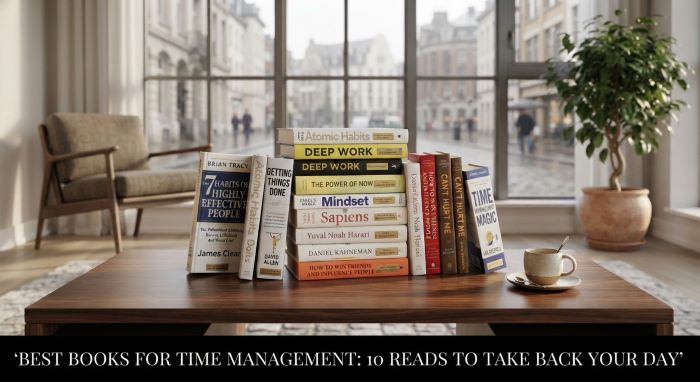
Why time management is really about priorities
Time management sounds like a scheduling problem, but it is usually a priorities problem. Everyone gets the same 24 hours. The difference is how deliberately those hours get spent. The most useful books on this topic teach three things:
- Capturing and organizing everything competing for your attention
- Choosing what actually matters and saying no to the rest
- Protecting focus so the important work gets done
The books below approach these from different angles. Some offer detailed systems, others offer mindset shifts, and a few challenge the whole idea of productivity. Reading two or three gives you a well-rounded toolkit.
The 10 best books for time management
1. Getting Things Done by David Allen
Getting Things Done, often called GTD, is one of the most influential productivity systems ever written. David Allen’s core idea is that your mind is for having ideas, not holding them. When you try to remember every task, you feel stressed and scattered. His solution is to capture everything in a trusted system, clarify what each item means, organize it into lists, review regularly, and then do the work.
The method is detailed and takes effort to set up, but people who adopt it describe a real sense of calm and control. The updated edition reflects modern digital tools.
Best for: People overwhelmed by too many tasks and commitments who want a complete system.
2. Eat That Frog! by Brian Tracy
The title comes from the idea that if you eat a live frog first thing in the morning, nothing worse can happen the rest of the day. Brian Tracy’s “frog” is your biggest, most important task, usually the one you are most likely to procrastinate on. His advice: do it first.
The book offers 21 short, practical strategies for beating procrastination and prioritizing. It is quick to read and easy to apply immediately, which makes it one of the best books for time management for beginners.
Best for: Procrastinators who need simple, actionable advice.
3. Deep Work by Cal Newport
Cal Newport, a computer science professor, argues that the ability to focus without distraction on demanding tasks is becoming rare and valuable. “Deep work” produces your best results, while “shallow work” like email and meetings fills the day without moving much forward.
He offers strategies for scheduling focus time, embracing boredom, cutting back on social media, and draining the shallows from your schedule. If your days feel busy but unproductive, this book explains why and how to fix it.
Best for: Knowledge workers, students, and creatives who struggle to focus.
4. Four Thousand Weeks by Oliver Burkeman
This book takes a refreshingly different angle. Oliver Burkeman points out that the average human life lasts about four thousand weeks, and no productivity system will ever let you do everything. Instead of chasing efficiency, he argues, you should accept your limits, make hard choices about what matters, and stop postponing life until your to-do list is finished.
It is thoughtful, honest, and oddly freeing. Many readers say it changed how they think about time entirely. It is one of the best books for time management precisely because it questions the productivity obsession.
Best for: Anyone burned out by productivity culture who wants a healthier perspective.
5. Essentialism by Greg McKeown
Greg McKeown’s Essentialism is about doing less, but better. He argues that most people spread their energy across too many commitments and make a millimeter of progress in a million directions. The essentialist instead asks, “What is the most important thing I should be working on right now?” and ruthlessly cuts the rest.
The book teaches how to explore options, eliminate the nonessential, and make execution effortless. It pairs perfectly with more tactical books.
Best for: People who say yes to too much and feel stretched thin.
6. The ONE Thing by Gary Keller and Jay Papasan
Gary Keller, cofounder of Keller Williams Realty, and Jay Papasan boil productivity down to a single question: “What is the one thing I can do such that by doing it everything else will be easier or unnecessary?” The book argues that extraordinary results come from narrowing your focus rather than multitasking.
It also debunks common myths, such as the idea that everything matters equally or that willpower is always available. Time blocking your one thing each day is its central practice.
Best for: Goal-driven readers who want sharper focus on what matters most.
7. Make Time by Jake Knapp and John Zeratsky
Written by two former Google designers, Make Time offers a flexible framework rather than a rigid system. Each day, you choose a single “Highlight” to prioritize, use tactics to stay laser-focused on it, and energize yourself through exercise, food, and sleep. You then reflect and adjust.
The book includes 87 tactics you can mix and match, so it adapts to different personalities and schedules. It is practical, friendly, and easy to experiment with.
Best for: People who want a flexible, experiment-friendly approach.
8. Indistractable by Nir Eyal
Nir Eyal, known for writing about how tech products capture attention, flips the script to show how to take control of it. He argues that distraction starts inside us, as a way to escape discomfort, and that managing those internal triggers matters more than blaming phones.
The book covers mastering internal triggers, making time for traction, hacking back external triggers, and preventing distraction with pacts. It is especially useful in a world full of notifications.
Best for: Anyone whose time disappears into phones, email, and social media.
9. 168 Hours by Laura Vanderkam
Laura Vanderkam’s 168 Hours starts with a simple observation: a week has 168 hours, and even people with full-time jobs and families have more time than they think. She encourages readers to track their time for a week to see where it really goes, then build a schedule around core competencies and priorities.
The time-tracking exercise alone is eye-opening, and the book shows that busy people can still make room for what they love.
Best for: Busy parents and professionals who feel they have no free time.
10. Slow Productivity by Cal Newport
Cal Newport’s newer book argues against the frantic “pseudo-productivity” of looking busy. He proposes three principles: do fewer things, work at a natural pace, and obsess over quality. Drawing on the lives of writers, artists, and scientists, he shows how sustainable, meaningful work beats burnout-driven hustle.
It is a strong counterpart to Deep Work and especially relevant for knowledge workers and freelancers.
Best for: People who want sustainable productivity without burnout.
Quick comparison table
| Book | Author | Core idea | Best for |
|---|---|---|---|
| Getting Things Done | David Allen | Capture everything in a trusted system | Overwhelmed task managers |
| Eat That Frog! | Brian Tracy | Do the hardest task first | Procrastinators |
| Deep Work | Cal Newport | Protect focused time | Knowledge workers |
| Four Thousand Weeks | Oliver Burkeman | Accept limits, choose wisely | Burned-out achievers |
| Essentialism | Greg McKeown | Do less, but better | Overcommitted people |
| The ONE Thing | Keller and Papasan | Focus on one priority | Goal-driven readers |
| Make Time | Knapp and Zeratsky | One daily Highlight | Flexible experimenters |
| Indistractable | Nir Eyal | Control internal triggers | Distracted phone users |
| 168 Hours | Laura Vanderkam | Track and reshape your week | Busy parents and pros |
| Slow Productivity | Cal Newport | Fewer things, better quality | Burnout prevention |
Where to start
The best books for time management help most when they match your specific struggle. Here is a quick guide:
- Too many tasks and loose ends: Getting Things Done.
- Chronic procrastination: Eat That Frog!
- Cannot focus: Deep Work or Indistractable.
- Saying yes to everything: Essentialism or The ONE Thing.
- Burned out and questioning the grind: Four Thousand Weeks or Slow Productivity.
- Feel like you have no time at all: 168 Hours.
- Want something flexible to experiment with: Make Time.
You do not need to read all ten. One well-chosen book, applied for a month, will do more than skimming the whole list.
Common ideas across these books
Read enough of the best books for time management and a few principles keep appearing. These are worth adopting no matter which book you start with:
- Get tasks out of your head and into a trusted list or system.
- Decide your top priority each day before checking email.
- Block time on your calendar for important work, and protect it like a meeting.
- Limit distractions by silencing notifications and batching email.
- Say no more often so your yes means something.
- Review your week regularly to adjust plans and catch loose ends.
- Rest on purpose, since exhausted people make poor use of their time.
Reading these books in the right order
If you want to work through several titles, the order can make a difference. Many readers find it helpful to start with perspective, move to priorities, and finish with systems.
Begin with Four Thousand Weeks to reset your expectations and accept that you cannot do everything. Then read Essentialism or The ONE Thing to decide what deserves your time. Next, pick up Deep Work or Indistractable to protect focus for those priorities. Finally, use Getting Things Done or Make Time to build a practical system that holds it all together. Reading the best books for time management in this sequence means each one builds on the last, rather than leaving you with ten competing methods.
If you only have time for one, choose based on your biggest pain point, as outlined above. A single book applied well beats a stack read quickly.
Formats that fit a busy schedule
Ironically, people who most need help with time often feel they have no time to read. Audiobooks solve much of that problem. Most of the best books for time management are available in audio, so you can listen during commutes, workouts, chores, or walks. Summaries and key-idea apps can help you decide which full book to read, though they rarely replace the depth of the original.
Another option is reading in short, scheduled blocks, such as 15 minutes each morning before checking email. That habit alone puts the lessons of these books into practice: protecting a small window of time for something important before the day takes over.
Putting the lessons into practice
Reading about time management is the easy part. Here is how to make the ideas stick:
- Pick one book and one habit. Do not try to overhaul everything at once.
- Track your time for a week. Most people are surprised where their hours actually go.
- Plan tomorrow tonight. Choose your top priority before the day starts.
- Try a weekly review. Spend 30 minutes each week clearing loose ends and planning ahead.
- Adjust and repeat. Keep what works, drop what does not, and add a new habit next month.
Time management for different kinds of work
The same principles apply differently depending on your job. Freelancers and creatives juggle client work, admin, and marketing without a boss setting deadlines, which makes self-management critical. These Time Management Tips for Freelance Writers show how to turn better time habits into higher income, a nice companion to any of the books above.
In larger organizations and emergency settings, time management scales up into coordinating people, equipment, and tasks at once. Understanding how teams deploy personnel and resources efficiently, as covered in this piece on Resource Management, shows how the same principles of prioritizing and assigning work apply far beyond a personal to-do list.
Signs your time management is improving
Change can be gradual, so it helps to know what progress looks like. You are on the right track if you notice any of these:
- You finish your most important task before lunch more days than not.
- Deadlines stop sneaking up on you, because everything lives in one trusted list.
- You say no to requests that do not fit your priorities, and feel less guilty doing it.
- Your evenings and weekends feel more like rest and less like catch-up time.
- You end the week knowing what you accomplished and what comes next.
Celebrate these small wins. They are proof that the habits are working, even if your to-do list never fully empties.
Mistakes to avoid
Many people read productivity books and see little change. Watch out for these traps:
- Collecting systems instead of using one. Switching methods every week means none of them work.
- Over-engineering your setup. Complex apps and color codes can become procrastination.
- Ignoring energy. Time management fails if you are exhausted. Sleep and breaks matter.
- Filling every minute. Leave buffer time, since things always take longer than planned.
- Chasing productivity for its own sake. The goal is time for what matters, not doing more of everything.
The bottom line
Better time management is not about squeezing more into your day. It is about deciding what matters and protecting time for it. The best books for time management cover every angle: Getting Things Done and Eat That Frog! for systems and action, Deep Work and Indistractable for focus, Essentialism and The ONE Thing for priorities, and Four Thousand Weeks and Slow Productivity for a healthier perspective on it all. Pick the book that matches your biggest struggle, apply one habit at a time, and review your progress weekly. Do that, and you will spend less time feeling behind and more time on the work and life that matter to you.
Key Takeaways
- Time management is mostly about priorities: capturing tasks, choosing what matters, and protecting focus for important work.
- Getting Things Done by David Allen offers a complete system for capturing and organizing every commitment.
- Eat That Frog! helps procrastinators tackle their hardest task first, while Deep Work and Indistractable build focus.
- Essentialism and The ONE Thing teach you to do less but better by narrowing your focus to what matters most.
- Four Thousand Weeks and Slow Productivity challenge productivity culture and promote a healthier, sustainable approach.
- Make Time offers a flexible daily Highlight method, and 168 Hours shows busy people how to find hidden time.
- Apply one book and one habit at a time, track your time for a week, plan your top priority the night before, and review weekly.