Best Sales Intelligence Tools B2B Contact Data: 10 Platforms Compared
Every sales team runs on data. You can have the sharpest pitch and the best product in your market, but if your rep dials a dead number or emails someone who left the company eight months ago, none of it matters. Bad contact data burns hours, wrecks sender reputation, and quietly kills pipeline. That is why choosing a sales intelligence platform ranks among the most important tooling decisions a revenue team makes. This guide walks through the best sales intelligence tools B2B contact data buyers compare today, with pricing, strengths, weak spots, and the kind of team each one suits.
What sales intelligence tools actually do
At the core, these platforms help you find the right people at the right companies and reach them. Most combine a few jobs in one place:
- Contact data: Verified work emails, direct dials, and mobile numbers for decision makers.
- Company data: Firmographics such as size, industry, revenue, location, and tech stack.
- Enrichment: Filling in missing fields on records already in your CRM.
- Signals: Hiring activity, funding rounds, job changes, and buying intent.
- Workflow: Browser extensions, CRM sync, and sometimes built-in sequencing or dialing.
Not every tool does all five well. Some win on raw database size, others on phone accuracy, others on price or ease of use. Knowing which job matters most to your team is the first step to a good choice.
How to judge B2B contact data quality
Before looking at vendors, it helps to know what separates good data from bad. When you evaluate the best sales intelligence tools B2B contact data vendors pitch, check these five things:
- Accuracy: How many emails bounce and how many phone numbers connect. Ask for a trial and test it against contacts you already know.
- Coverage: Does the database cover your specific region, industry, and job titles? A tool strong in North American tech may be thin in European manufacturing.
- Freshness: People change jobs constantly. Look for frequent re-verification.
- Compliance: If you sell into Europe, GDPR compliance is not optional. Check how the vendor sources and processes data.
- Integration: Data that does not flow into your CRM cleanly creates more work, not less.
With those criteria in mind, here are the ten platforms worth a close look.
The 10 best sales intelligence tools for B2B contact data
1. ZoomInfo
ZoomInfo is the heavyweight of the category. It claims more than 420 million contacts and 145 million company profiles, with especially deep coverage of North America. Its standout strength is org chart mapping, which lets you see entire buying committees, reporting lines, and departments inside a target account. It also bundles intent data, so you can spot companies researching topics related to what you sell.
Pricing is not published. Independent purchasing data puts the average contract around 33,500 dollars per year, and deals often require annual commitments. A limited free tier, ZoomInfo Lite, gives a small number of monthly credits.
Best for: Enterprise sales teams that need full account maps and have the budget for a premium platform.
Watch out for: Cost, long contracts, and add-on fees for extra modules.
2. Apollo.io
Apollo has become the default choice for many startups and small to mid-size teams because it combines a large contact database with outreach tools in one platform. It covers more than 230 million contacts and includes email sequencing, a dialer, and a Chrome extension. That means a rep can find a prospect, grab their email, and start a sequence without switching tools.
Paid plans start around 49 dollars per user per month on annual billing, and a free plan offers a limited number of credits each year. That low entry point makes Apollo one of the easiest ways to start.
Best for: SMBs and startups that want data and outreach together at a low price.
Watch out for: Data accuracy that can vary by region and seniority level, so verify before big campaigns.
3. Cognism
Cognism has built its reputation on phone-verified mobile numbers and strong European coverage. It claims a database of more than 400 million contacts and positions its “Diamond Data” as phone-verified, which makes it popular with cold-calling teams. Its compliance approach, including checks against do-not-call lists, is a key reason teams selling into the UK and EU pick it.
Like ZoomInfo, pricing is custom. Reported median contracts sit around 36,000 dollars per year, so it is an enterprise-level investment.
Best for: Outbound teams calling into Europe that need verified mobile numbers and GDPR confidence.
Watch out for: Price, and thinner coverage in some non-European niches.
4. Lusha
Lusha is built for speed and simplicity. Its browser extension lets a rep pull a contact’s email and phone number straight from a LinkedIn profile or company website in seconds. With a database of more than 280 million profiles, it covers a lot of ground for a tool that is quick to learn.
Paid plans start around 49.90 dollars per month on annual billing, and a free plan gives a small monthly credit allowance. That makes it a common pick for individual reps and small teams.
Best for: Reps who want fast, on-demand contact lookups without a heavy setup.
Watch out for: Credits run out quickly at higher volumes, and advanced features sit on pricier tiers.
5. LinkedIn Sales Navigator
Sales Navigator is less a contact database and more a prospecting layer on top of the world’s largest professional network. Its strength is fresh, self-reported job information, advanced lead filters, saved searches, and alerts when prospects change jobs or post. Because people update their own LinkedIn profiles, job titles and employers are often more current here than anywhere else.
Plans start around 100 dollars per month for the Core tier, with higher tiers for teams. The catch is that Sales Navigator does not hand you verified emails or phone numbers on its own, so most teams pair it with an enrichment tool like Lusha or Apollo.
Best for: Account research, relationship selling, and tracking job changes.
Watch out for: No built-in email or phone data, so budget for a second tool.
6. Seamless.AI
Seamless.AI takes a search-engine approach, using AI to find and verify contact details in real time rather than relying only on a static database. It advertises more than 1.9 billion records and markets itself heavily to high-volume prospecting teams. The real-time lookup model means data can be fresher for some contacts.
Pricing is custom, with a free trial to test results. Reviews are mixed on accuracy and on contract and cancellation terms, so read the agreement closely.
Best for: High-volume prospecting teams that want AI-driven, real-time lookups.
Watch out for: Inconsistent accuracy reports and strict contract terms.
7. UpLead
UpLead focuses on accuracy at a mid-market price. It covers more than 160 million contacts and backs its data with a 95 percent accuracy guarantee, verifying emails in real time when you download them. You only spend credits on contacts that pass verification, which keeps bounce rates low.
Plans start around 74 dollars per month, with no long-term contract required on entry tiers. For teams frustrated with bounces but not ready for enterprise pricing, it hits a sweet spot.
Best for: Mid-market teams that want reliable emails without an enterprise contract.
Watch out for: A smaller database than the giants and fewer intent features.
8. RocketReach
RocketReach claims one of the largest professional profile databases, with more than 700 million profiles. It works like a search engine for people, letting you look up almost anyone by name, company, or title. It is especially strong for email lookups across a broad range of industries, including those outside tech.
Plans start around 27 dollars per month on annual billing, which makes it one of the more affordable options for individuals.
Best for: Recruiters, founders, and reps who need broad lookups across many industries.
Watch out for: Phone data is less reliable than email, and filters are simpler than enterprise tools.
9. Hunter.io
Hunter is the specialist for email. It finds professional email addresses by domain and scores each one with a confidence rating, plus it verifies addresses and detects catch-all domains. It covers more than 100 million emails and is widely used by marketers, SDRs, and link builders.
A free plan includes a small number of searches per month, and paid plans start around 34 dollars per month.
Best for: Email-first outreach and cleaning email lists before a campaign.
Watch out for: No phone numbers and limited firmographic depth.
10. HubSpot Breeze Intelligence (formerly Clearbit)
Clearbit was acquired by HubSpot and now lives inside the platform as Breeze Intelligence. It enriches records automatically when someone fills out a form or visits your site, and it covers more than 50 million companies. For inbound-heavy teams, that means leads arrive in the CRM already filled in with company size, industry, and more.
It is no longer sold as a standalone product. You access it through HubSpot, with pricing based on credits.
Best for: HubSpot users who want automatic enrichment of inbound leads.
Watch out for: Only useful if you run on HubSpot, and it is not a full outbound prospecting database.
Features that separate the leaders
Once you look past database size, a few features decide which of the best sales intelligence tools B2B contact data teams actually stick with. Intent data tells you which accounts are researching topics tied to your product right now, so reps call when interest is high instead of guessing. Job change alerts flag when a past champion moves to a new company, which is often the warmest lead you will ever get. Technographic data shows which software a company already uses, helping you target accounts that fit your integration or displacement play.
Workflow features matter just as much. A browser extension that surfaces contact details on LinkedIn or a company site saves reps minutes on every lookup, and minutes add up across a team. Native CRM sync keeps records current without manual exports. Among the best sales intelligence tools B2B contact data buyers rate highly, the winners make the right action obvious and fast, not just the data available.
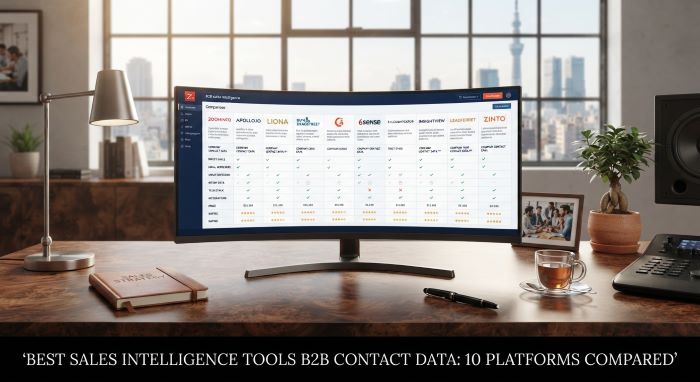
Quick comparison table
| Tool | Starting price (approx.) | Free option | Standout strength |
|---|---|---|---|
| ZoomInfo | Custom, often 30,000+ dollars/yr | Limited free tier | Org charts and intent data |
| Apollo.io | 49 dollars/user/mo | Yes | Data plus built-in outreach |
| Cognism | Custom | Sample on request | Phone-verified mobiles, GDPR |
| Lusha | 49.90 dollars/mo | Yes | Fast browser lookups |
| Sales Navigator | About 100 dollars/mo | Trial | Fresh job and account data |
| Seamless.AI | Custom | Trial | Real-time AI lookups |
| UpLead | 74 dollars/mo | Trial | 95 percent accuracy guarantee |
| RocketReach | 27 dollars/mo | No | Huge profile database |
| Hunter.io | 34 dollars/mo | Yes | Email finding and verification |
| Breeze Intelligence | Via HubSpot | No | Automatic inbound enrichment |
Pricing changes often and vendors negotiate, so treat these as starting points and confirm current rates before you buy.
Matching the tool to your team
There is no single winner here. The best sales intelligence tools B2B contact data teams choose depend on size, budget, and motion. Here is a simple way to narrow the field:
- Early-stage startup on a tight budget: Start with Apollo, and add Hunter for email verification.
- Small team with a few reps: Lusha or UpLead for accurate lookups, paired with Sales Navigator for research.
- Outbound team calling Europe: Cognism for verified mobiles and compliance.
- Enterprise with complex buying committees: ZoomInfo for account maps and intent.
- Inbound-heavy HubSpot shop: Breeze Intelligence for automatic enrichment.
Many mature teams run a stack of two or three tools rather than one, using a primary database plus a specialist for email or phone verification. That layered approach is how the best sales intelligence tools B2B contact data leaders use tend to deliver the most value, since no single vendor wins every category.
Turning data into pipeline
Good contact data is only the raw material. To get value from it, you need to know which accounts to go after and why. Reading the market well starts with patterns, and a data-driven approach to spotting sales trends in emerging businesses, like the one laid out in Mapping Market Movements, helps you decide where your contact data should point.
Your CRM is where that data lives and works. Keeping it clean, enriched, and connected to your other channels turns a pile of records into real relationships. The advice in Social Media CRM Power Tips is a good reminder that CRM strategy covers more than email and phone, since social touchpoints often warm up a cold contact before the first call.
For teams selling large, multi-stakeholder deals, contact data feeds straight into account-based marketing. Knowing every decision maker at a target account is the foundation of ABM, and if you are weighing outside help, this guide on choosing Marketing Services for Complex B2B Sales shows how agencies put that data to work.
Common mistakes when buying
Even experienced sales leaders stumble here. Avoid these traps when comparing the best sales intelligence tools B2B contact data vendors sell:
- Buying on database size alone. A billion records means little if half the emails bounce.
- Skipping a real trial. Test each tool against contacts you already know are accurate.
- Ignoring integration. A tool that does not sync with your CRM creates manual cleanup.
- Overbuying seats and credits. Start small, measure usage, then scale.
- Forgetting compliance. Selling into Europe without GDPR-ready data is a legal risk.
- Neglecting data hygiene. Even great data decays, so re-verify records on a schedule.
Budgeting for sales intelligence
Cost is where many teams get surprised. Entry plans look cheap, but credits, seats, and add-ons scale quickly. When you price the best sales intelligence tools B2B contact data vendors offer, estimate how many contacts each rep will pull per month, multiply by team size, and compare that to each plan’s credit limits. A tool that looks affordable at one seat can become expensive at ten.
How to run a fair trial
The smartest way to choose is to test two or three finalists side by side. Pull a list of 50 to 100 contacts you already know are correct, including a mix of regions, company sizes, and seniority levels. Run the same list through each tool and record how many emails verify, how many phone numbers connect, and how many records match current job titles.
Then look beyond accuracy. Time how long it takes a rep to find and export a contact, check how cleanly data lands in your CRM, and ask each vendor about renewal pricing, not just the first-year discount. A tool that wins on accuracy but frustrates reps will not get used, and an unused tool is the most expensive one of all.
The bottom line
Your pipeline is only as good as the data behind it. The best sales intelligence tools B2B contact data teams rely on range from enterprise platforms like ZoomInfo and Cognism to affordable, flexible options like Apollo, Lusha, UpLead, and RocketReach, plus specialists like Hunter for email and Sales Navigator for research. Define the job you need done, run a real trial against contacts you already know, check CRM integration and compliance, and start with the smallest plan that works. Pick well, keep your data clean, and your reps will spend their time selling instead of chasing dead ends.
Key Takeaways
- Sales intelligence tools combine contact data, company data, enrichment, buying signals, and workflow features, but each vendor excels at different jobs.
- Judge B2B contact data on accuracy, coverage for your market, freshness, GDPR compliance, and clean CRM integration, not database size alone.
- ZoomInfo and Cognism are premium enterprise options, with ZoomInfo leading on org charts and Cognism on phone-verified European mobiles.
- Apollo.io, Lusha, UpLead, and RocketReach offer strong data at lower prices, with Apollo adding built-in outreach tools.
- LinkedIn Sales Navigator provides the freshest job data but no emails or phones, so most teams pair it with an enrichment tool.
- Hunter.io specializes in email finding and verification, while HubSpot Breeze Intelligence automatically enriches inbound leads for HubSpot users.
- Run a side-by-side trial with 50 to 100 known contacts, check renewal pricing, and start with the smallest plan before scaling.