Best High Yield Savings Account: How to Pick One That Actually Pays
Money sitting in a regular checking account is money working for the bank instead of you. A high yield savings account flips that around, paying you real interest on cash you were going to keep anyway. The gap is not small either. The best high yield savings account today pays around 4 percent, while the national average savings rate sits near 0.38 percent. That is more than ten times the return for the same dollars. This guide breaks down how to choose one and what to watch for.
What makes an account “high yield”
A high yield savings account is simply a savings account that pays a much higher interest rate than a traditional bank account. Most of these accounts come from online banks, which skip the cost of physical branches and pass the savings to you as a better rate. That is why the best high yield savings account almost always lives online rather than at a big brick-and-mortar bank.
The rate is quoted as APY, or annual percentage yield, which includes the effect of compounding. When you compare accounts, APY is the number that matters most, since it tells you what you will actually earn over a year.
Why the rate gap is so large
It helps to see the difference in plain numbers. Say you keep 10,000 dollars in savings for a year. Here is roughly what you would earn at different rates:
- At the national average of 0.38 percent: about 38 dollars
- At a solid 4.00 percent: about 400 dollars
- At a top rate of 4.21 percent: about 421 dollars
Same money, same year, but the best high yield savings account earns you roughly ten times more than the average account. That is free money for doing nothing but parking your cash in a better spot.
Top accounts to consider
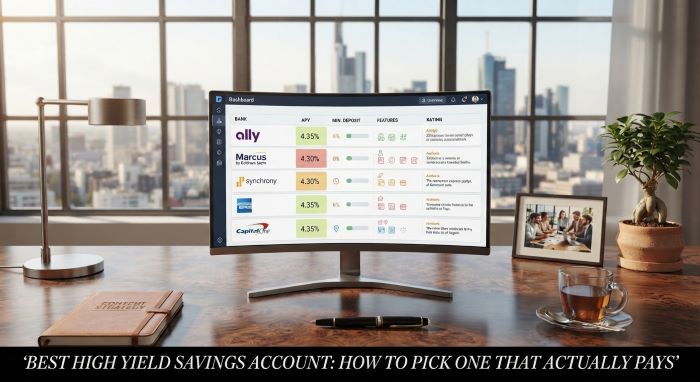
Rates shift over time, so always confirm the current APY before opening. As of September 2026, several online banks lead the pack. Here is a snapshot of strong options and what stands out about each.
| Account | APY (approx.) | Minimum | Notes |
|---|---|---|---|
| Axos Bank | 4.21% | Balance requirements apply | Top rate, some conditions |
| CIT Bank Platinum Savings | Up to 4.10% | $5,000 for top rate | Higher balance for best rate |
| Climate First Bank | 4.01% | Low | Values-focused banking |
| Peak Bank Envision | 4.01% | $0.01 | Very low minimum |
| SoFi | Up to 4.00% | $0 | No minimum, app-based |
Any of these can be the right fit for the right person, depending on your balance and how you like to bank. The top rate is great, but only if you can meet its conditions.
What to look for beyond the rate
The headline APY grabs attention, but the best high yield savings account is about more than one number. Before you open an account, check these factors.
- Fees: The best accounts charge no monthly maintenance fee. Never pay a fee that eats into your interest.
- Minimum balance: Some top rates require a large balance or regular direct deposits. Make sure you can meet the terms.
- FDIC insurance: Confirm the bank is FDIC insured, which protects your money up to 250,000 dollars per depositor. This is non-negotiable.
- Access to your money: Check how easily you can transfer funds to and from the account, and how long transfers take.
- Ease of opening: The best high yield savings account is quick to open online, often in minutes.
A slightly lower rate with no fees and easy access often beats a top rate loaded with conditions you cannot meet.
Watch out for teaser rates
One thing to be careful of: some accounts advertise eye-popping numbers that only apply to a tiny balance or for a short promotional window. If you see a rate that looks far above the rest, read the fine print. The best high yield savings account pays a strong rate on your full balance without hoops. A rate that only applies to your first 500 dollars is not the deal it appears to be.
Also remember that these rates are variable. Banks can and do change them as broader interest rates move, so the rate you open with may not last forever. That is normal and not a reason to avoid these accounts, just something to expect.
Who should use one
A high yield savings account is not for every dollar, but it is ideal for certain money. Consider putting these funds in the account you choose:
- Your emergency fund, which needs to stay safe and accessible
- Savings for a near-term goal like a vacation, wedding, or home down payment
- Any cash you want to keep liquid but do not need this week
It is less suited to money you will not touch for years, which might earn more in investments, or to daily spending, which belongs in checking.
How to open one
The process is refreshingly simple. To set up the best high yield savings account for you, follow these steps:
- Compare current APYs, fees, and minimums across a few reputable online banks.
- Confirm the bank is FDIC insured.
- Gather your ID, Social Security number, and bank details for funding.
- Apply online, which usually takes about 10 minutes.
- Transfer your initial deposit from an existing account.
- Set up automatic transfers to keep growing your balance.
Once it is open, the account does the work. Your money earns interest automatically, compounding over time.
The bottom line
Choosing the best high yield savings account is one of the easiest financial upgrades you can make. You get a rate around ten times the national average, your money stays safe with FDIC insurance, and you can usually open an account in minutes. Focus on a strong APY, no fees, and terms you can actually meet, and skip any teaser rate that only applies to a sliver of your balance. Park your emergency fund and short-term savings there, and let your cash finally start earning its keep. This is general information, not personalized financial advice, so weigh your own situation before deciding.
Key Takeaways
- The best high yield savings account pays around 4 percent APY, roughly ten times the national average of about 0.38 percent.
- These accounts are usually offered by online banks, which pass branch savings on to you as higher rates.
- Compare accounts using APY, the annual percentage yield, since it reflects compounding and shows what you will actually earn.
- Top options as of September 2026 include Axos Bank, CIT Bank, Climate First Bank, Peak Bank, and SoFi, though rates change often.
- Look beyond the rate at fees, minimum balance requirements, FDIC insurance, and how easily you can access your money.
- Watch for teaser rates that only apply to small balances or short promo windows, and remember these rates are variable.
- A high yield savings account is best for your emergency fund and short-term savings goals, not long-term investing or daily spending.