Best Books for Emotional Intelligence: 10 Reads That Change How You Relate
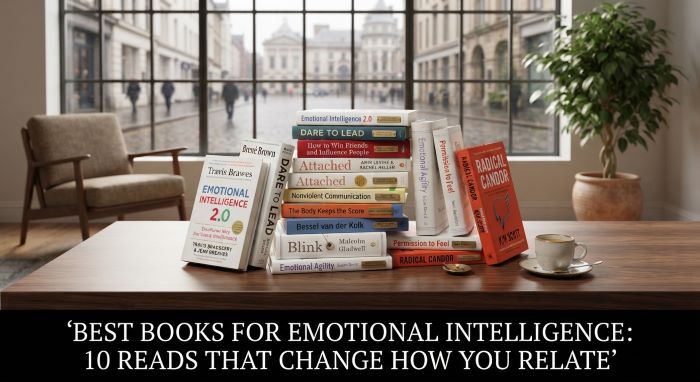
Smart people fail every day, not for lack of intelligence but for lack of emotional skill. They say the wrong thing in a tense meeting, misread a friend’s silence, or let frustration steer a decision they later regret. Emotional intelligence, often shortened to EI or EQ, is the ability to recognize, understand, and manage emotions, both your own and other people’s. The encouraging news is that it can be learned, and books are one of the best ways to learn it. This guide walks through the best books for emotional intelligence, what each one actually teaches, and how to turn the reading into real change.
What emotional intelligence really means
Before the list, it helps to define the term, since it gets thrown around loosely. Emotional intelligence usually breaks down into a handful of core skills: self-awareness, or knowing what you feel and why; self-regulation, or managing your reactions; motivation, or channeling emotions toward goals; empathy, or sensing what others feel; and social skills, or handling relationships well.
Those five pillars, popularized by psychologist Daniel Goleman, show up again and again across the titles below. Each author approaches them differently, some through research, some through practical exercises, and some through storytelling. Read a few and you start to see the same truths from multiple angles, which is exactly how the ideas stick.
1. Emotional Intelligence by Daniel Goleman
Any list has to start here. Published in 1995, Daniel Goleman’s Emotional Intelligence is the book that brought the concept into the mainstream. Goleman, a psychologist and former science journalist for the New York Times, argued that EQ can matter more than IQ for success in life and work. He drew on brain science and psychology to explain why people with strong emotional skills often outperform those with higher raw intelligence.
The book covers the five components of emotional intelligence in depth, explaining how the emotional brain works and why we sometimes get hijacked by feelings. It is more foundational and theoretical than practical, but it is essential reading. If you only read one of the best books for emotional intelligence, this is the cornerstone that everything else builds on.
Be warned that the writing leans academic in places, so give yourself time with it. The payoff is a solid grounding in why emotions shape our decisions so powerfully, which makes every other book on this list easier to absorb.
Best for: anyone who wants to understand the science and origins of the concept.
2. Emotional Intelligence 2.0 by Travis Bradberry and Jean Greaves
Where Goleman explains the theory, this book delivers the how-to. Emotional Intelligence 2.0, by Travis Bradberry and Jean Greaves, is built around practical strategies you can apply immediately. It breaks EQ into four skills, self-awareness, self-management, social awareness, and relationship management, and offers 66 specific techniques for improving each one.
The book also comes with access to an online assessment that scores your emotional intelligence and tracks your progress, which makes it feel actionable rather than abstract. It is short, direct, and easy to apply, which is why it remains one of the best books for emotional intelligence for busy readers who want results over theory.
Best for: people who want a practical, step-by-step improvement plan.
3. Permission to Feel by Marc Brackett
Marc Brackett, founder of the Yale Center for Emotional Intelligence, brings both research and personal history to this warm, insightful book. Permission to Feel introduces his RULER method, an acronym for Recognizing, Understanding, Labeling, Expressing, and Regulating emotions. Brackett weaves in his own childhood struggles, which gives the science real emotional weight.
What sets this book apart is its focus on giving yourself and others permission to actually feel emotions rather than suppress them. It is especially strong on emotional vocabulary, showing how naming a feeling precisely helps you manage it. Among these picks, this one is a favorite for its blend of heart and rigor.
Best for: parents, educators, and anyone who struggles to name what they feel.
4. Working with Emotional Intelligence by Daniel Goleman
Goleman earns a second spot because this follow-up applies the concept specifically to the workplace. Working with Emotional Intelligence argues that emotional competencies matter far more than technical skills or IQ for career success, especially in leadership. He shows how self-awareness, empathy, and relationship skills separate star performers from average ones.
For anyone focused on professional growth, this is one of the best books for emotional intelligence you can pick up. It makes a compelling, evidence-backed case that managing emotions well is a career skill, not a soft extra. The workplace framing makes the abstract ideas concrete and immediately relevant to your job.
Best for: professionals and managers who want to grow their careers.
5. Dare to Lead by Brené Brown
Brené Brown, a research professor who spent decades studying vulnerability, courage, and shame, has become one of the most beloved voices in this space. Dare to Lead applies her research to leadership, arguing that brave, emotionally honest leadership beats armored, defensive management. She covers topics like vulnerability, trust, and difficult conversations with warmth and practical tools.
While not labeled strictly as an EQ book, it belongs on this list because it teaches the emotional skills that great leadership requires. Brown’s storytelling makes hard ideas approachable, and her frameworks give you language for feelings and situations most people avoid.
Best for: leaders and anyone who wants to lead with courage and empathy.
6. Search Inside Yourself by Chade-Meng Tan
This one comes from an unexpected place: Google. Chade-Meng Tan, an early Google engineer, created a mindfulness-based emotional intelligence course for employees, and this book grew out of it. Search Inside Yourself blends mindfulness practices with EQ development, showing how attention training builds self-awareness and self-regulation.
The practical exercises make it stand out, giving you concrete meditation and reflection practices rather than just concepts. If you like the idea of combining mindfulness with emotional growth, this ranks high on the list. It bridges the gap between contemplative practice and workplace performance in a grounded, non-preachy way.
Best for: readers drawn to mindfulness and hands-on practice.
7. The Language of Emotions by Karla McLaren
Karla McLaren takes a deep, unusual dive into what specific emotions are actually trying to tell us. The Language of Emotions treats every emotion, even the uncomfortable ones like anger, fear, and jealousy, as carrying useful information. Instead of labeling feelings as good or bad, she teaches you to listen to them and respond wisely.
This book is a standout for building emotional literacy at a granular level. It helps you decode the messages behind your feelings, which is a core part of self-awareness. For readers who want to go deeper than the basics, it is one of the more profound titles available.
Best for: those who want a deep, nuanced understanding of individual emotions.
8. Atlas of the Heart by Brené Brown
Brown appears again, this time with a book that functions almost like an emotional map. Atlas of the Heart explores 87 different emotions and experiences, defining each one and explaining how they connect. The premise is simple but powerful: you cannot manage or communicate a feeling you cannot name.
By expanding your emotional vocabulary, this book directly strengthens self-awareness and empathy. It is beautifully designed and easy to dip in and out of. As a reference and a read, it earns its place here, especially for anyone who feels stuck describing their inner world in vague terms like “good” or “bad.”
Best for: readers building a richer emotional vocabulary.
9. Nonviolent Communication by Marshall Rosenberg
Marshall Rosenberg’s classic sits at the intersection of empathy and communication. Nonviolent Communication teaches a method for expressing needs and hearing others without blame or judgment. Its four-part framework, observations, feelings, needs, and requests, helps you navigate conflict with compassion rather than defensiveness.
Emotional intelligence and communication are deeply linked, since managing your own emotions is only half the work and connecting with others is the rest. This book is one of the best books for emotional intelligence precisely because it turns empathy into a repeatable practice. If communication is your growth area, it pairs perfectly with this guide to the Best Books for Communication Skills, which extends these ideas into everyday conversation.
Best for: anyone who wants to handle conflict and connection more skillfully.
10. Self-Compassion by Kristin Neff
Emotional intelligence includes how you treat yourself, and Kristin Neff is the leading researcher on self-compassion. Her book argues that being kind to yourself, rather than harshly self-critical, builds emotional resilience and healthier relationships. She backs it with research and offers practical exercises for treating yourself with the same care you would offer a friend.
This rounds out the list because self-regulation and self-awareness both depend on a stable, compassionate relationship with yourself. Among the best books for emotional intelligence, this one fills a gap the others sometimes miss: the inner voice. Learning to quiet your harshest critic frees up energy for growth.
Best for: anyone whose biggest obstacle is their own inner critic.
Quick comparison of the picks
Here is a snapshot to help you choose where to start.
| Book | Author | Best for |
|---|---|---|
| Emotional Intelligence | Daniel Goleman | Understanding the science |
| Emotional Intelligence 2.0 | Bradberry and Greaves | Practical, quick strategies |
| Permission to Feel | Marc Brackett | Naming and feeling emotions |
| Working with EI | Daniel Goleman | Career and workplace growth |
| Dare to Lead | Brené Brown | Courageous leadership |
| Search Inside Yourself | Chade-Meng Tan | Mindfulness plus EQ |
| The Language of Emotions | Karla McLaren | Deep emotional literacy |
| Atlas of the Heart | Brené Brown | Emotional vocabulary |
| Nonviolent Communication | Marshall Rosenberg | Empathy and conflict |
| Self-Compassion | Kristin Neff | Inner kindness and resilience |
How to actually apply what you read
Reading about emotional intelligence and building it are two different things. The best books for emotional intelligence only help if you put the ideas into practice. Here is how to make the reading count:
- Read slowly and reflect. Pause after key ideas and ask how they apply to your own life and recent situations.
- Keep a journal. Note the emotions you feel each day, what triggered them, and how you responded.
- Practice one skill at a time. Do not try to change everything at once. Pick one technique and use it for a week.
- Apply it in real conversations. Try naming a feeling out loud, pausing before reacting, or listening more deeply.
- Reread and revisit. These books reward a second pass once you have practiced the ideas.
Active reading matters here. When you engage with a nonfiction book, it helps to identify what the author is really arguing, so you can test it against your own experience. Learning to spot an author’s main claim, the kind of skill covered in this piece on Which of the Following Statements Most Directly Expresses the Author’s Thesis?, makes you a sharper reader of any of these titles. Pinning down the thesis first lets you absorb the supporting ideas far more effectively.
Building emotional intelligence in children
Emotional intelligence is not just for adults. Helping kids recognize and manage their feelings early sets them up for healthier relationships and better resilience for life. Many of the concepts in these books, especially Marc Brackett’s work, translate directly to parenting and teaching.
For younger readers, stories are one of the most powerful tools, since children learn about emotions through characters they relate to. If you are raising or teaching kids, pairing your own reading with quality children’s literature is a smart move, and this roundup of the Best Children’s Books 2025 is a great place to find stories that build empathy and emotional awareness in young readers. Reading together also gives you natural openings to talk about feelings.
A note on reading responsibly
As you dive into these titles, it is worth understanding a bit about how books and research reach readers. Authors and publishers have roles in sharing their work, and knowing who is responsible for distributing material, a topic explored in this piece on Which Author Is Normally Responsible for Sharing Reprints of a Publication with Readers?, can help you access and cite sources properly if you go deeper into the research behind these books. Many of the authors on this list draw on peer-reviewed studies, so following the trail to original sources deepens your understanding.
Supporting authors by buying their books, borrowing from libraries, or accessing legitimate copies also keeps this kind of valuable work coming. The best books for emotional intelligence represent years of research and reflection, and treating that work with respect is part of being a thoughtful reader.
Where to start
With ten strong options, it is fair to wonder which to pick first. A simple path:
- New to the topic? Start with Emotional Intelligence 2.0 for quick, practical wins, then read Goleman’s original for the foundation.
- Focused on work? Go straight to Working with Emotional Intelligence or Dare to Lead.
- Want depth? Permission to Feel and The Language of Emotions reward slower, reflective reading.
- Struggle with self-criticism? Begin with Self-Compassion.
There is no wrong entry point. The key is to start, then keep going, since emotional intelligence grows with consistent attention over time.
The bottom line
Emotional intelligence shapes nearly every part of life, from your closest relationships to your career and your peace of mind. The good news is that it is a skill you can build, and these ten books give you the map. The best books for emotional intelligence range from Goleman’s foundational science to Brackett’s warm, practical methods, Brown’s courageous leadership, and Neff’s gentle self-compassion. Pick the one that speaks to your biggest need, read it actively, and put even one idea into practice this week. Do that consistently, and you will notice real change in how you understand yourself and connect with the people around you.
Key Takeaways
- Emotional intelligence, the ability to recognize and manage emotions in yourself and others, can be learned, and books are one of the best ways to build it.
- Daniel Goleman’s Emotional Intelligence is the foundational text, while Emotional Intelligence 2.0 by Bradberry and Greaves offers quick, practical strategies.
- Marc Brackett’s Permission to Feel and Karla McLaren’s The Language of Emotions build deep emotional literacy and vocabulary.
- Brené Brown’s Dare to Lead and Atlas of the Heart bring courage, vulnerability, and a richer emotional vocabulary to relationships and leadership.
- Search Inside Yourself adds mindfulness, Nonviolent Communication adds empathy and conflict skills, and Self-Compassion addresses your inner critic.
- Apply what you read by journaling, practicing one skill at a time, reading actively to find the author’s main argument, and revisiting the books later.
- Emotional intelligence can be nurtured in children too, especially through stories, making quality children’s books a valuable companion to your own reading.