How to Tell if Eggs Are Still Good: Simple Tests That Actually Work
You reach into the fridge, spot a carton pushed to the back, and realize you have no idea how long it has been there. The date is smudged, and cracking a bad egg into your pan is a smell you never forget. So how to tell if eggs are still good without gambling on breakfast? The answer is a handful of quick, reliable tests you can do in under a minute. This guide walks through each one so you can cook with confidence.
First, understand the dates
Before any tests, know that the date on the carton is not an expiration date. Terms like “sell by” and “best by” tell stores and shoppers about peak quality, not safety. Eggs are often fine for three to five weeks past the sell-by date when stored properly in the fridge. That gap is exactly why learning how to tell if eggs are still good matters, since the printed date rarely tells the whole story.
The float test
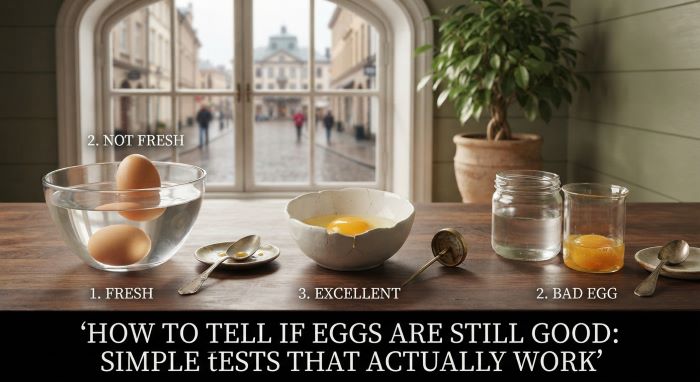
This is the most popular method, and for good reason. It is fast and needs nothing but a bowl of water. Here is how to tell if eggs are still good with the float test:
- Fill a bowl or glass with cold water, deep enough to cover an egg.
- Gently lower the egg in.
- Watch what it does.
Read the result like this:
- Sinks and lies flat on its side: very fresh.
- Sinks but stands upright on one end: older but still fine to eat, best cooked well.
- Floats to the top: toss it.
The science is simple. As an egg ages, air seeps in through the shell and the air pocket inside grows. More air means more buoyancy, so a floater has taken in enough air to signal it is past its prime. The float test is the go-to trick when you want to know how to tell if eggs are still good at a glance.
The sniff test
Your nose is a powerful tool here. A spoiled egg gives off a sharp, sulfur-like, rotten smell that is unmistakable. To use this method for how to tell if eggs are still good, crack the egg into a clean bowl, not straight into your dish, and take a sniff. A fresh egg smells like almost nothing. Any foul or sour odor means it goes in the trash, no matter what the float test said.
Cracking into a separate bowl first is smart practice anyway. It saves you from ruining a whole recipe with one bad egg.
The visual check
Once cracked, your eyes finish the job. A good egg has a firm, slightly domed yolk and a thick white that clings close to the yolk. Signs to watch for when figuring out how to tell if eggs are still good include:
- A cloudy white: this is actually a sign of freshness, not spoilage.
- A very runny, watery white: the egg is older, though not necessarily unsafe.
- Any pink, green, or iridescent tint in the white: a sign of bacteria. Throw it out.
- Black or green spots on the shell or inside: mold. Discard it.
Fresh eggs pair well with rich, savory dishes, and a truly fresh egg makes a difference in a recipe like a Best Revuelto Gramajo Near Me, where the eggs are the star. That kind of dish rewards the extra minute you spend checking quality first.
The shake test
No water or bowl handy? Give the egg a gentle shake next to your ear. A fresh egg makes little to no sound because the contents are firm and fill the shell. A sloshing sound means the inside has gone watery and the egg is old. This is a handy backup method for how to tell if eggs are still good when you are on the go.
Quick reference
Here is a simple table to keep the tests straight.
| Test | Good sign | Bad sign |
|---|---|---|
| Float | Sinks flat or stands up | Floats |
| Sniff | No smell | Sulfur or sour odor |
| Visual | Firm yolk, cloudy white | Pink, green, or iridescent tint |
| Shake | Silent | Sloshing sound |
How to keep eggs fresh longer
Prevention beats testing. A few habits stretch how long your eggs last and cut down how often you need to check how to tell if eggs are still good:
- Store eggs in the main body of the fridge, not the door, where the temperature swings.
- Keep them in their original carton, which protects them and blocks odors.
- Do not wash store-bought eggs, since that removes a natural protective coating.
- Refrigerate promptly and keep the fridge at or below 40 degrees Fahrenheit.
Follow these and your eggs will stay good closer to that five-week mark.
When in doubt, throw it out
Here is the honest bottom line. The tests above are reliable, but if something feels off and you are still unsure how to tell if eggs are still good, it is not worth the risk. A carton of eggs is cheap. A bout of food poisoning is not. Trust your senses, especially your nose, and when a test gives you a clear bad sign, act on it.
The bottom line
Knowing how to tell if eggs are still good takes the guesswork out of cooking. Start with the float test for a quick read, back it up with the sniff and visual checks once cracked, and use the shake test in a pinch. Combine those with smart storage and you will rarely waste a good egg or risk a bad one. Next time you find a mystery carton in the fridge, you will know exactly what to do.
Key Takeaways
- The date on the carton is a quality guide, not a safety deadline, and eggs often last three to five weeks past it when refrigerated properly.
- The float test is the quickest check: an egg that sinks is good, one that stands upright is older but usable, and one that floats should be tossed.
- The sniff test is decisive; any sulfur or sour smell means the egg is spoiled, no matter what other tests show.
- Crack eggs into a separate bowl to check for a firm yolk and clear white, and discard any egg with a pink, green, or iridescent tint.
- The shake test works in a pinch: a silent egg is fresh, while a sloshing sound signals an old, watery egg.
- Store eggs in the main fridge body in their original carton, keep the fridge below 40 degrees Fahrenheit, and do not wash store-bought eggs.
- When any test gives a clear bad sign or something simply feels off, throw the egg out, since the risk is not worth it.