Best Books for Communication Skills: 12 Worth Your Time
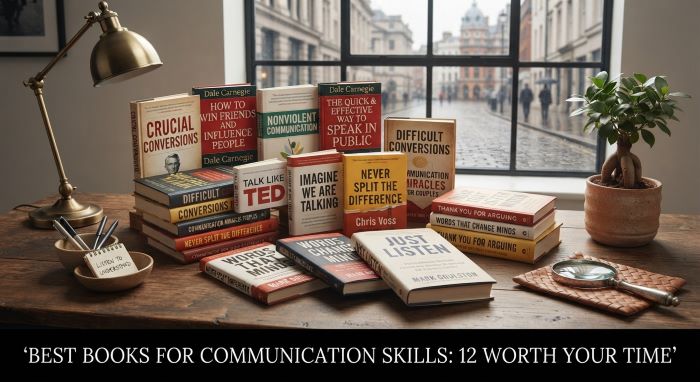
Most people who want to communicate better assume they have a speaking problem. They almost always have a listening problem, and the books that help are frequently not the ones about being more articulate. What follows is twelve specific titles, what each actually teaches, and which one to start with depending on where you are getting stuck.
Start With the Right Book
A short framing point before the list of the best books for communication skills.
The best books for communication skills are not interchangeable. Each addresses a different failure mode, and reading the wrong one first wastes time.
| If your problem is | Start with |
|---|---|
| Avoiding hard conversations | Difficult Conversations or Crucial Conversations |
| Not being heard or understood | Nonviolent Communication |
| Talking too much, listening too little | You’re Not Listening |
| Negotiating or high-stakes asks | Never Split the Difference |
| Presenting and public speaking | Talk Like TED |
| General social connection | How to Win Friends and Influence People |
| Giving feedback at work | Radical Candor |
Pick the one matching your actual bottleneck rather than working through a list in order.
How to Win Friends and Influence People
Dale Carnegie, 1936
This is the obvious inclusion among the best books for communication skills, and it earns its place despite the dated title and manipulative-sounding premise.
Published in 1936 and having sold over 30 million copies, it remains in print because the principles hold up. Carnegie’s advice centres on sincere interest in other people, remembering and using names, listening more than talking, and framing requests in terms of the other person’s interests rather than your own.
What it does well: the fundamentals of social warmth, explained simply, with the observation that most people are far more interested in themselves than in you.
What dates it: the examples are from the 1930s and the business anecdotes feel remote. The prose is repetitive.
Read it if: you struggle with basic social connection or find networking uncomfortable.
Crucial Conversations
Kerry Patterson, Joseph Grenny, Ron McMillan, and Al Switzler, 2002
The workplace standard among the best books for communication skills, built around a specific and useful concept.
The authors define a crucial conversation as one where stakes are high, opinions differ, and emotions run strong, and they argue these are precisely the conversations people handle worst.
The central idea is the pool of shared meaning, the notion that a conversation improves as more relevant facts and feelings get safely into the open. The book’s methods focus on making it safe enough for people to contribute to that pool rather than withdrawing or attacking.
What it does well: practical, structured, and directly applicable to performance conversations, disagreements with a manager, and conflicts that have been avoided too long.
What limits it: it is written for organizational contexts and reads that way. Applying it at home requires translation.
Read it if: you freeze, avoid, or escalate when a workplace conversation gets difficult.
Nonviolent Communication: A Language of Life
Marshall B. Rosenberg, 1999
The most structurally useful book on this list, and the one people most often describe as changing how they speak.
Rosenberg teaches a four-part structure: observation, feeling, need, and request.
The method separates what actually happened from your interpretation of it, names the emotion honestly, identifies the underlying need, and makes a specific request rather than a demand or a complaint.
What it does well: it gives you an actual sentence structure to use, which is rare. It is particularly effective in personal relationships and conflict.
What limits it: the phrasing can sound stilted until you adapt it to your own voice, and some readers find the tone earnest.
Read it if: your conflicts spiral into blame, or you find yourself unable to say what you actually need.
Difficult Conversations
Douglas Stone, Bruce Patton, and Sheila Heen
From the Harvard Negotiation Project, and the most analytically precise book here.
Its core insight is that every difficult conversation is actually three conversations happening simultaneously: one about what happened, one about feelings, and one about identity, meaning what the exchange implies about who you are.
Most conversations fail because people argue the first while the real difficulty sits in the second or third.
What it does well: diagnosis. It explains why a conversation went badly in a way that is genuinely clarifying afterward.
What limits it: it is more analytical than prescriptive, so it tells you what is happening more clearly than what to say.
Read it if: you keep having the same argument and cannot work out why it never resolves.
Never Split the Difference
Chris Voss with Tahl Raz, 2016
Written by a former FBI hostage negotiator, and considerably more useful in ordinary life than the premise suggests.
Voss’s core techniques include tactical empathy, mirroring by repeating the last few words someone said, and labelling by naming the emotion you observe. He also argues that “no” is not a failure but the point at which real negotiation begins, since it lets people define what they do not want.
Notably, the book emphasizes that active listening is the highest-value negotiation skill, because information is what determines outcomes.
What it does well: concrete, rehearsable techniques with clear explanations of why they work.
What limits it: the hostage-negotiation framing can feel adversarial, and applied clumsily the techniques come across as manipulative.
Read it if: you handle salary discussions, client conversations, or any high-stakes ask badly.
You’re Not Listening
Kate Murphy
The book that addresses what is usually the actual problem.
Murphy, a journalist, examines how badly most people listen and why, drawing on interviews with people whose work depends on listening well, including bartenders, therapists, and intelligence officers.
What it does well: it makes a convincing case that listening is a skill rather than a passive state, and that most people are worse at it than they believe.
What limits it: it is more reportage than manual, so it persuades more than it instructs.
Read it if: people tell you that you interrupt, or you find yourself planning your reply while someone is still talking.
We Need to Talk
Celeste Headlee
A practical counterpart to Murphy’s book, from a radio journalist.
Headlee offers ten rules for better conversation, including do not multitask, use open-ended questions, and go with the flow rather than steering toward a point you want to make.
Her argument is that the ability to hold a genuine face-to-face conversation has degraded, and that the fix is behavioural rather than conceptual.
What it does well: it is direct and immediately actionable, with rules you can apply in your next conversation.
What limits it: it covers less ground than the more comprehensive titles.
Read it if: you want something short and usable rather than a framework to study.
Supercommunicators
Charles Duhigg, 2024
The most recent book here, and the most current synthesis of the research.
Duhigg argues that every conversation is one of three kinds, practical, emotional, or social, and that most breakdowns happen when two people are having different kinds simultaneously. One person wants a solution while the other wants to be heard, and neither realizes.
What it does well: the diagnostic framing is genuinely useful, and Duhigg writes well.
What limits it: some of the underlying research is familiar from other books.
Read it if: conversations with people close to you frequently end in frustration for reasons neither of you can identify.
Influence: The Psychology of Persuasion
Robert B. Cialdini
Not strictly a communication book, and essential anyway.
Cialdini identifies principles governing why people say yes, including reciprocity, commitment and consistency, social proof, authority, liking, and scarcity.
What it does well: it explains the mechanics underneath persuasion, which makes you both more effective and considerably harder to manipulate.
What limits it: it is descriptive psychology rather than conversational technique, so it does not tell you what to say.
Read it if: you want to understand why some people get agreement easily and others do not.
Made to Stick
Chip Heath and Dan Heath
About making ideas memorable rather than about conversation, and one of the most useful books here for anyone who presents, teaches, or pitches.
The brothers identify what makes ideas stick, including simplicity, unexpectedness, concreteness, credibility, emotion, and story.
What it does well: it explains why some explanations land and others evaporate, with excellent examples.
What limits it: it is about message design rather than interpersonal exchange.
Read it if: people forget what you told them, or your explanations fail to persuade.
Radical Candor
Kim Scott
Written for managers and useful to anyone who has to tell someone something they will not enjoy hearing.
Scott’s framework plots communication on two axes, caring personally and challenging directly, arguing that most people fail by doing one without the other. Caring without challenging produces vagueness, and challenging without caring produces aggression.
What it does well: it names a specific and common failure, which is avoiding necessary feedback out of misplaced kindness.
What limits it: it is workplace-specific and the framework has been widely misapplied as licence for bluntness.
Read it if: you soften feedback until the point disappears, or deliver it so directly people stop listening.
Talk Like TED
Carmine Gallo
The most useful single book on public speaking among the best books for communication skills.
Gallo analyses successful TED talks and extracts nine principles, covering passion, storytelling, conversational delivery, novel information, and staying within a memorable length.
What it does well: it is concrete and example-driven, with specific talks you can watch alongside the analysis.
What limits it: it teaches a particular style of talk, and not every context suits it.
Read it if: you present, teach, or pitch and want a structured approach to improving.
The Charisma Myth
Olivia Fox Cabane
The book on presence rather than content.
Cabane argues charisma is a learnable set of behaviours rather than an innate trait, built on presence, power, and warmth, and she breaks each into practices.
What it does well: it addresses the non-verbal side that most communication books skip entirely.
What limits it: some of the techniques are more psychological exercise than conversation skill.
Read it if: you say sensible things and find people do not respond to you the way they respond to others.
How to Actually Improve
Reading is the easy part, and the reason most people do not improve despite finishing several of the best books for communication skills.
Pick one book and one technique. Trying to apply six frameworks simultaneously produces nothing.
Practise deliberately in low-stakes situations before using anything in a conversation that matters.
Expect it to feel artificial initially. Any new verbal pattern does, and that passes with use.
Record or reflect afterward. Reviewing how a conversation went, while it is fresh, is where the learning actually happens.
Write it down. Reflective writing genuinely helps here, since it forces you to reconstruct what was said and notice what you missed at the time. A guide like Journaling Techniques covers structured approaches to that, which turns vague impressions about a difficult conversation into something specific enough to learn from.
Get feedback from someone who will tell you the truth.
Do not sound scripted. A technique should support your own voice rather than replace it, and the most common failure among people applying these books is delivering the phrasing verbatim.
Audiobooks and Formats
Worth a brief practical note, since format affects how much sticks.
Audiobooks suit the narrative titles well. Duhigg, Murphy, Headlee, and Voss all work in audio, since the arguments are carried by story and example.
Print or ebook suits the framework titles better. Nonviolent Communication, Difficult Conversations, and Crucial Conversations all contain structures you will want to reread, annotate, and return to, which is awkward in audio.
Summaries are a poor substitute for these specifically. The value in a book like Nonviolent Communication lies in the worked examples and the repetition, neither of which survives compression into bullet points.
Rereading beats reading more. Most people would get further returning to one book they found useful than adding a fourth to the pile.
Common Mistakes
Three errors recur among people working through the best books for communication skills.
Treating it as a speaking problem. It is usually a listening problem first. Confident speakers who read Just Listen or Crucial Conversations are frequently surprised by how much they were missing.
Ignoring context. A direct style that works in a status meeting fails badly in a personal argument, and a warm style that works with friends reads as vague in a negotiation.
Collecting frameworks without practising any. Reading six books and applying none leaves you exactly where you started, with a better vocabulary for describing the problem.
Where to Go Next
A few additional titles worth knowing beyond the best books for communication skills above, depending on direction.
Just Listen by Mark Goulston, on reaching people who are resistant or shut down.
The Art of Communicating by Thich Nhat Hanh, a mindfulness-based approach quite different in register from the rest of this list.
Getting to Yes by Roger Fisher and William Ury, the foundational negotiation text from the Harvard Negotiation Project.
Thanks for the Feedback by Douglas Stone and Sheila Heen, on receiving criticism well rather than giving it.
The Pyramid Principle by Barbara Minto, on structuring written and spoken arguments clearly.
Quiet by Susan Cain, for introverts navigating environments built around extroverted communication norms.
The bottom line on the best books for communication skills is that they address different problems and are not interchangeable. Start with Nonviolent Communication if your conflicts spiral, Difficult Conversations or Crucial Conversations if you avoid hard talks, You’re Not Listening if you interrupt, Never Split the Difference for high-stakes asks, and Talk Like TED for presenting. Carnegie remains worth reading for basic social warmth despite its age. Whichever you pick, apply one technique deliberately rather than reading several books and practising none, since the reading is the easy part.
Key Takeaways
- These books address different problems and are not interchangeable, so pick by your actual bottleneck.
- How to Win Friends and Influence People by Dale Carnegie, published 1936, has sold over 30 million copies.
- Crucial Conversations by Patterson, Grenny, McMillan, and Switzler centres on the pool of shared meaning.
- Nonviolent Communication by Marshall B. Rosenberg teaches observation, feeling, need, and request.
- Difficult Conversations from the Harvard Negotiation Project identifies three simultaneous conversations.
- Never Split the Difference by former FBI negotiator Chris Voss covers tactical empathy, mirroring, and labelling.
- Voss argues that “no” begins the real negotiation rather than ending it.
- You’re Not Listening by Kate Murphy addresses what is usually the actual problem.
- We Need to Talk by Celeste Headlee offers ten immediately usable conversation rules.
- Supercommunicators by Charles Duhigg identifies practical, emotional, and social conversation types.
- Influence by Robert Cialdini explains the mechanics of persuasion and makes you harder to manipulate.
- Most people have a listening problem rather than a speaking problem, whatever they assume.
- Apply one technique deliberately rather than collecting frameworks without practising any.
- A technique should support your own voice rather than replace it, since scripted delivery fails.