Journaling Techniques: A Practical Guide to Methods, Habits, and Ideas
A blank page can feel like the most intimidating thing in the world, especially when someone tells you it is supposed to change your life. The truth about journaling is simpler and less precious than the wellness world makes it sound. It is just putting your thoughts somewhere outside your head, and there are many journaling techniques that make that easier, more useful, and more sustainable than staring at an empty notebook hoping inspiration strikes.
This guide cuts through the noise and answers how to journal in a way that fits your life. It covers the main approaches, how to actually start without overthinking it, how to keep the habit going, and plenty of ideas for what to write. Whether you want to reduce stress, track your goals, process your feelings, or just remember your life better, there is a method here that fits. The goal is not to journal perfectly. It is to find a practice that works for you and stick with it.
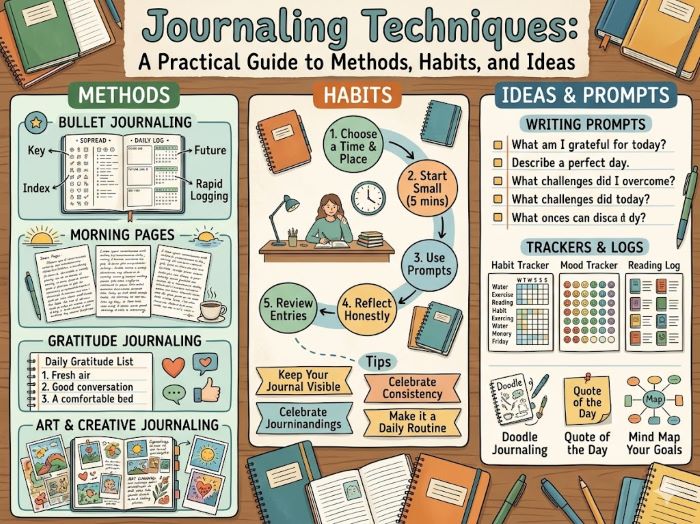
Why Journaling Is Worth the Effort
Before the methods, it helps to know what you are getting. Journaling is one of the simplest tools for managing a busy mind, and people use it for very different reasons.
For many, the biggest benefit is mental clarity. Writing down a tangle of worries often makes them feel smaller and more manageable, since getting thoughts out of your head and onto paper creates distance from them. Journaling can help you notice patterns in your moods, habits, and reactions that are invisible when everything stays internal. It supports goal-setting and reflection, gives you a record of your life to look back on, and offers a private space to be completely honest with yourself.
None of this requires talent or fancy supplies. A cheap notebook and a few minutes work as well as an expensive guided journal. The various journaling techniques in this guide are simply different doors into the same room, and the best one is whichever gets you writing regularly. With that in mind, here is how to begin.
How to Start Journaling
The hardest part is the first page, so let us make starting easy. Learning how to start journaling is mostly about lowering the bar until it feels almost too small to skip.
Begin with a tiny commitment. Five minutes a day, or even three sentences, is enough at first. The point is to build the habit before you worry about depth or consistency. Choose a format that suits you, whether a physical notebook, a notes app, or a dedicated journaling app, since the best tool is the one you will actually use. Pick a regular time, like first thing in the morning or just before bed, so the practice attaches to an existing routine and becomes automatic.
When you sit down, do not aim for profound. Write about your day, how you feel, or what is on your mind. If you freeze, start with a single sentence about the weather or what you ate, since momentum matters more than meaning at the start. Knowing how to begin really comes down to giving yourself permission to write badly, since a messy, honest entry beats a perfect one you never wrote. Once the habit takes hold, you can explore the deeper methods that follow.
Types of Journaling
There is no single right way to keep a journal, and understanding the main types of journaling helps you choose an approach that fits your personality and goals. Each serves a different purpose, and many people mix several over time.
Here is an overview of the most common approaches:
- Free writing, where you write continuously without editing or judging
- Gratitude journaling, focused on what you are thankful for
- Bullet journaling, a flexible system that combines planning and reflection
- Reflective journaling, which examines experiences and what you learned from them
- Prompt-based journaling, guided by questions or themes
- Dream journaling, recording dreams soon after waking
- Visual or art journaling, using drawing, collage, and color alongside words
- Travel journaling, capturing trips and experiences
Among these approaches, none is better than another. The right one depends on what you want from the practice. Someone seeking emotional release might love free writing, while a planner-minded person may prefer a bullet journal. Trying a few of them is the best way to discover which clicks for you, and there is no rule against switching or combining them. Now let us look more closely at the most popular methods.
Free Writing and Morning Pages
Free writing is the most unstructured approach, and for many people it is the most freeing. You simply write whatever comes to mind, without stopping to edit, judge, or make sense of it. The idea is to bypass your inner critic and let your thoughts flow onto the page.
One famous version is Morning Pages, popularized by Julia Cameron, which involves writing three pages of longhand stream-of-consciousness first thing each morning. The aim is not to produce anything good but to clear the mental clutter before the day begins. Many people find this dumps out the anxious, repetitive thoughts that would otherwise nag at them all day.
To try free writing, set a timer for five or ten minutes and write without lifting your pen, even if you have to write “I do not know what to write” until something else surfaces. Among all journaling techniques, this one is especially good for processing emotions, breaking through creative blocks, and figuring out what you actually think about something. The lack of structure is the point, so resist the urge to tidy it up.
Gratitude Journaling
Gratitude journaling is one of the most popular and well-studied journaling techniques, and it is refreshingly simple. You write down things you are thankful for, regularly, to shift your attention toward the positive.
The basic practice is to list three to five things you are grateful for each day. They can be big, like a supportive friend, or small, like a good cup of coffee. The specificity matters, since “I am grateful for my sister calling to check on me” lands deeper than a generic “I am grateful for my family.” Writing why you appreciate something, not just what, makes the practice more powerful.
This approach suits people who want a quick, uplifting routine rather than deep introspection. It works well in the evening as a way to end the day on a positive note, or in the morning to set a constructive tone. Even on hard days, finding one small thing to appreciate trains your attention to notice the good, which is the whole point. As a low-effort entry into journaling, gratitude writing is hard to beat.
Bullet Journaling
Bullet journaling is a flexible system that blends planning, tracking, and reflection in one notebook. Created by Ryder Carroll, it uses short, dotted entries, called rapid logging, to capture tasks, events, and notes quickly, then organizes them with simple symbols and collections. It appeals to people who want structure and a sense of control over their days.
The beauty of a bullet journal is its adaptability, and this is where bullet journal page ideas come in. You can design pages for almost anything, which is part of why the method has such a devoted following. Some popular bullet journal page ideas include:
- A monthly calendar spread for events and deadlines
- A daily or weekly task log
- Habit trackers to monitor routines like water intake, exercise, or sleep
- Mood trackers to spot emotional patterns over time
- Goal-setting and progress pages
- Reading, movie, or gratitude logs
- A future log for plans further out
The system is as minimal or elaborate as you want. Some people keep a plain, functional bullet journal, while others fill theirs with decorative layouts and art. If you enjoy creativity, experimenting with colorful layouts can make the practice genuinely fun, but a simple black-pen setup works just as well. The key is that the structure serves you rather than becoming another source of pressure.
Reflective and Prompt-Based Journaling
Reflective journaling goes deeper than recording events. It asks you to examine your experiences and draw meaning from them, which makes it valuable for personal growth. Instead of just noting that something happened, you explore how it affected you, what you learned, and what you might do differently.
Prompt-based journaling supports this by giving you a question or theme to respond to, which removes the pressure of the blank page. Prompts are especially helpful when you want to journal but do not know where to begin. They point your reflection somewhere specific, and answering them often surfaces insights you would not have reached on your own.
These two journaling techniques pair naturally. A reflective practice guided by good prompts is one of the most effective ways to understand yourself, work through difficult experiences, and track your growth over time. If open-ended writing feels too vague, a steady supply of prompts gives your reflection direction while still leaving room for honesty.
How to Journal Effectively
Knowing how to journal is one thing. Getting real value from it is another. Learning how to journal effectively comes down to a handful of principles that apply across every approach.
First, be honest. A journal only helps if you write what you actually think and feel, not a polished version meant for an imaginary reader. No one else needs to see it, so drop the performance. Second, focus on consistency over length. A few honest lines most days beats a brilliant essay once a month, since the benefits come from the regular habit. Third, do not censor or edit as you go, since stopping to fix grammar interrupts the flow of thought that makes journaling useful.
A few more habits help you journal effectively. Date your entries so you can track changes over time and look back meaningfully. Write by hand if you can, since the slower pace of handwriting tends to deepen reflection, though typing is perfectly fine if it lowers the barrier to writing. And revisit old entries occasionally, because reading past writing reveals patterns and progress you cannot see in the moment. Above all, journaling well means releasing the idea of doing it correctly, since the only real failure is not writing at all.
Journaling Ideas and Prompts
When you do not know what to write, prompts rescue the practice. A good list of journaling ideas turns a blank page into an easy start, so keep some on hand for the days inspiration runs dry.
Here are some prompts to get you going:
- What went well today, and what drained me?
- What am I avoiding, and why?
- Describe a moment this week that made me feel something strongly.
- What would I do if I knew I could not fail?
- Write a letter to my younger or future self.
- What patterns keep showing up in my life right now?
- List the things within my control today and the things outside it.
- What does a good day look like for me, in detail?
These prompts work for almost any method, whether you free write your response, use them as reflective prompts, or jot quick answers in a bullet journal. You can also theme your prompts around a goal, like career, relationships, or health, to focus your reflection. Keeping a running list means you never face the blank page unarmed, which removes one of the most common reasons people quit.
Building a Lasting Journaling Habit
The best technique in the world is useless if you stop after a week, so building the habit matters more than perfecting the method. A few strategies make the practice stick.
Attach journaling to an existing routine, like your morning coffee or your bedtime wind-down, so it rides on a habit you already have. Keep your journal visible and accessible, since an out-of-sight notebook is an out-of-mind one. Lower your standards on busy days, allowing a single sentence to count, because a tiny entry keeps the streak alive without pressure. And forgive missed days rather than abandoning the whole practice, since one skipped day is a blip, not a failure.
It also helps to remember why you started. If the practice begins to feel like a chore, change the approach rather than quitting. Switching from long reflective entries to quick gratitude lists, or from typing to a creative bullet journal, can rekindle the habit. The various journaling techniques exist precisely so you can adapt when one stops serving you. Flexibility, not discipline, is usually what keeps a journaling practice alive for years.
Common Mistakes to Avoid
A few predictable pitfalls cause people to quit, and knowing them helps you sidestep the most common reasons journaling fizzles out.
The biggest mistake is aiming for perfection, treating the journal like a polished product instead of a private tool. This kills the habit fast, since the pressure makes writing feel like work. Another is comparing your practice to the beautiful, elaborate journals you see online, which sets an unrealistic standard that has nothing to do with the actual benefits. A plain notebook with honest words beats a gorgeous one filled with nothing.
People also tend to give up after missing a few days, treating a gap as proof they cannot do it, when the right move is simply to start again. Some write only when they feel terrible, which is fine, but journaling during good times too gives you a fuller picture and a record worth keeping. And many overthink the method, hopping between systems instead of just writing. Pick an approach, give it a few weeks, and adjust only once you have given it a real chance.
Frequently Asked Questions
How long should I journal each day? As little as five minutes is enough. Consistency matters far more than length, so a short daily entry beats a long, occasional one.
How do I learn how to journal? Start small, pick a method that appeals to you, and write regularly. There is no single correct way to journal, so experiment until a technique sticks.
Should I journal by hand or on a device? Either works. Handwriting tends to slow you down and deepen reflection, while typing is faster and may lower the barrier to starting. Use whichever you will stick with.
What if I do not know what to write? Use prompts, or simply describe your day. Starting with a single mundane sentence often unlocks more meaningful writing.
Is there a best time to journal? The best time is whenever you will do it consistently. Morning suits clearing your head for the day, while evening suits reflecting on what happened.
Do I need a special journal or app? No. A cheap notebook works perfectly. Special journals and apps can help if they motivate you, but they are not required.
How is bullet journaling different from regular journaling? Bullet journaling is a structured system for planning and tracking alongside reflection, while regular journaling is usually free-form writing. Many people combine the two.
What if someone reads my private journal? Keep it in a private spot, and remember that the value comes from honesty. If privacy worries block you, a password-protected app can ease the concern.
Key Takeaways
- Journaling techniques are simply different doors into the same practice of getting your thoughts out of your head, and the best one is whichever keeps you writing regularly.
- The benefits include mental clarity, noticing patterns, supporting goals, and creating a private record, none of which require talent or special supplies.
- When learning how to start journaling, begin tiny, choose a format you will use, attach it to a routine, and give yourself permission to write badly.
- The main types of journaling include free writing, gratitude, bullet, reflective, prompt-based, dream, visual, and travel, and trying a few helps you find your fit.
- Free writing and Morning Pages clear mental clutter, while gratitude journaling offers a quick, uplifting routine that trains your attention toward the positive.
- Bullet journaling blends planning and reflection, and bullet journal page ideas like habit trackers, mood logs, and monthly spreads make it endlessly adaptable.
- Reflective and prompt-based journaling pair well for personal growth, since prompts remove the blank-page pressure and point your reflection somewhere useful.
- To journal effectively, be honest, prioritize consistency over length, avoid editing as you go, date your entries, and revisit old writing to spot progress.
- Keep a list of journaling ideas and prompts on hand so you never face an empty page, and theme them around goals when you want focus.
- Build the habit by attaching it to an existing routine, lowering standards on busy days, forgiving missed days, and switching journaling techniques whenever one stops serving you.