How to Prevent Freezer Burn: Keep Your Food Fresh Longer
You reach into the freezer for that steak or bag of vegetables you stashed weeks ago, only to find it covered in grayish, dried-out patches and crystallized ice. That is freezer burn, and while it does not make food unsafe, it ruins texture and flavor, leading to waste and disappointment. The frustrating part is that freezer burn is almost entirely preventable with a few simple habits. Once you understand what causes it, keeping your frozen food fresh becomes easy. Here is how to prevent freezer burn and keep your food tasting great.
What Causes Freezer Burn?
Understanding the cause is the foundation of prevention. Freezer burn happens when frozen food is exposed to air, causing moisture to escape from the food’s surface through a process called sublimation, where ice turns directly to vapor. This dehydrates the surface, leaving those dry, discolored, leathery patches and ice crystals.
The two main culprits are air exposure and temperature fluctuations. Air reaching the food’s surface draws out moisture, and temperature changes accelerate the process. So the whole strategy for how to prevent freezer burn comes down to minimizing air contact and keeping the freezer consistently cold. Everything below follows from those two principles.
Package Food Properly
The single most important factor is proper packaging, since it controls air exposure:
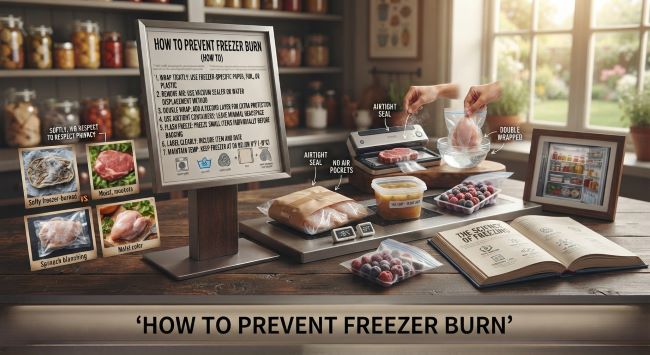
- Remove as much air as possible from packaging before freezing, since air is the enemy.
- Use airtight containers or freezer-safe bags, pressing out excess air.
- Wrap food tightly, using freezer wrap, foil, or plastic wrap in close contact with the food’s surface.
- Double-wrap for extra protection, especially for longer storage.
- Use freezer-specific materials, which are thicker and more moisture-resistant than regular wrap or bags.
Tight, airtight packaging that eliminates air contact is the most effective way to prevent freezer burn. Wrapping food so no air can reach its surface makes a dramatic difference.
Use a Vacuum Sealer
One of the best tools is a vacuum sealer, which removes virtually all the air around food and seals it tightly. Vacuum-sealed food is exceptionally well protected against freezer burn, since there is almost no air left to draw out moisture. If you freeze food regularly, a vacuum sealer is a worthwhile investment. For those without one, pressing air out of freezer bags manually (including the water-displacement method, submerging a sealed bag in water to push out air) achieves a similar, if less complete, effect.
Keep the Freezer Consistently Cold
Temperature stability is a key part of how to prevent freezer burn:
- Keep the freezer at a proper, consistently cold temperature, ideally at or below 0°F (around -18°C).
- Avoid frequent temperature fluctuations, which accelerate freezer burn.
- Do not overload the freezer in ways that block airflow or cause uneven cooling.
- Minimize door openings, since each opening lets in warm air and causes temperature swings.
- Let hot food cool before freezing, so it does not raise the freezer’s temperature.
A cold, stable freezer environment slows the moisture loss that causes freezer burn, complementing good packaging. Both together are the key to how to prevent freezer burn effectively.
Freeze Food Quickly and Properly
How you freeze food also affects how to prevent freezer burn. Freezing food quickly forms smaller ice crystals that damage the food less and help preserve quality. Freezing food in appropriate portions, and freezing it while fresh, also helps. Spreading items out initially so they freeze fast, then consolidating, can help for large batches. The faster food freezes solid, the better it holds up, which supports preventing freezer burn.
Label and Rotate Your Food
An often-overlooked aspect of how to prevent freezer burn is managing how long food stays frozen. Even well-packaged food degrades over very long storage, so:
- Label everything with dates, so you know how long it has been frozen.
- Use older food first, rotating your stock so nothing lingers too long.
- Know general storage times, since different foods keep well for different durations.
- Do not store food indefinitely, since even properly frozen food is best used within reasonable timeframes.
Using food within reasonable timeframes reduces the chance of freezer burn developing over very long storage, making labeling and rotation simple but effective habits.
What to Do With Freezer-Burned Food
Part of understanding how to prevent freezer burn is knowing that freezer-burned food is still safe to eat, just lower in quality. If food does get some freezer burn, you can cut away the affected areas and use the rest. The dried patches will be less flavorful and have worse texture, but the food is not unsafe. Still, prevention is far better, since it preserves the quality you want.
The bottom line on how to prevent freezer burn is that it comes down to two things: minimizing air exposure and keeping the freezer consistently cold. Package food tightly in airtight, freezer-safe materials (a vacuum sealer is ideal), press out all the air, keep your freezer at a stable, cold temperature, freeze food quickly while fresh, and label and rotate your stock. Follow these simple habits, and your frozen food will stay fresh, flavorful, and free of those dreaded dry, icy patches, saving you money and reducing waste.
Key Takeaways
- Freezer burn happens when air exposure draws moisture from frozen food, causing dry, discolored, icy patches.
- The two main causes are air exposure and temperature fluctuations, so preventing both is the whole strategy.
- Proper packaging is most important: use airtight containers or freezer bags and wrap food tightly, removing all air.
- A vacuum sealer is an excellent tool, removing nearly all air; otherwise press air out of bags manually.
- Keep the freezer consistently cold, ideally at or below 0°F, and avoid temperature fluctuations and frequent door openings.
- Freeze food quickly and while fresh, in appropriate portions, to form smaller ice crystals and preserve quality.
- Label food with dates and rotate your stock, using older items first, since even frozen food degrades over long storage.
- Freezer-burned food is still safe to eat; cut away affected areas, though prevention preserves far better quality.