Top 7 Established Software Development Firms for Legacy Modernization and Re-engineering (2026)
Seven firms with the track record to modernize legacy systems, re-engineer applications, and rebuild architectures a business has outgrown, plus how to tell which problem you actually have.
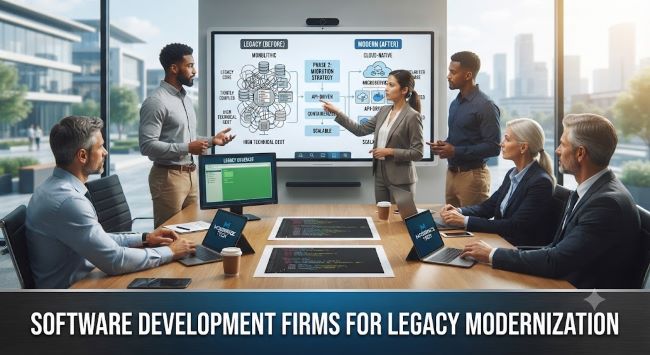
Three different problems get filed under the same heading.
- A legacy system is old and hard to maintain.
- An application that needs re-engineering may be recent but was built in a way that no longer holds.
- An outgrown architecture works fine; it simply cannot carry the load the business now puts on it.
→ They call for different work, and hiring a firm that solves one when you have another is how modernization budgets disappear.
The firms below were selected for one shared quality: an established record, measured in years of operation and client relationships rather than marketing claims.
That matters more here than in most categories, because modernization work punishes inexperience. Each was verified against its own site and third-party reviews.
Which problem do you actually have?
| Problem | What it looks like | Usual fix |
| Legacy system | Old stack, few people left who understand it, hiring is hard, integrations are impossible | Assessment, then phased re-engineering or migration to a modern platform |
| Application needing re-engineering | Every new feature breaks something else, releases slow to a crawl, tests are unreliable | Refactoring and structural cleanup, preserving behaviour |
| Outgrown architecture | The system works but buckles under load, costs spike, one component blocks everything | Rearchitecting, often splitting a monolith into services |
Worth knowing: most real projects are a blend of the three, which is why the assessment phase matters more than the pitch. A firm that names your problem precisely before quoting has usually seen it before.
Matching firms to problems
| Firm | Established | Strongest on | Typical client |
| Mind Studios | 2013 | Re-engineering and extending outgrown products | Growing product companies |
| ModLogix | Parent firm since 1996 | Legacy migration without downtime | Businesses on obsolete stacks |
| Softjourn | 2001 | Long-run re-engineering in fintech and ticketing | Payments and ticketing platforms |
| Keyhole Software | 2008 | US-based monolith-to-microservices work | Mid-market and enterprise US firms |
| N-iX | 2002 | Multi-system modernization at scale | Companies scaling toward enterprise |
| Intellectsoft | 2007 | Enterprise architecture upgrades under compliance | Regulated enterprises |
| Leobit | 2014 | Microsoft-stack rebuilds and Azure migration | .NET and Azure products |
1. Mind Studios
Mind Studios works on software re-engineering aimed at updating tech stacks and extending what a system can do, which puts it directly in the middle of the three problems above.
Running 100+ specialists across Europe and the US since 2013, it is repeatedly brought in to fix products where every new feature breaks something else.
- Where they excel: application refactoring and re-architecture, cloud migration and digital transformation, and custom software development once the system is stable again, with AI development and integration for teams extending a modernized product.
- How they work: every engagement opens with business analysis and a free consultation that produces an action plan before a contract is signed, so the hidden complexity in an old system surfaces before budgets are fixed.
- Track record: ISO/IEC 27001 and ISO 9001 certified, rated 4.9 out of 5 across 34+ Clutch reviews, with clients returning across successive years.
Case in point: for a food-packaging manufacturer, it built an AI quality-control system that reached over 93% defect-detection accuracy and cut inspection time from around 30 seconds to under 2 seconds, then kept optimizing after launch.
The trade-off: best for a business that wants one partner to re-engineer a product and keep developing it afterwards.
2. ModLogix
ModLogix does one thing deliberately: it modernizes legacy applications while keeping them running. It operates inside a company that has built software since 1996, which is the kind of longevity that matters when the system you need modernized was written two decades ago.
- Where they excel: legacy assessment, re-engineering, cloud migration, and database and API modernization, with particular depth in obsolete Microsoft technologies.
- How they work: a parallel-run approach where old and new operate side by side and components are replaced one at a time, so the product never goes dark during migration.
- Track record: Microsoft Gold Application Development Partner, with a portfolio focused entirely on modernization rather than general development.
Case in point: for a healthcare eligibility platform, it built a microservices integration layer that made reports run around 12 times faster and helped the client grow its customer base by roughly 43% in a year. For a nonprofit around 90 years old, it consolidated ageing MS Access and VB6 tools into one modern platform without interrupting daily services.
The trade-off: fewer independent third-party reviews than the larger firms here, so weigh its case studies and references more heavily. Best when modernizing a live legacy system is the entire job.
3. Softjourn
Softjourn has been in business since 2001 and is known for extensive legacy modernization and re-engineering services, backed by client partnerships that routinely pass the ten-year mark. Headquartered in Fremont, California, it runs 300+ specialists with teams across Europe and Brazil.
- Where they excel: architecture consulting, code audits, re-engineering, and long-term maintenance, concentrated in fintech and payments, ticketing, and expense management.
- How they work: as a long-running extension of the client’s team, which is what allows them to re-architect systems they have maintained for years without losing the logic buried in them.
- Track record: 25 years of operation, with clients including PEX, UPC, and Tacit, several of whom have stayed for a decade or more.
Case in point: for a US expense-management client it has served since 2011, Softjourn re-architected a decade-old core so it could integrate with modern banks and payment processors without disrupting existing users.
The trade-off: its public review volume is smaller than that of the larger firms here. Best for payments or ticketing platforms that need re-engineering by a partner who already knows the domain.
4. Keyhole Software
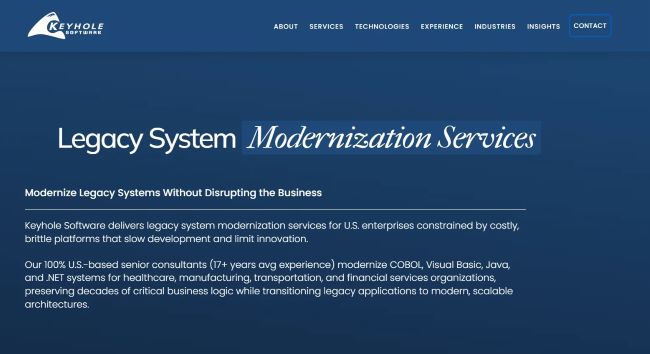
Keyhole Software is a US consultancy founded in 2008 that staffs engagements entirely with senior domestic consultants and does not subcontract. Its consultants average well over a decade of experience each, which is why it turns up in modernization work that other firms find risky.
- Where they excel: application modernization in Java, .NET, and JavaScript, cloud migration on AWS and Azure, and breaking monoliths into microservices.
- How they work: embedded senior consultants who transfer knowledge to your internal team as they go, so you own and can evolve the modernized system afterward.
- Track record: Gold Microsoft Partner and AWS Competency holder, named to Clutch’s Top 15 for 2026 in software development and application modernization, with around 78% of last year’s work coming from returning clients.
Case in point: for American Century Investments, it modernized a legacy monolithic Java application into a cloud-native microservices architecture on Kubernetes, OpenShift, and AWS, with structured knowledge transfer to the internal team.
The trade-off: a US-only senior consultant model costs more than offshore alternatives. Best for a US business that wants continuity and to keep ownership of the result.
5. N-iX

N-iX has operated since 2002 and brings scale to modernization, which counts when the problem spans many connected systems rather than one application. It fields 2,400+ engineers across 25 countries from a headquarters in Malta.
- Where they excel: re-architecting monoliths into microservices, cloud migration, and data-platform modernization, delivered on a “zero disruption” promise.
- How they work: dedicated teams staffing multi-phase programs, with the depth to run modernization and new development in parallel.
- Track record: named in the 2023 Gartner Magic Quadrant for Custom Software Development, with client relationships past seven years and names such as KTC, Marex, and Lebara active since 2015.
Case in point: in one engagement for a marketing company, N-iX improved system performance by around 40% and lifted operational efficiency by roughly 30% through automation.
The trade-off: across 35 Clutch reviews, clients advise insisting on a strong-communicating project manager from the start. Best for companies scaling toward enterprise with several systems to modernize at once.
6. Intellectsoft

Intellectsoft has modernized enterprise systems since 2007 from a headquarters in Palo Alto, with a structure built for durability: a senior architect leads every engagement from day one so early decisions do not become expensive to unwind.
- Where they excel: upgrading existing architectures to hold up under peak load and multiple integrations rather than defaulting to a rebuild, alongside cloud engineering and enterprise application development.
- How they work: as part of the client’s team, with compliance built into delivery rather than added at the end.
- Track record: ISO 27001 and 9001 certified with HIPAA and GDPR-aligned processes and enterprise clients including EY, Harley-Davidson, and the London Stock Exchange across multi-year relationships.
Case in point: it has built and maintained enterprise systems for clients such as EY and Harley-Davidson over successive years, upgrading architectures in place rather than replacing them.
The trade-off: across 44 Clutch reviews, the recurring caveats are a higher price and a weaker fit for very early-stage startups. Best for regulated enterprises with integration-heavy systems.
7. Leobit
Leobit has focused on the Microsoft stack since 2014, which makes it the specialist to call when an outgrown .NET application needs rebuilding rather than patching. It fields 170+ specialists from a US headquarters in Austin with development centers across Europe.
- Where they excel: end-to-end rebuilds and Azure migration, including the database architecture that often gets left until last, plus web, .NET, and mobile development.
- How they work: dedicated and team-extension setups, with a track record of taking over platforms from previous vendors and stabilizing them.
- Track record: ISO 9001 and 27001 certified, a Microsoft Solutions Partner, and rated 4.9 across more than 50 Clutch reviews.
Case in point: Leobit took over a client’s web platform from a previous vendor and rebuilt it end-to-end on Microsoft Azure in an engagement running since late 2021.
The trade-off: the main recurring request in reviews is more regular reporting. Best for .NET and Azure products that need a rebuild followed by years of iteration.
Re-engineer, rearchitect, or rebuild?
The choice between these three drives most of the cost, and firms will steer you differently depending on what they sell.
- Re-engineer when the business logic is sound but the code has decayed. You keep the behaviour and clean up the structure, which is the cheapest route and usually the right one when releases have simply become slow and risky.
- Rearchitect when the system works but cannot scale, integrate, or absorb new load. This is the answer for an outgrown architecture, and it is where monolith-to-microservices work belongs. It costs more than refactoring and less than starting over.
- Rebuild only when the code is genuinely beyond economical repair. It is the most expensive and highest-risk option, and it is chosen too often because it is easier to sell than the patient work of re-engineering.
A useful test: ask two firms to assess the same system independently. If one recommends a rebuild and the other a phased re-engineering, the gap between those estimates tells you a great deal about which one is solving your problem and which is selling its capacity.
What “established” should mean in practice:
Years in business are a weak signal on their own. What actually predicts a good modernization outcome is evidence that the firm has lived with the consequences of its own work.
- Long client relationships.
→ A firm that still maintains systems it modernized five years ago has had to face its own shortcuts. Ask for references from multi-year accounts specifically.
- Low team turnover.
→ Modernization depends on knowledge of your system that is expensive to rebuild every time an engineer rotates off.
- A repeat-client rate.
→ Returning clients are the hardest metric to fake and the most honest measure of whether the work held up.
- Willingness to recommend the cheaper option.
→ A partner who talks you out of a rebuild you do not need is demonstrating exactly the judgment you are hiring for.
The bottom line
Name your problem before you shortlist. A legacy system, a decayed application, and an outgrown architecture look similar from the outside and need different work, and the firms above are strongest at different points on that spectrum.
ModLogix and Softjourn are the specialists at the legacy end; Keyhole and N-iX carry the architectural work; and Mind Studios sits where re-engineering meets continued product development.
Whichever direction you go, start with a paid assessment rather than a full program. It costs a fraction of the build, surfaces the undocumented logic that derails modernization projects, and shows you how a firm thinks before you commit years to working with it.